
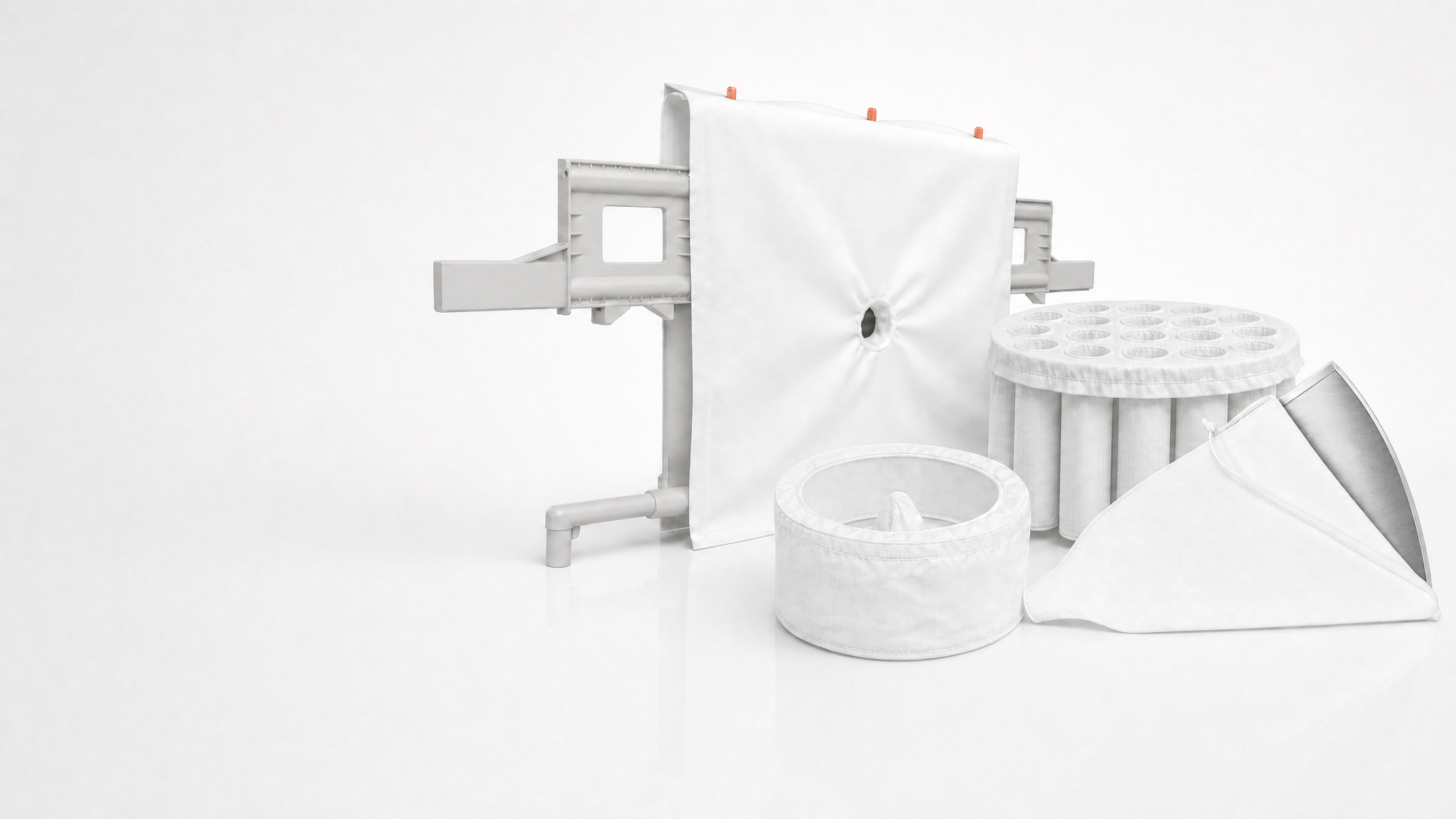
Starch and sugar plants run some of the toughest solid-liquid separation duties in the food industry: very fine particles, sticky deposits, frequent cleaning, and strict hygiene expectations. If the filter fabric is not matched to the process, you quickly see higher pressure drop, poor cake release, and shorter cloth life.
For operators, the goal is simple: stable throughput, clean filtrate, and fabrics that can handle repeated washing without losing performance. That is where the right weave, surface finish, and fabric construction make a measurable difference in daily operation.
🔑 Key Takeaways
- Starch and sugar slurries contain very fine solids that can clog standard fabrics quickly.
- Food-grade filtration needs low contamination risk, easy cleaning, and reliable release.
- Fabric selection must match the machine type, washing method, and cake characteristics.
- Using the right fabric can reduce downtime, improve filtrate clarity, and extend service life.
⚙️ Why Starch and Sugar Filtration Is So Demanding
In starch recovery, dewatering, and sugar clarification, the solids are often extremely fine and compressible. That means the cloth has to capture small particles without blinding too fast, while still letting liquid pass at a practical rate. In many plants, this is not a one-time challenge but a daily cycle across filter presses, centrifuges, belt filters, and pressure leaf filters.
The biggest operational pain points usually show up as:
- Clogging from starch gel or sugar fines
- Poor cake release on sticky or compressed solids
- Frequent wash cycles that shorten fabric life
- Contamination risk from seams, stitching, or fiber shedding
💡 Tip: In food applications, smooth filtration behavior matters as much as retention. A cloth that releases cake cleanly often saves more production time than a cloth with slightly higher initial throughput.
🔬 Fabric Requirements for Food-Grade Operation
When you are running a starch or sugar line, the fabric is part of the product-contact chain. That means the material must be suitable for food processing, easy to clean, and stable under repeated wash-downs. If the process uses hot water, caustic cleaning, or CIP-style routines, the fabric must keep its shape and permeability over time.
| Requirement | Why It Matters | What Operators Should Look For |
|---|---|---|
| Fine particle retention | Improves filtrate clarity and product recovery | Controlled pore structure and stable weave |
| Easy cake release | Reduces discharge time and mechanical stress | Low-adhesion surface and suitable finish |
| Washability | Supports frequent cleaning cycles | Dimensionally stable fibers and durable construction |
| Low contamination risk | Protects food quality and compliance | Clean edge design and reliable seam execution |
⚠️ Caution: If your process includes high-temperature cleaning or aggressive chemicals, confirm fabric compatibility before installation. Repeated exposure can reduce permeability, weaken seams, or distort fabric geometry.
For finer separation duties, many operators compare pressure-driven systems such as RF-FF Series filter press fabrics with vacuum or polishing duties like RF-SP Series sparkler filter fabrics. The right choice depends on whether your priority is cake dryness, filtrate clarity, or sanitary handling.
🛠️ Choosing the Right Fabric by Machine Type
The machine defines the mechanical stress on the cloth. A filter press places different demands on a fabric than a centrifuge or a belt filter. Matching the cloth to the machine is often the fastest way to stabilize performance.
Typical machine-to-fabric pairings include:
- Filter presses with fine woven fabrics for controlled cake formation
- Belt filters with open yet stable fabrics for continuous dewatering
- Centrifuges with fabrics designed for high rotational stress
- Pressure leaf filters for clarification and polishing steps
- Nutsche filters where product purity and clean discharge are critical
Rule of thumb: The finer the starch or sugar solids, the more important it becomes to balance retention with cleanability. A fabric that blinds too quickly will usually cost more in downtime than it saves in filtrate quality.
📋 Selection checklist for operators
📋 Pre-selection Checklist
- What is the particle size distribution?
- Is the product sticky, compressible, or crystalline?
- How often is the fabric washed or sanitized?
- Which machine is being used?
- Is cake release or filtrate clarity the main priority?
💡 Cleaning Frequency, Lifetime, and Downtime Control
In starch and sugar plants, cleaning is not optional — it is part of keeping the line stable. The more often the cloth is cleaned, the more important fabric durability becomes. If a fabric loses permeability after repeated wash cycles, you will see longer cycle times, higher differential pressure, and inconsistent discharge.
Watch for slower filtrate flow, wetter cake, or rising pressure drop. These are early signs of blinding or surface fouling.
Use a cleaning method that removes residues without damaging the fabric finish or seam integrity.
Record cycle time, filtrate clarity, and cloth life so you can compare batches and cleaning routines.
For plants with repeated thermal drying steps, fabrics used in fluid bed dryers must also resist heat, mechanical movement, and product carryover. If your operation combines filtration with drying or pneumatic handling, the fabric specification should reflect the full process, not just the filtration stage.
📊 Practical Fabric Choices for Starch and Sugar Lines
Different process goals require different fabric characteristics. If your main problem is fine solids passing through, a tighter structure can help. If the issue is clogging, a fabric with better release and cleaning behavior may perform better over time. The most reliable choice is the one that keeps your system running with the least intervention.
R+F filter fabrics for starch and sugar duties are commonly selected for:
- Consistent retention in clarification and dewatering stages
- Better cleanability under frequent wash cycles
- Stable mechanical behavior in continuous or batch operation
- Food-process suitability for clean handling and low contamination risk
If you are comparing options for the same line, the find and configure the right filter fabric with our Solution Finder makes it easier to select a fabric based on your machine, process, and operating conditions. It returns a pre-filled, non-binding inquiry that helps speed up specification.
For specialty duties where contamination control is especially important, look closely at seam construction and edge finishing to reduce the risk of contamination from stitching. If your fabric is wearing out too quickly, it is also worth reviewing the causes of short filter lifespan before the next replacement cycle.
✅ Final Operator Takeaway
In starch and sugar processing, filtration fabrics must do more than retain solids. They must stay cleanable, release cake efficiently, and maintain food-grade reliability under frequent wash cycles. The best-performing fabric is usually the one that reduces intervention, not just the one with the highest initial retention.
If you are troubleshooting blinding, discharge issues, or rising pressure drop, start by reviewing the fabric structure, cleaning routine, and machine compatibility. That combination will usually reveal where the bottleneck is — and where the biggest improvement is available.
📩 Need Help Choosing the Right Fabric?
Our technical team at R+F FilterElements can help you find the perfect filter fabric for your specific application. Get in touch for a free consultation — we will recommend the right solution based on your machine, process, and operating conditions.
Prefer to start online? Use our Solution Finder to find and configure the right filter fabric for your machine and receive a pre-filled, non-binding specification and inquiry.