
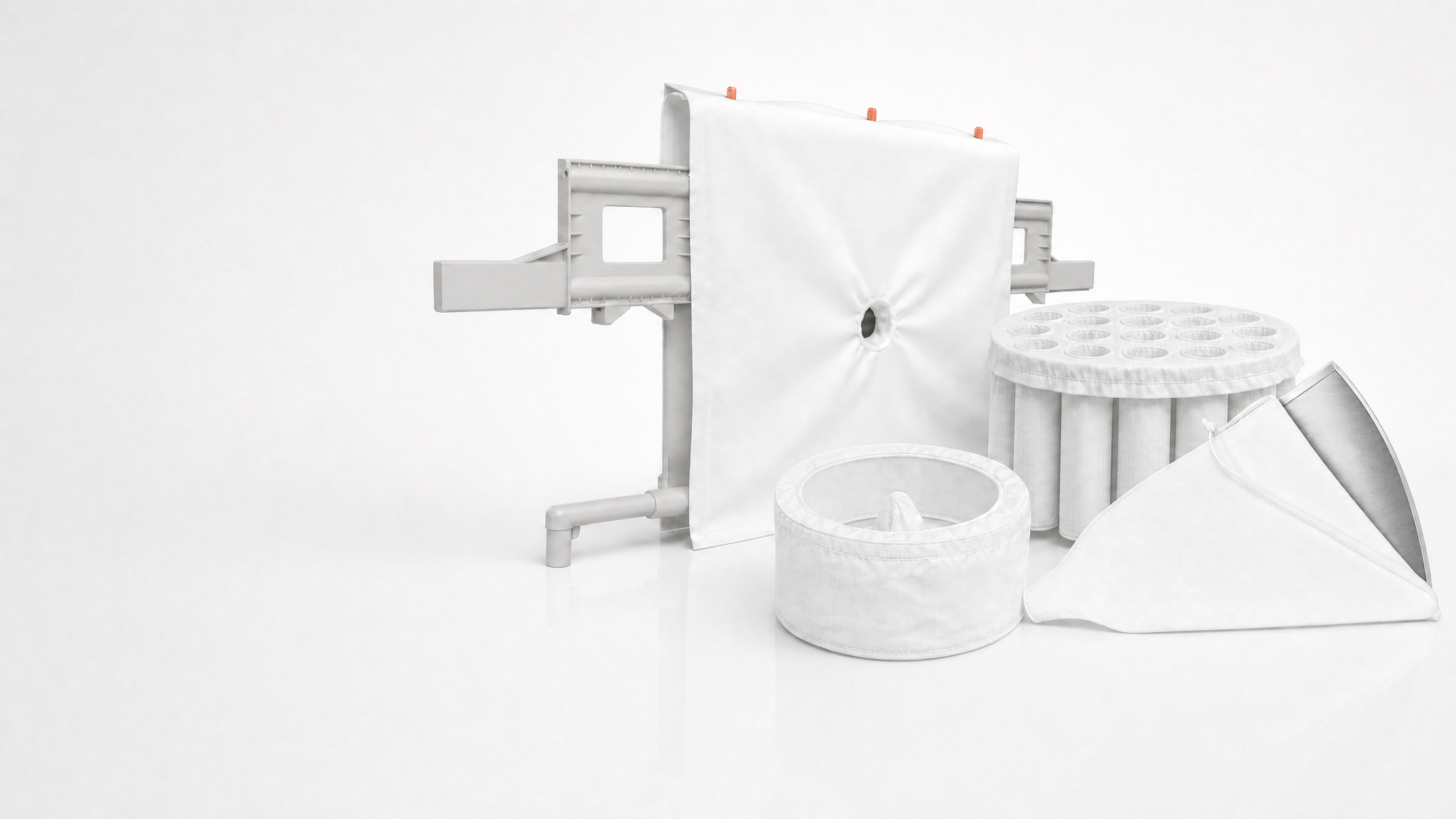
Pigment and dye production lives or dies by separation performance. If your filter fabric lets fine particles escape or blinds too early, you lose colour yield, dilute product quality, and spend more time cleaning than running the line.
The good news: with the right fabric structure, permeability, and finish, operators can improve filtrate clarity while keeping valuable solids in the cake or recovered product stream. For many plants, that starts with matching the fabric to the machine — whether that is a filter press, centrifuge, vacuum filter, or RF-PLF Series pressure leaf filter fabrics.
🔑 Key Takeaways
- Fine particle retention is the main driver for higher pigment and dye yield.
- Fabric weave, filament type, and surface finish directly affect clarity and cake release.
- Match the fabric to the machine and slurry behaviour to reduce blinding and carryover.
- Use the right selection tool and test data to avoid costly trial-and-error in production.
⚙️ Why Fabric Selection Matters in Pigment and Dye Filtration
In pigment and dye plants, the separation challenge is rarely just “remove solids.” You often need to retain ultrafine particles, protect product colour strength, and keep filtrate clear enough for reuse, washing, or downstream processing. That means the fabric must balance retention, permeability, and release.
A fabric that is too open can let valuable fines pass through, reducing yield and increasing turbidity. A fabric that is too tight may blind quickly, slow the cycle, and raise pressure drop. The best choice depends on your process and machine — for example, filter press operations often need different cloth behaviour than centrifuge applications.
💡 Tip: If your filtrate looks clear at startup but turns hazy later in the cycle, your fabric may be loading unevenly or losing retention as the cake structure changes.
For operators, the goal is simple: keep the pigment where it belongs, reduce wash losses, and maintain stable cycles. In many cases, the correct fabric on an RF-FF Series filter press fabric or RF-BF Series belt filter fabric can make a measurable difference in both yield and uptime.
🔬 What to Look for in a High-Performance Filter Fabric
Not all fabrics behave the same with pigments and dyes. Fine powders, sticky intermediates, and crystallising slurries place different demands on the cloth. When you review options, focus on the following parameters:
- Mesh/open area: tighter structures improve retention but can increase blinding.
- Filament type: monofilament fabrics typically release cakes better and are easier to clean.
- Surface finish: calendered or smooth surfaces often support better cake release.
- Air and liquid permeability: must fit the slurry viscosity and filtration cycle time.
- Chemical resistance: important in dye baths, solvents, and aggressive cleaning regimes.
| Fabric characteristic | Effect on pigment yield | Effect on filtrate clarity | Operator impact |
|---|---|---|---|
| Tighter weave | Improves fines retention | Usually clearer filtrate | Can blind faster |
| Open weave | Risk of product loss | May allow more carryover | Higher throughput, less retention |
| Monofilament | Stable over long runs | Consistent clarity | Easier cleaning and cake release |
| Multifilament / felt-like structure | Can trap fine solids well | Good early retention | Higher fouling risk in some slurries |
⚠️ Caution: In pigment and dye production, excessive cloth blinding can look like “good retention” at first, but it often causes rising pressure, unstable cycles, and unexpected solids loss during cleaning or cloth discharge.
🛠️ Matching the Fabric to Your Machine
The same slurry can behave very differently on different equipment. A filter press, for example, relies on cake build-up and cloth surface behaviour, while a centrifuge depends more on continuous fine solids capture under dynamic forces. That is why fabric selection should start with the machine, then the process chemistry.
When to favour tighter retention
- Very fine pigments or dye crystals with high value per kilogram
- Processes where filtrate clarity is critical for reuse or downstream polishing
- Slurries with short cycles where carryover immediately affects product spec
When to favour easier release
- Sticky cakes that bridge and smear on the fabric
- Long production runs where blind-off reduces net throughput
- Operations where washing efficiency matters as much as retention
📊 Practical Selection Rules for Fine Particle Retention
In the plant, the best fabric is usually the one that gives the most stable balance over the whole batch, not just the first few minutes. Use these rules of thumb when evaluating options for pigment and dye filtration:
Rule of thumb: If filtrate clarity is good but cake moisture is high, you may have over-tightened the fabric. If cake release is excellent but colour yield drops, the fabric may be too open.
Understand how much of your product sits in the fine fraction and whether the process produces soft agglomerates or hard crystals.
pH, dispersants, solvents, and temperature all influence how the fabric loads and how the cake releases.
Run a side-by-side comparison to see which cloth gives the best yield without unacceptable pressure rise.
Measure how many cycles the fabric survives before performance drops due to fouling or abrasion.
📋 Pre-selection checklist for pigment and dye operations
- Machine type confirmed: press, centrifuge, vacuum filter, or leaf filter
- Particle size distribution known, especially fines below 10 µm
- Filtrate clarity target defined
- Cake discharge method and release behaviour understood
- Cleaning chemicals and temperatures documented
- Any ATEX or static risks assessed for the installation
💡 Reducing Clogging, Carryover, and Lost Yield
Many yield losses in pigment and dye filtration are not caused by one big failure. They come from small, repeated issues: premature blinding, bypass around the cloth, contamination from stitching or seams, and poor cake release that leaves valuable solids behind.
If you are seeing recurring issues, it can help to cross-check the fabric against known operating problems such as filter cloth clogging, poor cake release, or short filter lifespan. The right construction can often prevent the problem rather than just treating the symptom.
For complex processes, use the online find and configure the right filter fabric with our Solution Finder to select your filtration machine and receive a pre-filled, non-binding specification and inquiry. It is a fast way to narrow down options before you start testing.
Typical operator improvements from better fabric selection
- Less pigment loss to filtrate
- More consistent cake formation
- Reduced washing and clean-down effort
- Lower risk of premature shutdown due to blind-off
In plants running chemical industry and pharmaceutical processes, fabric choice also affects contamination control and batch consistency. For aggressive or sensitive products, the construction must support both separation performance and process integrity.
📩 Need Help Choosing the Right Fabric?
Our technical team at R+F FilterElements can help you find the perfect filter fabric for your specific application. Get in touch for a free consultation — we will recommend the right solution based on your machine, process, and operating conditions.
If you want to move faster, use our Solution Finder to find and configure the right filter fabric for your machine and request a non-binding inquiry with the relevant specification already prepared.