
Application
Chemical Industry
Chemically resistant filter fabrics for the most demanding process environments. Engineered for acids, alkalis, solvents, and elevated temperatures.
The Challenge
The chemical industry requires filter fabrics that withstand aggressive media — concentrated acids, strong alkalis, organic solvents, and process temperatures up to 260°C. Standard textile materials quickly degrade under these conditions, leading to product contamination, unexpected downtime, and safety concerns.
Beyond chemical resistance, precision filtration is often critical: catalyst recovery, product purification, and intermediate separation all demand defined particle retention and high filtrate clarity. The right fabric choice directly impacts product quality, yield, and process economics.
Typical Chemical Filtration Tasks
Key Fabric Requirements
Chemical process filtration demands materials and constructions selected for extreme conditions.
Chemical Resistance
Concentrated H₂SO₄, NaOH, HCl, and organic solvents attack standard fabrics. Material selection — PP for acids, PA for moderate alkalis, PEEK for extreme conditions — is critical.
Temperature Stability
Many chemical processes operate at elevated temperatures. PEEK handles up to 260°C continuously; PPS up to 190°C. Standard PET is limited to 150°C.
Precision Retention
Catalyst recovery and product purification demand precise particle cut-off. Controlled weave patterns deliver defined retention from 1 µm to 100 µm+.
Filtrate Purity
Product contamination is unacceptable in fine chemicals and pharma. Monofilament fabrics minimise fibre shedding and particle release into the filtrate.
Cleanability
Chemical cloths must be easily cleanable — often with aggressive wash solutions. Smooth monofilament surfaces resist residual buildup and simplify CIP procedures.
Regulatory Compliance
Food-contact chemicals, pharmaceutical intermediates, and environmental regulations may require certified materials and documented traceability.
Material Selection Guide
Choosing the right polymer is the foundation of chemical filtration success.
| Material | Acids | Alkalis | Solvents | Max Temp. |
|---|---|---|---|---|
| PP (Polypropylene) | Excellent | Excellent | Good | 100 °C |
| PET (Polyester) | Good | Moderate | Good | 150 °C |
| PA (Polyamide) | Poor | Good | Moderate | 120 °C |
| PEEK | Excellent | Excellent | Excellent | 260 °C |
R+F Products for Chemical Filtration
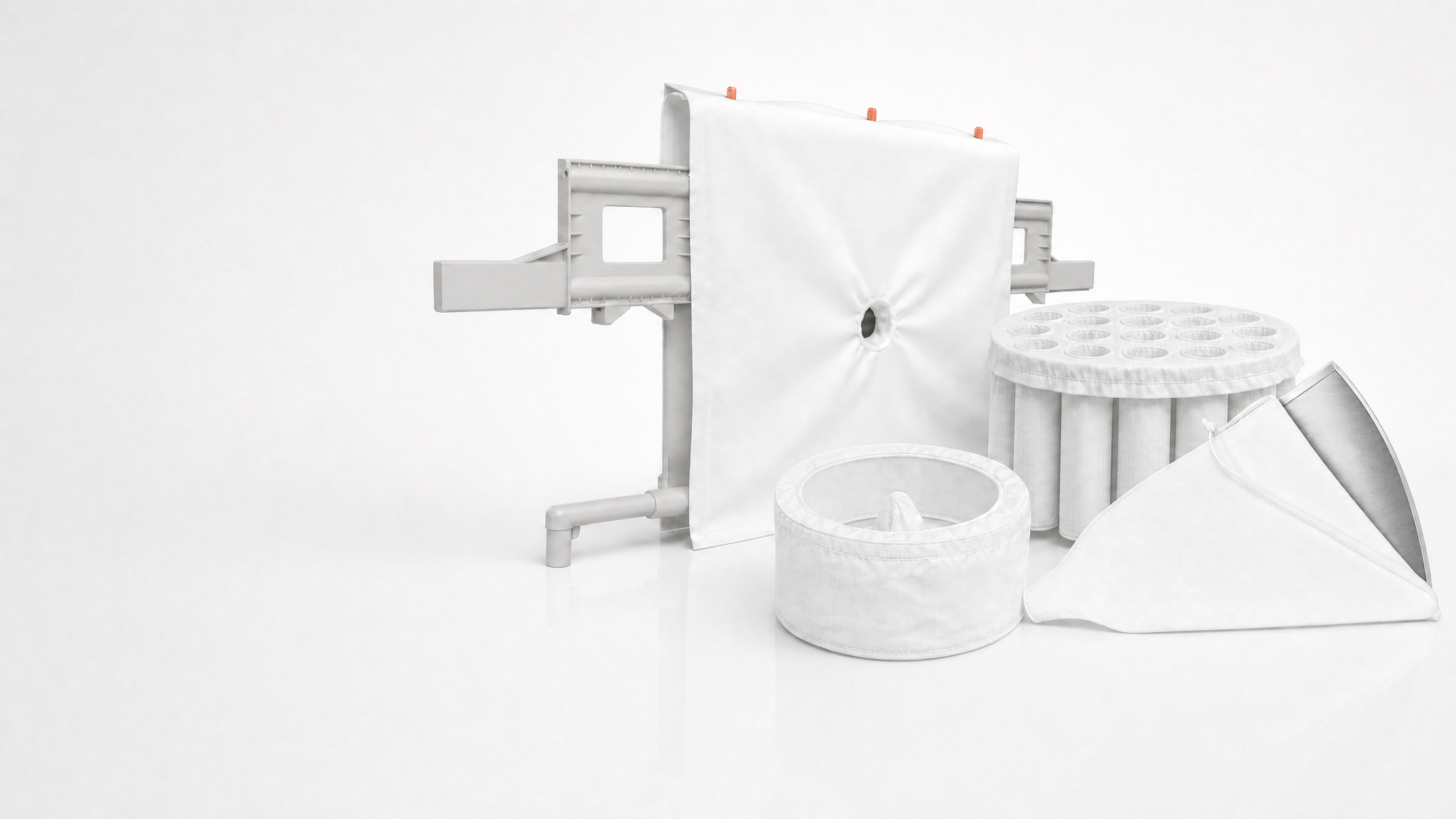
We provide chemically resistant filter fabrics for all standard filtration equipment in the chemical industry.
RF-FF Series
Filter Press Fabrics
For chamber and plate-and-frame presses handling acids, alkalis, and solvents.
Learn MoreRF-CF Series
Centrifuge Fabrics
Precision media for peeler and inverting filter centrifuges in batch chemical processes.
Learn MoreRF-BF Series
Belt Filter Fabrics
Continuous filtration media for high-throughput chemical slurry processing.
Learn MoreRF-ANF Series
Agitated Nutsche Fabrics
Filter plates and cloths for ANF/D filter-dryers in pharmaceutical and fine chemical production.
Learn MoreRF-PLF Series
Pressure Leaf Filter Fabrics
Precision filter bags and cloths for vertical and horizontal pressure leaf filters.
Learn MoreRF-SP Series
Sparkler Filter Fabrics
Round filter pads and cloths for horizontal plate pressure filters in chemical polishing.
Learn MoreFiltration Equipment in Chemical Plants
We supply filter fabrics for all major machine types used in chemical processing.
Filter Press
Chamber and plate-and-frame presses for batch chemical filtration.
Learn MoreCentrifuge
Peeler, pusher, and inverting centrifuges for batch separation.
Learn MoreNutsche Filter / ANF
Agitated Nutsche filter-dryers for API and fine chemical isolation.
Learn MorePressure Leaf Filter
Enclosed pressure filtration for catalyst recovery and polishing.
Learn MoreSparkler Filter
Horizontal plate pressure filters for chemical clarification.
Learn MoreBelt Filter
Continuous belt filters for high-throughput chemical slurries.
Learn MoreCommon Chemical Filtration Problems
Challenges frequently encountered in chemical process filtration.
Filter Cloth Clogging
Blinding from fine chemical precipitates and sticky intermediates.
Learn MoreShort Filter Lifespan
Chemical attack from acids, solvents, and elevated temperatures.
Learn MoreCake Release Problems
Adhesion of fine chemical cakes to filter surfaces.
Learn MoreContamination from Stitching
Fibre shedding in pharmaceutical and fine chemical applications.
Learn MoreAntistatic & ATEX
ESD risks in solvent-bearing and explosive chemical environments.
Learn MoreDrip & Leakage
Inter-plate leakage in filter presses handling hazardous chemicals.
Learn MoreNeed chemically resistant filter fabrics?
Tell us about your process medium, temperature, and machine — we will recommend the right material and construction.
Send Inquiry