
Product Series
RF-RD Series — Disc Filter Bags & Sector Cloths
Pull-over sector bags and precision-cut sector panels for rotary vacuum disc filters. Made to your exact sector geometry for a tight fit, high abrasion resistance and reliable filtrate clarity in mining, chemical processing and wastewater treatment.
Request a Quote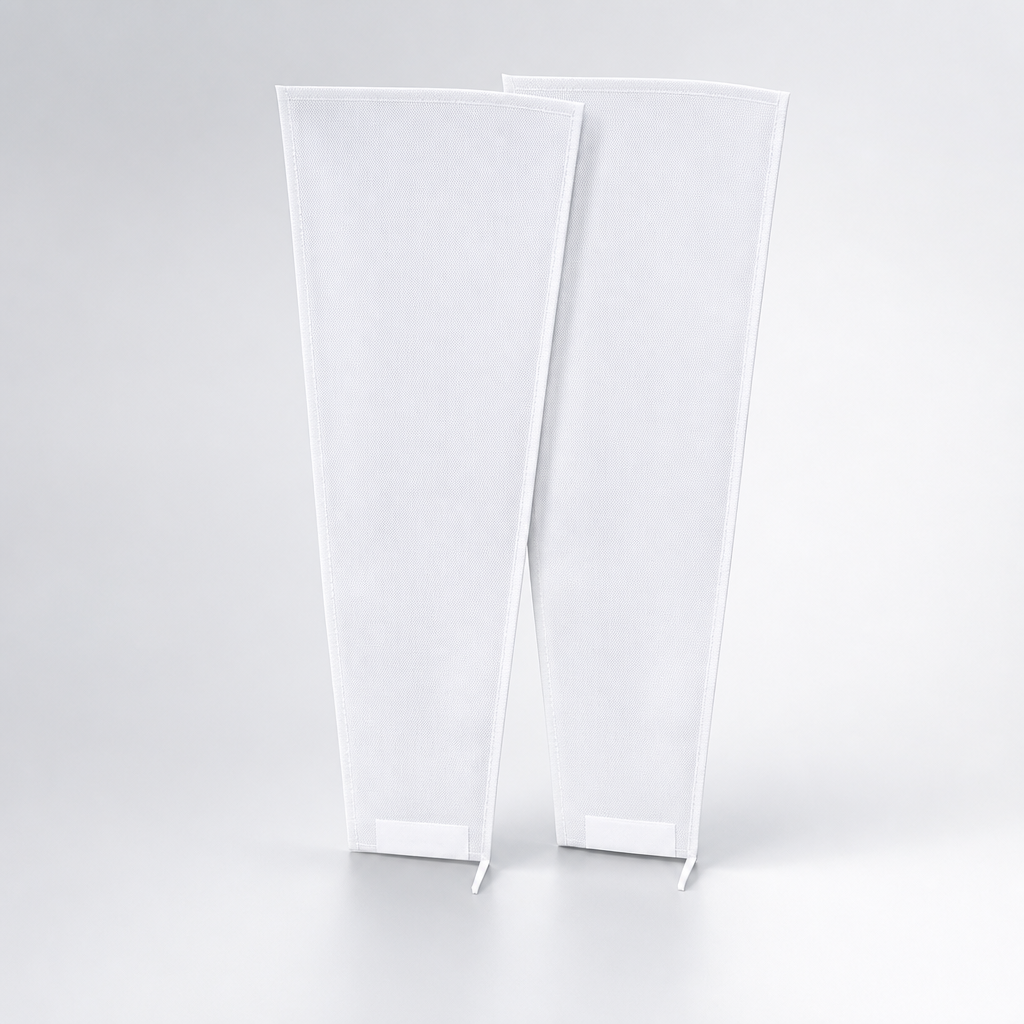
Series Overview
The RF-RD Series covers both filter media formats used on rotary vacuum disc filters: sewn sector bags that are pulled over the complete metal sector, and precision-cut sector panels fixed to each disc face. Both are made to the exact geometry of your disc segments, which is what delivers a tight fit, uniform vacuum distribution and consistent cake thickness across the disc area.
We manufacture from monofilament and multifilament yarns with weave constructions chosen for the duty — abrasive mineral slurries in mining and mineral processing, chemically aggressive process liquids, and clarification and solids recovery in wastewater treatment. Bags and panels are supplied ready to install as compatible replacements for existing disc filters.
Bags & Cut Panels
Exact sector geometry
Abrasion Resistant
For mining slurries
High Permeability
Fast drainage & dewatering
OEM Compatible
Outotec, BOKELA, Andritz
How the Fabric Works on a Disc Filter
A rotary disc filter carries several discs on a horizontal shaft, each disc built from wedge-shaped sectors. The lower part of the disc runs through a slurry trough; vacuum applied inside the sector draws liquid through the fabric while a cake builds on both faces of the disc. As the sector rotates out of the trough, air is drawn through the cake to dry it further, and the cake is discharged before the sector re-enters the slurry. Every revolution therefore puts the fabric through the full cycle of submersion, vacuum loading, drying and discharge.
Submersion & cake build-up
The fabric has to retain the target particle size from the first seconds of contact, otherwise fines pass into the filtrate before a cake layer has formed.
Vacuum & drying phase
Air permeability decides how much air is pulled through the cake and therefore the residual moisture. Too open and the vacuum collapses, too tight and throughput drops.
Discharge & re-entry
Cake release determines output. A surface that holds residual cake blinds progressively, so each revolution starts with less effective filter area.
Sector Bags or Precision-Cut Panels
There are two established ways of dressing a disc sector. Which one applies is decided by your machine, not by preference — so the first thing we ask for is how the fabric is currently held on the sector.
Sector bags (pull-over covers)
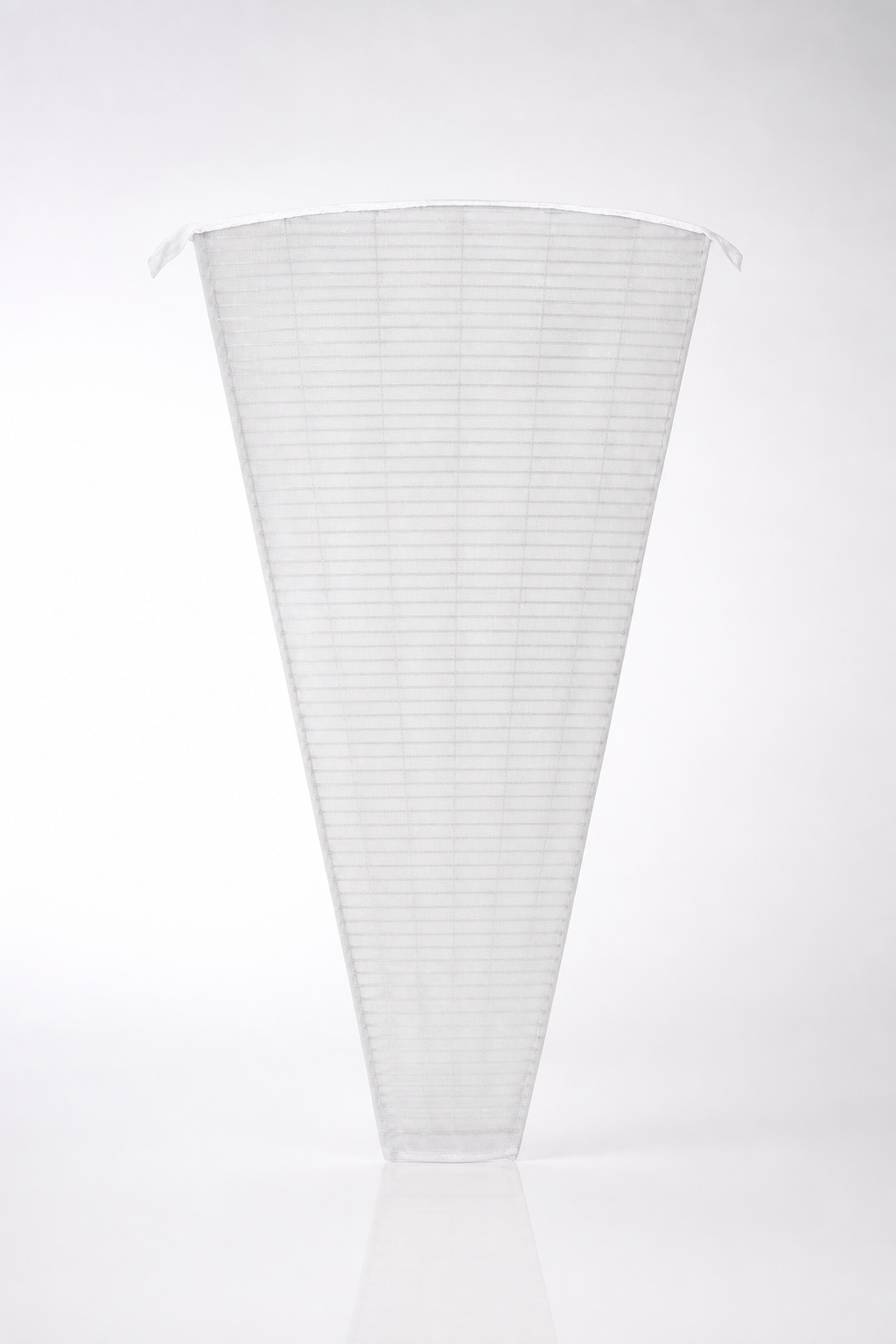
A sewn trapezoidal sleeve that is slipped over the complete metal sector like a cover. Both disc faces are filtering surfaces of the same bag, so there is no seam across the filtering area and no caulking rope to set. The bag is open at the hub end, where it is secured to the sector neck — typically with a fixing tab, a cord or a clamp, depending on the machine.
- Fast change-over, no special tools required
- No caulking groove needed on the sector
- Reinforced hem and edge seams take the mechanical load
- Well suited to wastewater and chemical duties and to frequent bag changes
Precision-cut sector panels
One flat panel per disc face, cut to the exact sector outline and fixed mechanically — caulking rope in a groove, snap rings or bolt-on strips. The panel lies directly on the drainage grid, which gives a very tight, low-movement fit.
- Tightest possible contact with the drainage surface
- Standard on many heavy-duty mining and mineral discs
- Individual faces can be replaced separately
- Requires caulking tooling and more installation time
We manufacture both. If you are unsure which type is installed on your machine, send us a photograph of a used sector from both sides — that usually settles it faster than a drawing.
Installation & Fit
On a disc filter the fit of the fabric is as important as the fabric itself. A bag that is too tight cannot be pulled over the sector; a bag that stays loose forms folds where solids collect and where the fabric chafes against the drainage grid until it fails.
Controlled oversize
Bags are cut with a defined allowance over the sector dimensions so they can be fitted by hand without forcing the seams.
Elasticity & shrinkage
Fabrics with controlled stretch and shrinkage behaviour pull tight onto the sector in service instead of remaining slack.
Seams & hems
Edge seams and the reinforced hem carry the installation and vacuum loads. They sit outside the effective filter area wherever the geometry allows.
Hub-end fixing
Tab, cord or clamp at the neck of the sector prevents the bag from lifting off under vacuum and from creeping outwards during rotation.
Configure your rotary disc filter cloth online
Answer a few guided questions about your application and receive a near-complete specification with a pre-filled inquiry. Skip anything you are unsure about.
Material Options
Material selection depends on slurry chemistry, particle size, and operating temperature.
PET (Polyester)
The standard choice for most disc filter applications. Excellent mechanical strength, good dimensional stability, and high resistance to acidic slurries. Monofilament PET provides superior cake release.
PP (Polypropylene)
Full pH resistance (1–14) for alumina red mud, phosphoric acid, and other chemically aggressive slurries. Lower temperature limit but excellent chemical durability.
PA (Polyamide / Nylon)
Superior abrasion resistance for highly abrasive mineral concentrates. Good elasticity helps the cloth conform to disc segment geometry under vacuum.
Cloth Configurations
Sector Panels
Pre-cut to your exact disc segment dimensions. Ready-to-install panels with finished edges and mounting provisions.
Caulking Rope Pockets
Integrated rope pockets for caulking-style mounting systems. Ensures secure attachment and prevents cloth lift-off under vacuum.
Snap Ring Attachment
Compatible with snap ring or bolt-on mounting systems used by Outotec, BOKELA, Andritz, and Alar disc filters.
Weave Construction
Monofilament Weaves
Single-strand yarns provide excellent cake release, high permeability, and resistance to blinding. Ideal for coarse mineral slurries.
Multifilament Weaves
Multi-strand yarns offer finer retention and higher particle capture. Best for fine mineral concentrates and tailings.
Twill & Satin Constructions
Advanced weave patterns for optimized drainage, surface smoothness, and controlled cake discharge characteristics.
Technical Specifications
Approximate values. Actual specifications depend on weave construction and application requirements.
| Material | Max. Temp. | pH Range | Air Permeability | Weight | Format |
|---|---|---|---|---|---|
| PET (Polyester) | 150 °C | 2–10 | 200–1,500 L/m²/s | 250–800 g/m² | Sector-cut |
| PP (Polypropylene) | 100 °C | 1–14 | 300–2,000 L/m²/s | 200–700 g/m² | Sector-cut |
| PA (Polyamide) | 120 °C | 3–11 | 200–1,200 L/m²/s | 250–750 g/m² | Sector-cut |
Applications
Rotary disc filter cloths are used across heavy-duty mineral and chemical filtration processes.
Related Machines
RF-RD cloths are designed for these machine types.
Rotary Disc Filter
The primary machine for RF-RD sector cloths — continuous vacuum filtration with rotating disc segments.
Learn MoreVacuum Filter
General-purpose vacuum filtration systems including drum and disc configurations.
Learn MoreDrum Filter (RVD)
Rotary vacuum drum filters for continuous slurry dewatering in similar applications.
Learn MoreIndustries
Disc filter cloths are critical components in these sectors.
Common Challenges
These filtration problems are especially relevant for disc filter applications.
Filter Cloth Clogging
Mineral fines progressively blind the cloth, reducing vacuum and throughput.
SolutionsShort Filter Lifespan
Abrasive slurries cause rapid surface wear, requiring frequent sector replacements.
SolutionsCake Release
Poor cake discharge from disc sectors reduces output and causes uneven operation.
SolutionsFrequently Asked Questions
What is the difference between a disc filter bag and a precision-cut sector cloth?
A sector bag is a sewn textile sleeve that is pulled over the complete metal sector like a cover — it filters on both faces and is held by the sector geometry itself plus a fixing tab or cord at the hub end. A precision-cut sector cloth is a flat panel per disc face, fixed mechanically with caulking rope, snap rings or bolt-on strips. Bags install faster and need no caulking tools; cut panels allow a tighter fit against the drainage grid and are the standard on many heavy mining discs. Which concept applies is determined by your machine, not by preference.
Why does the fabric of a sector bag need to be elastic?
The bag has to slide over the sector during installation, then sit tight on it in service. Fabrics with controlled elasticity and shrinkage behaviour can be cut slightly oversized for easy fitting and then pull tight onto the sector, so no slack folds remain where solids could collect and where the fabric would chafe against the drainage grid.
What do you need from us to quote sector bags?
The disc diameter and the number of sectors per disc, the sector dimensions (inner width at the hub, outer width at the rim, radial length, sector thickness), the fixing method at the hub, the material to be filtered with its finest particle size, the slurry chemistry and temperature, and your current fabric type if known. A photograph of a used bag or sector from both sides is often the fastest route.
Can disc filter bags be washed and reused?
Washing can recover part of the permeability, and many operators run a spray bar or a periodic wash cycle. It rarely restores a bag fully: fine mineral particles embed inside the yarn structure and abrasive slurries wear the surface at the same time. Bags are consumables — the practical question is service life per bag and how quickly a change can be made, not whether they can be cleaned indefinitely.
Which materials are available for disc filter bags?
Polypropylene, polyester and polyamide cover the great majority of disc filter duties. Polypropylene for chemically aggressive slurries across the full pH range, polyester for mechanical strength and dimensional stability, polyamide where abrasion dominates. For higher temperatures or aggressive chemistry, PTFE and other special fabrics are available — we specify these against your actual operating data rather than from a table.
Do you supply bags for existing OEM disc filters?
Yes. We manufacture to your sector geometry, so bags and cut panels can be supplied as compatible replacements for existing installations. We are an independent manufacturer and not affiliated with any machine builder; OEM names are used only to describe fit.
Independent manufacturer — no affiliation with the named companies. R+F FilterElements GmbH is an independent manufacturer of filter fabrics and filter elements. All manufacturer, machine and brand names on this page are used solely to describe the compatibility of our products with existing equipment. We are not affiliated with, endorsed by, authorised by or a licensee of the named companies, and we do not supply original spare parts. All trademarks remain the property of their respective owners.
Need disc filter bags or sector cloths?
Tell us your disc model, sector dimensions, fixing method and the material you filter — we deliver bags or precision-cut panels ready for installation.
Send Inquiry