
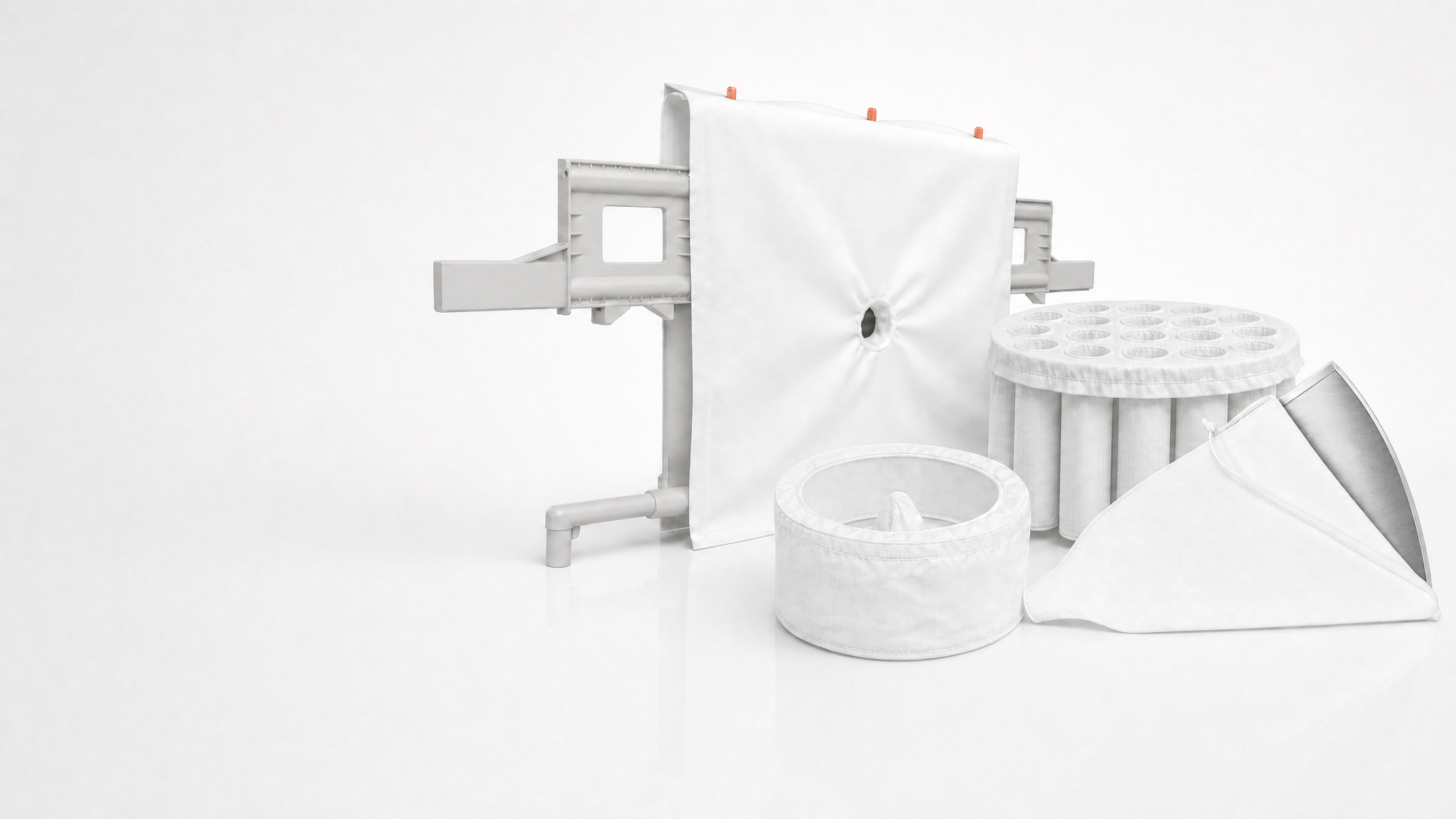
Calendering is one of those finishing steps that operators often notice only when it makes a measurable difference: cleaner filtrate, better cake release, and more stable running times. By compressing and smoothing the fabric surface, it changes how particles meet the cloth at the very first contact point — which matters on a filter press, centrifuge, belt filter, or Nutsche filter.
🔑 Key Takeaways
- Calendering smooths the fabric surface and can reduce effective pore openings.
- A tighter, more uniform surface often improves particle retention and filtrate clarity.
- For many processes, it also supports better cake release and easier cleaning.
- The right finish depends on your machine, slurry properties, and target throughput.
For operators, the real question is not whether calendering looks better — it is whether it helps the plant run longer, cleaner, and with fewer interruptions. That depends on how the fabric is used in your machine, and whether you are trying to reduce filter cloth clogging, improve cake release, or extend service life on demanding cycles.
⚙️ What Calendering Does to the Fabric Surface
Calendering is a mechanical surface treatment where the fabric passes through heated or unheated rollers under pressure. In practical terms, this compresses the top layer of the fabric, flattening surface fibrils and making the cloth more uniform.
For an operator, that usually means three things:
- Smoother surface: less loose fiber structure at the cloth face
- Smaller surface openings: reduced risk of fine solids passing through
- More consistent filtration zone: less variation across the cloth area
This is especially useful where the slurry contains fine or abrasive solids, or where product quality depends on clear filtrate. In applications such as chemical industry filtration and wastewater treatment, the surface finish can directly influence stable operation.
How it differs from an untreated fabric
An untreated fabric may offer more open structure and faster drainage, but it can also allow deeper particle penetration at the start of the cycle. A calendered surface often delays that penetration, so solids build a more controlled cake layer instead of embedding quickly into the fabric.
Rule of thumb: If your biggest issue is fines migrating into the fabric and causing premature blinding, a calendered finish is often worth testing.
🔬 Why It Improves Particle Retention
Particle retention is not only about pore size — it is also about how the filter medium presents itself to the solids. A smoother, compressed face creates a more defined first barrier, which helps retain fine particles more reliably at the start of filtration.
That matters in systems where clarity and consistency are important, such as filter presses and centrifuges. If you are working with fine crystals, pigments, or mineral slurries, calendered fabrics can help reduce carryover and improve cake formation.
| Fabric finish | Surface behavior | Typical operational effect |
|---|---|---|
| Untreated | More open, fiber-rich surface | Fast initial drainage, but higher risk of particle embedding |
| Calendered | Smoother, compressed face | Better fine particle retention and more uniform surface filtration |
| Heavily calendered | Very dense surface layer | Highest retention, but may reduce permeability if overdone |
The key is balance. Too little finishing may not solve retention issues; too much can reduce flow and increase differential pressure. This is where a fabric matched to the machine and solid load becomes important. For example, RF-FF Series filter press fabrics and RF-CF Series centrifuge fabrics are often selected differently because their operating dynamics are not the same.
💡 Tip: If your filtrate looks clearer early in the cycle but becomes inconsistent later, inspect whether particle penetration is changing as the cloth loads. Surface finishing can make a big difference here.
🛠️ Impact on Cake Release and Cleaning
For many plants, cake discharge is where the time savings show up first. A calendered surface can reduce the number of fiber protrusions that mechanically hold the cake, so the cake is more likely to release in one piece.
That is especially helpful on belt filters, Nutsche filters, and pressure leaf filters, where incomplete release can slow the whole cycle or create manual cleanup work.
Operational benefits you may notice
- Less cake sticking after discharge
- Shorter wash or rinse times
- Lower risk of residual solids remaining on the cloth
- Improved repeatability between cycles
On some systems, calendering can also help reduce drip leakage at the edges of the process, because a cleaner fabric face can support more stable cake formation and fewer bypass paths.
⚠️ Caution: A smoother surface does not automatically mean better performance. On very fine or sticky solids, an overly dense finish can increase blinding and reduce throughput.
📊 When Calendering Helps Most — and When It Does Not
Not every process needs the same surface treatment. The best choice depends on solids size, moisture, pressure, and whether the priority is retention, release, or throughput.
📋 Good candidates for calendered fabrics
- Fine or mixed particle distributions
- Processes with strict filtrate clarity requirements
- Applications where cake release is difficult
- Plants trying to extend cloth life by reducing surface wear
In contrast, if your process is already draining well and the fabric is not blinding, a heavily calendered surface may not add value. In high-throughput applications, you may need to compare calendered and non-calendered options side by side — especially on equipment like belt presses or rotary disc filters.
Identify whether the main issue is retention, release, cloth blinding, or cycle time.
Fine particles usually benefit more from a smoother surface than coarse solids do.
Compare drainage, cake release, and cleaning effort on your actual machine.
For plants handling specialized or regulated products, it is also worth considering fabric construction alongside finishing. For example, RF-ANF Series Nutsche Pharma fabrics are selected with attention to cleanliness, consistency, and process control, while RF-BF Series belt filter fabrics may prioritize continuous operation and reliable discharge.
✅ Choosing the Right Finish for Your Machine
The same calendering level will not perform the same way on every machine. A filter press often benefits from better retention and cleaner cake release, while a fluidized process or continuous belt operation may need a different balance of openness and surface smoothness.
If you are working on mining filtration, cement and bulk solids, or pharmaceutical applications, the process variables can be very different — and so should the fabric selection strategy.
The fastest way to narrow down your options is to use our online tool to find and configure the right filter fabric with our Solution Finder. You choose your filtration machine, define the process, and receive a pre-filled, non-binding specification and inquiry — a practical starting point before you request samples or a technical review.
For many operators, calendering is not about making the fabric “better” in general; it is about making it better for a specific duty. When the finish matches the process, the result is usually more stable filtration, easier discharge, and fewer unplanned interventions.
📩 Need Help Choosing the Right Fabric?
Our technical team at R+F FilterElements can help you find the perfect filter fabric for your specific application. Get in touch for a free consultation — we will recommend the right solution based on your machine, process, and operating conditions.
Prefer to start online? Use our Solution Finder to configure the right fabric for your machine and send a pre-filled, non-binding inquiry.