
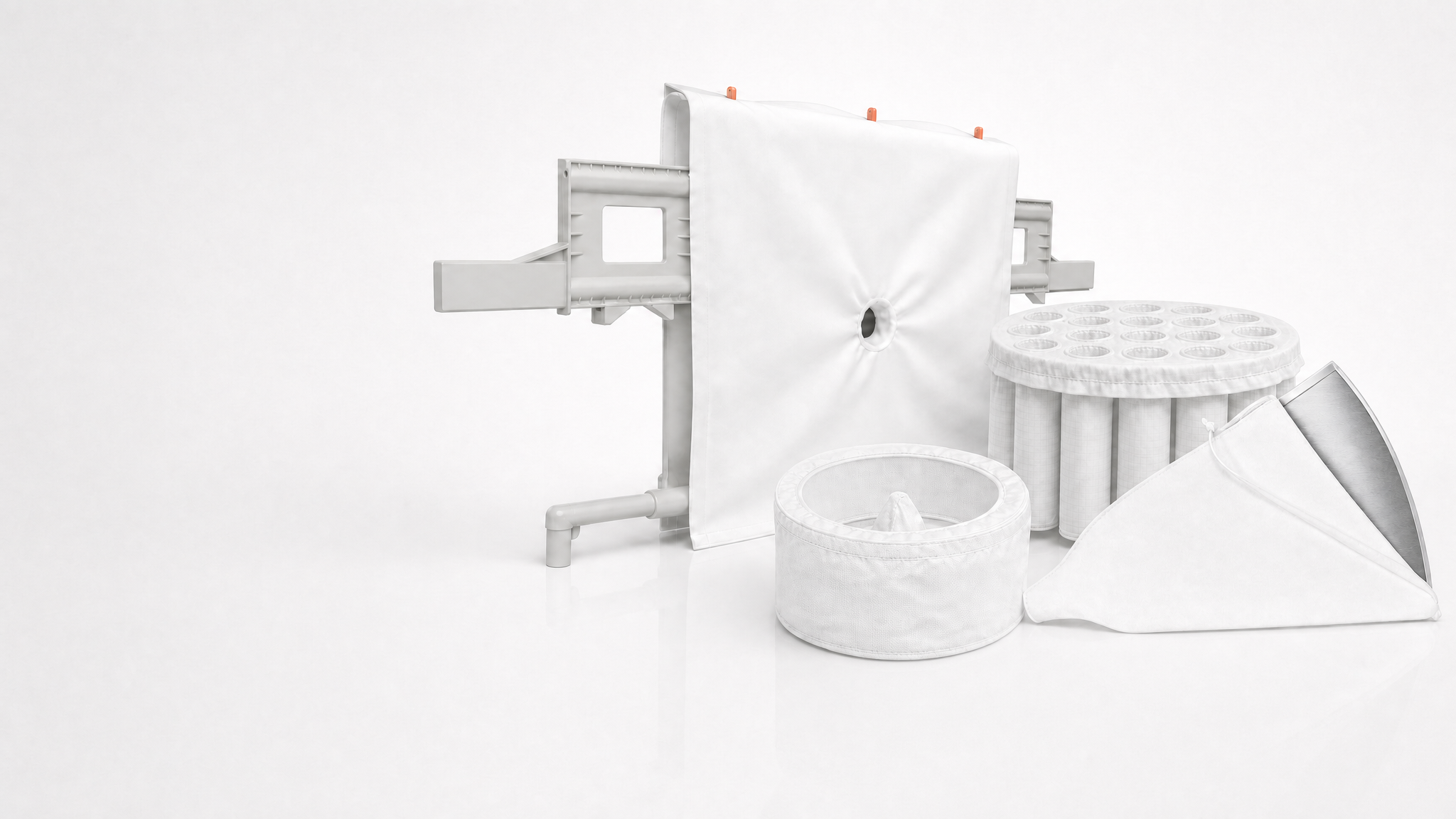
When cake moisture is the bottleneck, the fabric is often the first place operators can make a measurable difference. Small changes in weave, permeability, and surface finish can improve drainage, reduce capillary hold-up, and help you achieve drier cakes without changing the whole process.
🔑 Key Takeaways
- Weave pattern controls drainage paths, cake support, and release behavior.
- Air permeability matters most in membrane squeeze and air blow cycles.
- Calendered vs. uncalendered surfaces can shift moisture content by affecting fine particle retention and capillary wetting.
- The right fabric can often reduce cake moisture by 2-5% through selection alone, with direct savings in energy, drying time, and disposal costs.
💡 Tip: If your cake is wet but filtration time is already stable, look at the fabric first before changing cycle times, pump pressure, or chemistry.
⚙️ Why Filter Fabric Properties Change Cake Moisture
Cake moisture is not only a process issue; it is also a fabric interface problem. During filtration, the cloth must let liquid pass quickly while holding solids in place and allowing the cake to form a permeable structure. If the fabric holds too much liquid in its structure, the cake stays wetter for longer.
For operators running a filter press or a belt filter, the fabric determines how the first filtrate escapes, how evenly the cake builds, and how easily final drainage occurs. That is why fabric selection often has a direct impact on residual moisture, especially in the last part of the cycle.
🔬 Weave Pattern: The Hidden Driver of Drainage
Weave geometry influences the balance between drainage speed, particle retention, and cake support. In practice, the weave determines how freely filtrate can move through the cloth and how much capillary water remains trapped near the surface.
Open vs. tight weaves
- Open weaves typically provide better drainage and can help lower residual moisture, but may allow finer particles to penetrate if the slurry is very fine.
- Tighter weaves improve retention and cloth life in some duties, but they can slow drainage and increase capillary hold-up.
- Balanced structures are often the best starting point when your goal is drier cakes without sacrificing filtrate clarity.
On a centrifuge or rotary disc filter, the same logic applies: the fabric must drain fast enough to keep the cycle efficient, but not so open that solids migrate or blinding accelerates. For that reason, R+F often evaluates weave pattern together with particle size distribution and process pressure, rather than treating it as a standalone property.
| Fabric feature | Effect on drainage | Effect on cake moisture | Operator trade-off |
|---|---|---|---|
| Open weave | Fast | Lower potential | Higher risk of fines migration |
| Tight weave | Slower | Higher potential | Better retention and finer clarity |
| Balanced weave | Moderate to fast | Often optimal | Best compromise for many duties |
💨 Air Permeability and the Final Drying Stage
Air permeability becomes especially important in membrane squeeze and air blow cycles. In the final dewatering stage, the cake is already formed, so the fabric’s job is to let air or drainage liquid pass through the structure with as little resistance as possible.
If permeability is too low, the cake cannot vent efficiently, and the last moisture remains trapped. If it is too high, you may lose retention or create uneven cake formation at the start of the cycle. This is why the best fabric for a belt press is not automatically the best for a high-pressure filter press.
For operators in chemical, mining, and wastewater duties, permeability tuning can be one of the fastest ways to improve moisture outcomes. In many plants, the change is visible not only in the cake, but also in shorter downstream drying times and reduced steam or thermal energy demand in the next process step.
🧪 Surface Finish: Calendered vs. Uncalendered
Surface finish affects how water sits on the cloth and how the cake detaches. A calendered surface is smoother and denser, which can improve release and reduce fine particle penetration. An uncalendered surface is more open and can enhance initial drainage, but it may hold more moisture in capillary spaces.
Rule of thumb: Use a smoother, calendered finish when cake release is poor; use an open, uncalendered finish when drainage is the main limitation.
If you are fighting cake release issues, a surface change can be just as important as chemistry or cycle pressure. The trick is to match the finish to the solids: sticky slurries often benefit from smoother surfaces, while free-draining sludges can often handle a more open texture.
⚠️ Caution: Do not assume a smoother fabric always gives a drier cake. In some slurries, reduced drainage at the cloth-cake interface can increase residual moisture even if release improves.
📊 Porosity vs. Retention: Finding the Best Compromise
Porosity improves drainage, but retention protects product quality and prevents blinding. That trade-off is central to fabric engineering. Too much porosity can shorten cloth life and reduce filtrate clarity; too little can trap liquid and inflate moisture content.
In practice, the best fabric is the one that delivers the lowest total cost per ton, not just the lowest moisture number. That is why R+F takes a process-based approach for each machine type, whether the target is a RF-FF Series filter press fabric, a RF-BF Series belt filter fabric, or a specialty design for a nutsche filter.
What operators should check before ordering
📋 Fabric selection checklist
- Solids size distribution and fines content
- Required filtrate clarity or product purity
- Cycle stage where moisture remains highest
- Membrane squeeze or air blow availability
- Observed blind rate, cake release, and cloth cleaning frequency
Check whether moisture remains after filtration, after squeeze, or after discharge. That tells you which fabric property matters most.
Use more open structures for drainage-limited cycles and finer structures where retention and clarity are more important.
Compare moisture, cycle time, and discharge behavior before making a full conversion.
🏭 How R+F Optimises Fabric for Lower Moisture and Lower Cost
R+F FilterElements does not treat filter fabric as a commodity. We tune weave, permeability, and finish to the actual operating window of your machine and slurry. That engineering approach helps operators reduce moisture, improve discharge, and protect uptime without forcing a process redesign.
For users in mining, wastewater, and chemical processing, the savings can be substantial. A 2-5% moisture reduction may mean less thermal drying energy, lower disposal mass, fewer truckloads, and faster turnaround in downstream handling. In many plants, that translates directly into lower operating cost per ton.
If you work with air-supported drying systems, our RF-FBD Series fluid bed dryer fabrics and related engineered media can also help with airflow consistency and product handling after filtration. For bulk-solids handling, the same principle applies across the process line: good fabric design improves flow, stability, and efficiency.
When you are ready to specify, you can find and configure the right filter fabric with our Solution Finder to select your machine, define the operating conditions, and receive a pre-filled, non-binding inquiry in minutes.
📩 Need Help Choosing the Right Fabric?
Our technical team at R+F FilterElements can help you find the perfect filter fabric for your specific application. Get in touch for a free consultation — we will recommend the right solution based on your machine, process, and operating conditions.
Ready to cut cake moisture and operating cost? Use our Solution Finder to configure the right fabric online and start with a targeted recommendation for your filter press, belt filter, centrifuge, or other solid-liquid separation equipment.