
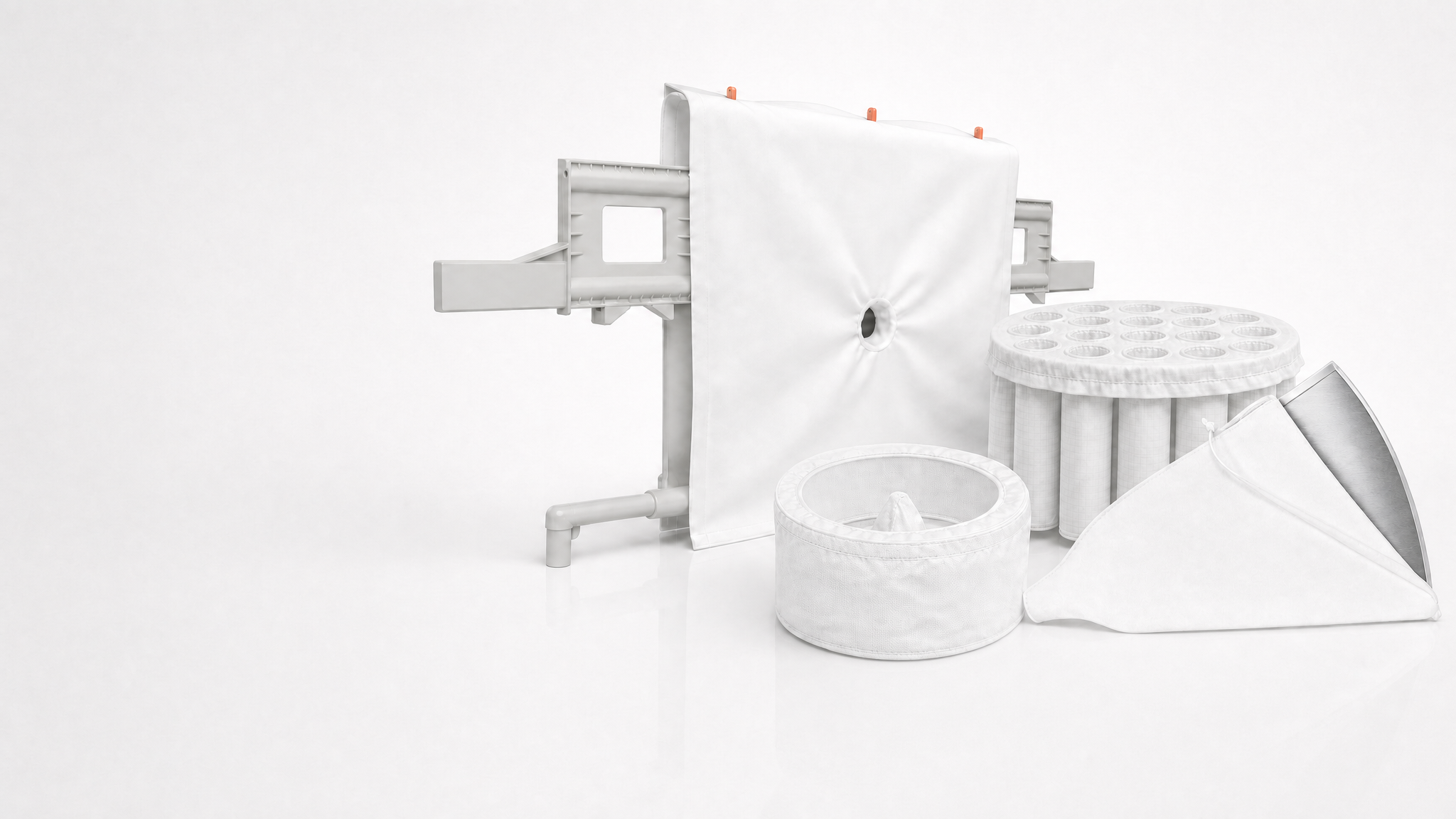
In precoat filtration, the support cloth is more than a backing layer: it determines whether your diatomaceous earth, perlite, or cellulose precoat forms a stable, evenly draining filtration bed. If the cloth is too coarse, you risk bleed-through and turbidity spikes; if it is too fine, the precoat can blind early and slow the cycle down.
For operators on pressure leaf filters, sparkler filters, and rotary vacuum precoat filters, the fabric choice directly affects start-up behavior, re-coating intervals, and cleaning effort. That is why support cloth quality is a critical process component, not just a spare part.
🔑 Key Takeaways
- Precoat filtration depends on the right match between filter aid grade and support cloth pore size.
- A cloth that is too coarse can cause precoat bleed-through and poor filtrate clarity.
- A cloth that is too fine can restrict drainage, shorten run time, and make re-coating less stable.
- R+F RF-PLF and RF-SP support cloths are engineered for reliable precoat performance and repeatable cycles.
⚙️ How Precoat Filtration Works in Daily Operation
Precoat filtration uses a thin, porous layer of diatomaceous earth (DE), perlite, or cellulose deposited onto a woven support cloth before product filtration begins. The precoat acts as the actual filter medium, while the cloth provides mechanical support and drainage.
In practice, the sequence is simple: you build the precoat, circulate until the layer is stable, then run product through the precoat while solids are retained on the cake surface. As the layer loads up, you clean it off or re-coat for the next cycle.
For operators working in chemical industry or pharmaceutical service, the precoat often has to deliver both clarity and reproducibility. If your cloth selection is inconsistent, the whole filtration step becomes harder to control.
🔬 Matching Cloth Pore Size to the Precoat Grade
The key selection rule is straightforward: the support cloth openings must be fine enough to retain the precoat particles, but open enough to allow liquid to drain freely. That balance depends on filter aid particle size, slurry properties, and operating pressure.
| Cloth condition | Typical result | Operator impact |
|---|---|---|
| Too coarse | Precoat particles pass through support cloth | Bleed-through, cloudy filtrate, unstable start-up |
| Well matched | Stable precoat layer forms quickly | Good clarity, predictable cycle length, easier re-coating |
| Too fine | Drainage slows and surface blinding starts early | Longer cycle times, higher pressure drop, more cleaning effort |
When you are unsure, it helps to find and configure the right filter fabric with our Solution Finder. You can select the machine type and operating conditions online to receive a pre-filled, non-binding specification and inquiry.
🏭 Why Cloth Quality Matters on Pressure Leaf and Sparkler Filters
On a pressure leaf filter or sparkler filter, the support cloth is exposed to repeated precoat build-up, filtration, and cleaning cycles. If the fabric has inconsistent pore geometry, you may see uneven coating, localized breakthrough, or premature cake release.
R+F RF-PLF and RF-SP support cloths are designed as quality-critical components for these machines. In field use, that means consistent porosity, better precoat anchoring, and a more repeatable filtration surface from cycle to cycle.
Rule of thumb: If the precoat layer keeps disappearing into the cloth at start-up, the weave is usually too open; if drainage slows down immediately, the weave may be too tight.
Typical machine-specific issues
- Pressure leaf filters: uneven leaf coverage can lead to differential flow across the bundle.
- Sparkler filters: poor cloth matching may cause slow precoat formation and messy cleaning.
- Rotary vacuum precoat filters: the cloth must support stable pickup and release during continuous operation.
🛠️ Cleaning, Re-Coating, and Cycle Stability
Precoat systems succeed or fail in the cleaning phase. Once the filter aid layer is spent, you must remove it fully enough to avoid contamination of the next batch, but gently enough not to damage the support cloth. Harsh cleaning can shorten fabric life and create defects that show up as bypass paths later.
Apply DE, perlite, or cellulose evenly so the support cloth is fully covered before product enters the filter.
Watch clarity, flow rate, and pressure rise. Sudden changes can indicate blinding or precoat instability.
Clean the surface using the approved procedure for your machine and fabric construction.
Keep slurry concentration and start-up method consistent to maintain repeatable cycle performance.
⚠️ Caution: Aggressive mechanical cleaning, incorrect chemical cleaners, or over-pressurised wash procedures can damage the weave and cause early failure. A damaged cloth often shows up later as filter cloth clogging or reduced service life.
If you are seeing frequent re-coating, poor release, or dirty filtrate, the issue may not be the filter aid alone. It can also be a support-fabric mismatch, a worn weave, or an operating change in solids concentration. In those cases, reviewing the machine setup and the cloth specification together usually gives the best result.
✅ Choosing the Right Support Cloth for Reliable Precoat Performance
For operators, the goal is not just retention — it is repeatable, economical operation. The right support cloth helps you reduce filter aid consumption, stabilise cycle time, and avoid unnecessary shutdowns. That is why precoat applications deserve a purpose-engineered fabric, not a generic one.
📋 Precoat Fabric Selection Checklist
- Match cloth pore size to the finest filter aid grade you plan to use
- Confirm chemical and temperature resistance for your process
- Check whether cleaning is manual, CIP, or automated
- Review whether the machine is a leaf, sparkler, or rotary vacuum design
- Consider whether your main issue is bleed-through, blinding, or short lifespan
For precoat service on a pressure leaf filter or sparkler filter, R+F’s engineered support fabrics are built to keep the precoat layer stable and the drainage path open. That makes them a practical choice when the process depends on consistent batch quality.
📩 Need Help Choosing the Right Fabric?
Our technical team at R+F FilterElements can help you find the perfect filter fabric for your specific application. Get in touch for a free consultation — we will recommend the right solution based on your machine, process, and operating conditions.
To speed up the process, use our Solution Finder to find and configure the right filter fabric for your precoat filtration setup and receive a pre-filled, non-binding inquiry.