
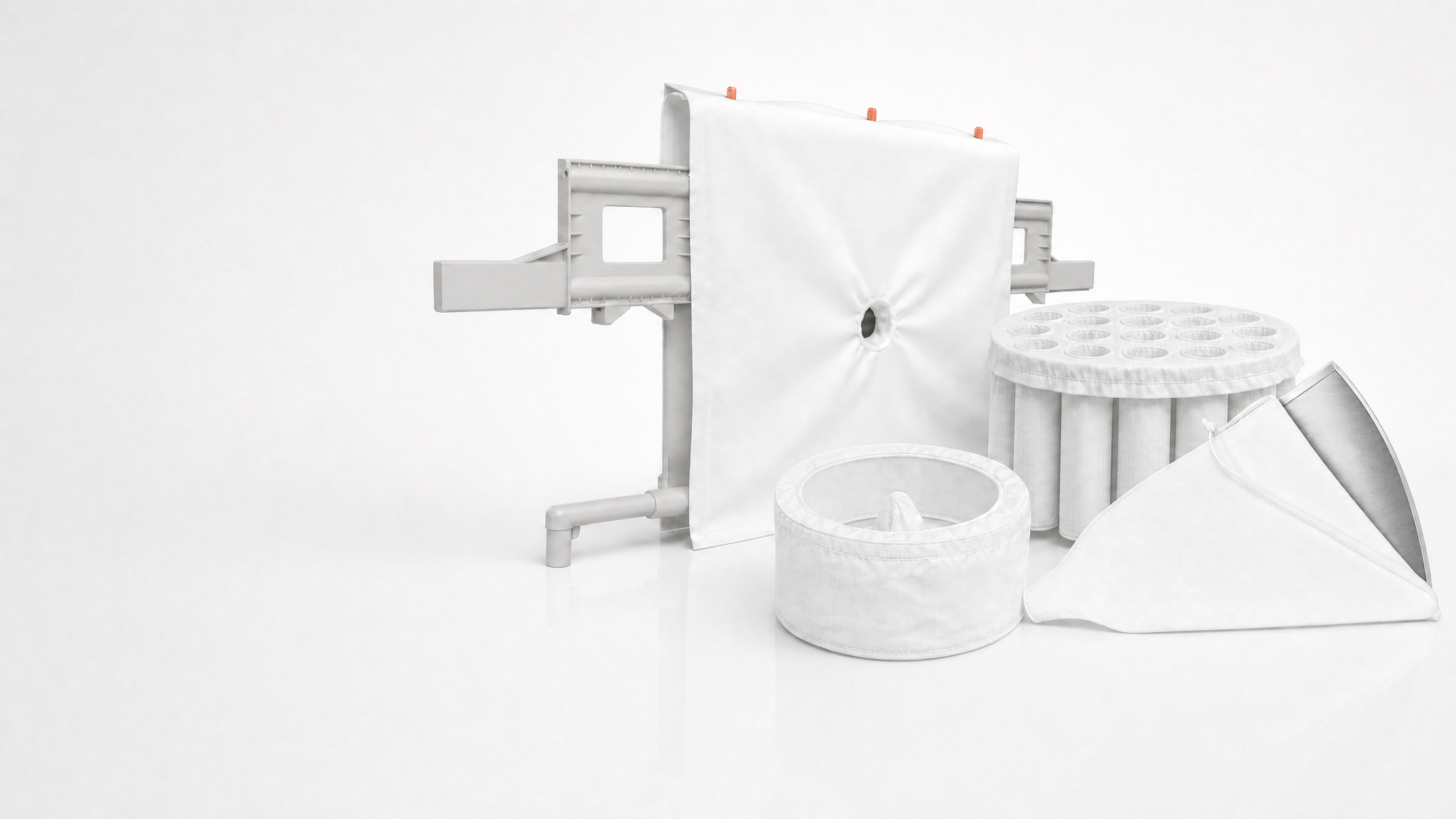
Even if your filter press, centrifuge, or belt filter has been running reliably for months, a process change can quickly alter filter fabric performance. A shift in pH, temperature, solids loading, or chemistry often shows up first as slower dewatering, poorer cake release, or unexpected cloth wear.
The good news: in many cases, the fabric itself is not “bad” — it is simply no longer matched to the new operating conditions. That is why every process change should trigger a quick re-check of your filtration setup, especially on filter presses, centrifuges, and belt filters.
🔑 Key Takeaways
- Process changes can affect permeability, cake release, and fabric lifetime.
- pH, temperature, solids concentration, and particle shape are common causes of performance drift.
- The right fabric for yesterday’s process may be the wrong fabric after a recipe or feed change.
- Use your machine data, a quick checklist, and the Solution Finder to re-evaluate the fabric before problems escalate.
⚙️ Why Process Changes Affect Fabric Performance
Filter fabrics are selected for a specific balance of retention, drainage, release, and mechanical stability. When your process shifts, that balance changes too. A fabric that worked well at one pH or solids level may start clogging faster, draining slower, or wearing out early once the feed stream changes.
This is especially important in wastewater, chemical industry, and mining applications, where feed variability is common and operating windows can move without warning.
Common process changes that matter
- pH shifts can attack yarn chemistry, stitching, or finish coatings.
- Temperature increases can soften fibers, change shrinkage, or reduce dimensional stability.
- Higher solids concentration can drive faster blinding and lower throughput.
- Particle size or shape changes can increase abrasion or make cakes harder to release.
💡 Tip: If you changed the chemistry upstream, do not assume the fabric is still the bottleneck. Check whether the new feed has simply pushed the cloth outside its original design envelope.
🔬 Typical Scenarios Operators Run Into
Most fabric issues after a process change fall into a few repeatable patterns. If you can identify the symptom quickly, you can usually narrow the cause faster and avoid unnecessary cloth replacement.
| Process change | What you may see | Likely fabric impact | What to check |
|---|---|---|---|
| Lower pH | Shorter cloth life, stitching issues, leakage | Chemical attack on yarns or seams | Fiber compatibility, seam construction, finish |
| Higher temperature | Fabric shrinkage, distorted fit, seal problems | Loss of dimensional stability | Max temperature rating, shrinkage behavior |
| More fine solids | Clogging, slower drainage, wetter cake | Pore blocking and blinding | Weave/open area, surface finish, cleaning cycle |
| Abrasive solids | Rapid wear at wear zones | Fiber damage and thinning | Yarn type, cloth reinforcement, wear pattern |
⚠️ Caution: A fabric that is exposed to a new chemical environment may fail silently at first. By the time leakage or tearing appears, the process may already have been operating with reduced separation quality for days or weeks.
🛠️ How to Re-Evaluate the Fabric After a Process Change
When operating conditions change, a structured check is faster than trial-and-error. Start with the process data, then compare it against the fabric specification and the machine’s current symptoms.
Note pH, temperature, solids concentration, particle size, cycle time, and any new chemicals or polymers.
Look for cake release issues on a filter press, blinding on a belt filter, or balance/vibration changes on a centrifuge.
Review fiber type, weave, permeability, seam design, and any thermal or chemical limits against the new process conditions.
Use a sample run or limited production window before converting the entire line to a new fabric specification.
Rule of thumb: If your process changes by more than one major variable at once — for example pH plus temperature — re-check the fabric instead of assuming the old specification will still work.
📊 Choosing Between Retaining More Fines or Improving Release
After a process change, operators often face a trade-off: keep fine retention high, or open the fabric enough to improve drainage and cake release. The right answer depends on your machine, product, and downstream handling.
For many plants, the best next step is not a guess — it is a quick re-specification. You can find and configure the right filter fabric with our Solution Finder by selecting your machine and operating conditions online. It generates a pre-filled, non-binding inquiry and helps narrow the options before you change production hardware.
When to consider a different fabric family
If the process change is significant, you may need to move to a different fabric series altogether. For example, a more demanding solids duty may require a different solution than a standard filter press cloth, while thermal or release-sensitive applications may call for a specialized fabric for RF-NF Series needle felt or RF-FF Series filter press fabrics. Likewise, a changed dewatering profile on a belt line may justify reviewing RF-BF Series belt filter fabrics.
📋 Quick Re-Evaluation Checklist
- Has pH shifted outside the original range?
- Has process temperature increased or become less stable?
- Did solids concentration, particle size, or abrasiveness change?
- Are you seeing clogging, leakage, or poor cake release?
- Has cloth life shortened compared with the previous campaign?
- Do seam, stitch, or edge areas show unusual wear?
🏭 Practical Examples from the Plant Floor
In the field, process changes are often gradual, not dramatic. A wastewater plant may add a new coagulant and suddenly see faster blinding. A chemical plant may raise temperature for yield reasons and then notice shrinkage at the cloth edge. A mineral operation may move to a finer feed and lose cycle time on the filter press or rotary disc filter.
These are classic moments to compare the new conditions with the fabric’s original design target. If you operate a nutsche filter, pressure leaf filter, or sparkler filter, even small changes in chemistry can alter release behavior and cleanliness between cycles. In pharmaceutical service, the tolerance for contamination and trace leakage is especially low, so re-evaluation is critical.
- New chemistry: check chemical resistance and seam integrity.
- New temperature: verify dimensional stability and fit.
- New solids profile: evaluate permeability and blinding tendency.
- New production target: balance clarity, cake dryness, and cycle time.
✅ What to Do Next
If your process has changed, don’t wait for the fabric to fail completely. Review the operating data, inspect the wear pattern, and compare the current process against the original fabric specification. In many cases, a small adjustment in weave, permeability, fiber selection, or seam design can restore performance without major machine changes.
For tailored support, compare your machine and process against our product range, including RF-CF Series centrifuge fabrics and RF-PLF Series pressure leaf fabrics, then validate the fit with a technical review. If you are troubleshooting a specific issue such as filter cloth clogging, cake release problems, or short filter lifespan, the right fabric change can make a measurable difference.
📩 Need Help Choosing the Right Fabric?
Our technical team at R+F FilterElements can help you find the perfect filter fabric for your specific application. Get in touch for a free consultation — we will recommend the right solution based on your machine, process, and operating conditions.
Before you replace anything, use our Solution Finder to find and configure the right filter fabric for your machine online. You will receive a pre-filled, non-binding specification and inquiry to speed up the next step.