
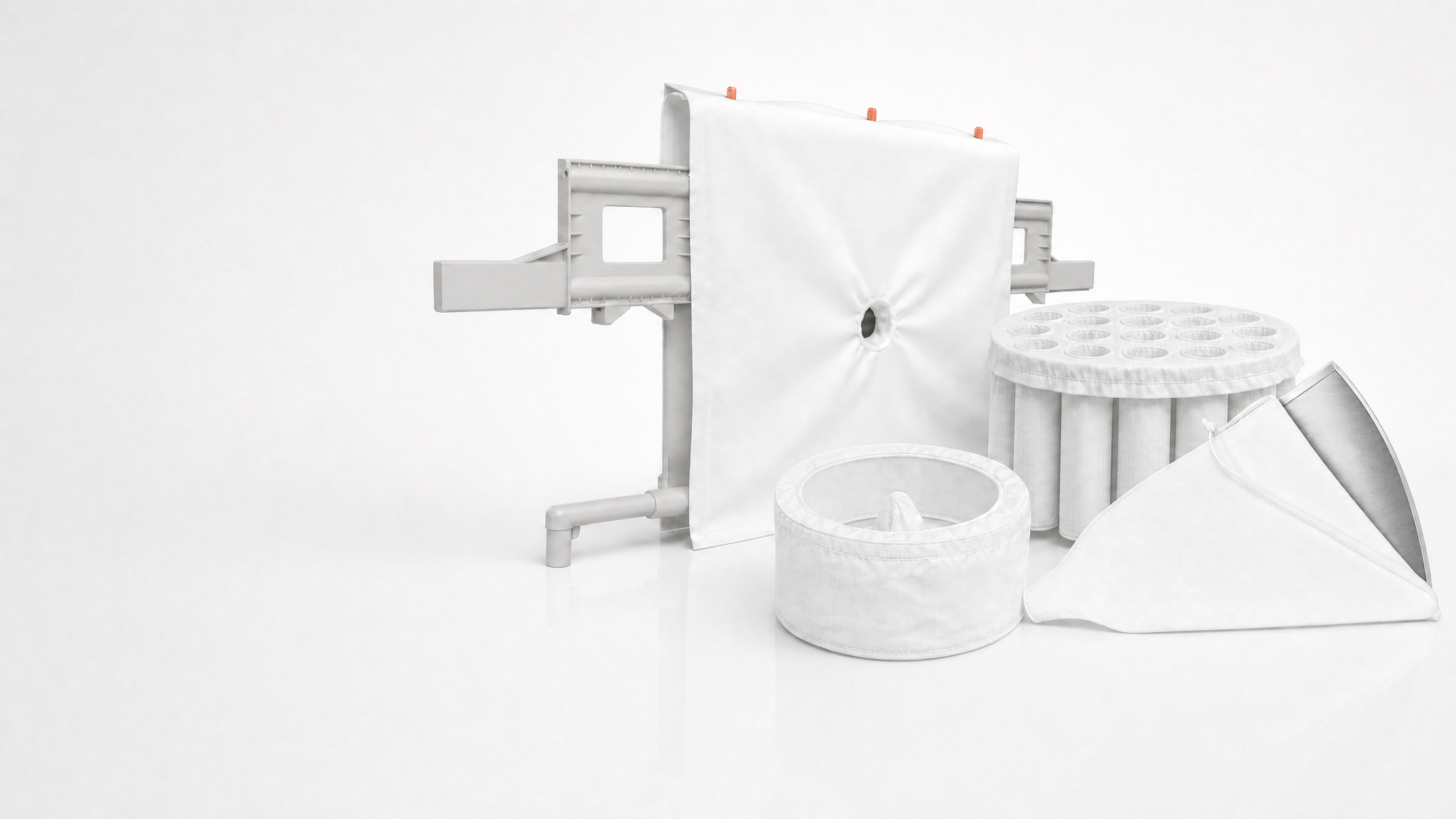
Brewery and winery filtration has one job that never changes: deliver a clear, stable beverage without adding off-flavors, contamination, or unnecessary downtime. In practice, that means choosing a filter fabric that is food-grade, taste-neutral, easy to clean, and matched to your machine and process conditions.
🔑 Key Takeaways
- Food-grade filter fabrics must be hygienic, chemically resistant, and taste-neutral.
- Pressure leaf and sparkler filters often need different weave and finishing properties.
- Fabric choice affects clarity, drip behavior, cake release, and cleaning intervals.
- Use machine-specific selection tools, including our Solution Finder, to reduce trial-and-error.
🍷 What Beverage Filtration Demands From the Fabric
When I run a brewery or winery filtration line, I need a fabric that does more than just hold back solids. It has to protect the product’s flavor profile, maintain stable flow, and stand up to repeated cleaning cycles. That is especially important in finishing filtration, where even minor contamination or extractables can affect product quality.
For beverage applications, the fabric should be designed with low extractables, smooth release characteristics, and consistent filtration performance. If you are working on a pressure leaf filter or sparkler filter, fabric choice directly influences clarity, throughput, and how often you need to interrupt production for cleaning.
⚠️ Caution: Never assume a technically strong fabric is automatically suitable for beverage service. If the material, finishing, or stitching is not aligned with food-contact expectations, you risk contamination, odor transfer, or quality claims.
🔬 Pressure Leaf vs. Sparkler Filters: What Changes in Fabric Selection?
Pressure leaf and sparkler filters both play important roles in brewery and winery operations, but they do not ask the fabric to do the same job. Pressure leaf systems usually need stronger support, reliable cake formation, and controlled discharge. Sparkler filters, by contrast, often focus on fine polishing filtration and must maintain a clean, uniform filtrate path.
| Selection Factor | Pressure Leaf Filter | Sparkler Filter |
|---|---|---|
| Primary goal | Cake filtration and clarification | Fine polishing and beverage clarity |
| Fabric requirement | Robust support, stable permeability | Uniform surface, fine retention |
| Release behavior | Important for clean cake discharge | Important for low hold-up and easy cleaning |
| Typical concern | Cake release and blinding | Taste neutrality and low carryover |
If you operate a pressure leaf unit, start with the RF-PLF Series pressure leaf filter fabrics. For polishing and bright filtration, the RF-SP Series sparkler filter fabrics are built for beverage-duty use where clean filtrate and neutral product contact are critical.
🧪 Food Safety, Taste Neutrality, and Cleaning Discipline
In beverage plants, the fabric is part of the product-contact chain. That means I look for materials and construction that support hygienic operation and avoid unwanted transfer into the beverage. A good fabric should rinse cleanly, resist buildup, and keep its performance after many wash cycles.
- Taste neutrality: no odor, color, or off-flavor transfer.
- Low contamination risk: clean seams, suitable stitching, and controlled finishing.
- Washability: stable after repeated chemical or hot-water cleaning.
- Consistent pore structure: reliable retention without rapid blinding.
If you are troubleshooting solids buildup or premature fouling, it is worth reviewing our guides on filter cloth clogging and short filter lifespan. In many beverage lines, the real issue is not just process load — it is a fabric that is too open, too tight, or not finished for the application.
💡 Tip: In brewery and winery filtration, a slightly better-matched fabric often pays back quickly through fewer cleaning stops, more stable clarity, and lower product loss at changeover.
🛠️ How to Select the Right Fabric for Your Line
The selection process gets much easier when you break it into practical operator questions: What machine am I running? What solids do I need to retain? How often do I clean? And how sensitive is the product to extractables or carryover?
Confirm whether you are using a pressure leaf or sparkler filter, because the support structure and fabric format must match the element geometry.
Decide whether you need clarification, polishing, or precoat-supported filtration. This affects weave tightness and permeability.
Match the fabric to your CIP, rinse, and sanitation routine so performance stays stable across batches.
Test for clarity, pressure drop, cake release, and sensory neutrality before moving to full-scale use.
📋 Pre-Selection Checklist
- Machine type confirmed: pressure leaf or sparkler filter
- Target product: beer, wine, must, cider, or other beverage
- Required clarity level defined
- Cleaning method verified
- Food-contact expectations documented
- Any odor, taste, or carryover sensitivity noted
💡 Practical Rules for Better Beverage Filtration
From an operator’s point of view, the best fabric is the one that makes the line predictable. If I can keep pressure stable, protect flavor, and clean quickly between batches, the plant runs better and the product stays consistent.
Rule of thumb: If your beverage filtration is sensitive to flavor and haze, prioritize taste-neutral finishing and stable retention over the most aggressive possible filtration rating.
When the process is still evolving, use digital guidance to avoid guesswork. Our Solution Finder lets you select your filtration machine online and configure the right filter fabric to receive a pre-filled, non-binding specification and inquiry. That is a fast way to narrow down the correct choice before you request samples or a quotation.
For plants that also run other solid-liquid separation equipment, it can help to compare beverage service against other demanding installations such as filter presses or centrifuges to understand how fabric construction changes with load, discharge, and cleaning strategy.
📩 Need Help Choosing the Right Fabric?
Our technical team at R+F FilterElements can help you find the perfect filter fabric for your specific application. Get in touch for a free consultation — we will recommend the right solution based on your machine, process, and operating conditions.
Ready to move faster? Find and configure the right filter fabric with our Solution Finder and send us a pre-filled, non-binding inquiry for your brewery or winery line.