
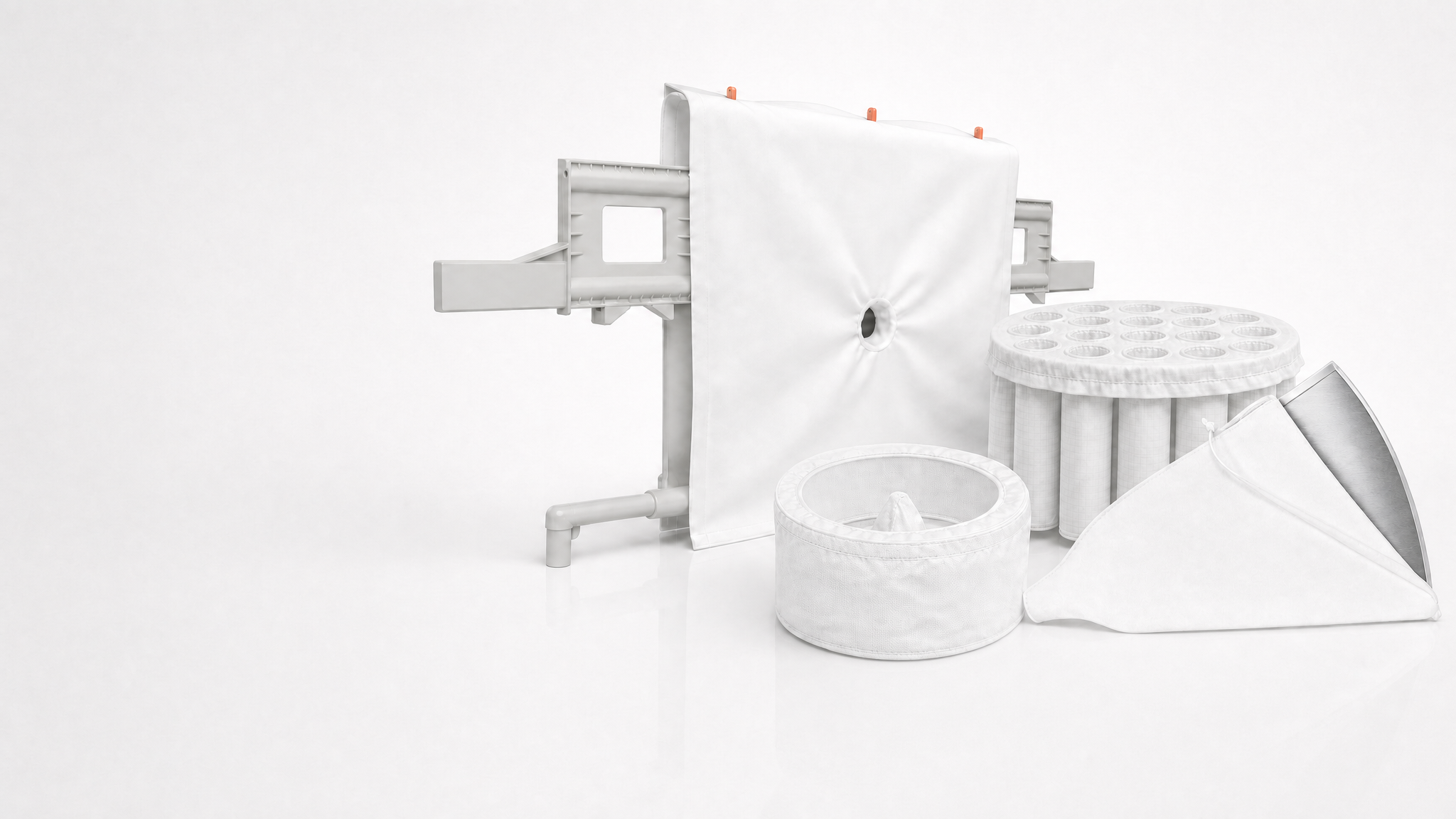
Gold plants put filter fabrics under two very different loads: abrasive CIL/CIP tailings on one side, and ultra-fine Merrill-Crowe precipitate on the other. In both cases, the operator needs stable throughput, clean cake release, and reliable solids capture—without losing valuable gold, zinc, or carbon fines.
🔑 Key Takeaways
- CIL/CIP tailings need chemically resistant fabrics that handle alkaline cyanide slurry and abrasion.
- Merrill-Crowe filtration demands very fine retention to recover zinc dust and gold precipitate efficiently.
- PP-based fabrics are a strong fit for cyanide service because they resist alkaline process conditions.
- R+F RF-FF Series filter fabrics are designed for filter press duty where fine capture and dependable dewatering matter most.
🏭 Gold Filtration Challenges in Daily Plant Operation
In gold processing, filtration is not just a downstream utility—it protects recovery, controls water balance, and keeps the plant running. The filtration task changes depending on the circuit: CIL/CIP tailings typically go to belt filters, disc filters, or other dewatering equipment, while Merrill-Crowe zinc precipitation is usually handled on a filter press.
From the operator’s point of view, the main challenges are straightforward: fine particles, abrasive tailings, and chemically aggressive slurry. In cyanide service, the process often runs at alkaline pH 10–11, so fabric choice must support stable operation under those conditions.
💡 Tip: If your tailings cake is blinding the cloth too quickly, check particle size, flocculation quality, and wash water distribution before changing fabric grade.
⚙️ Merrill-Crowe Zinc Precipitation: Why Fine Retention Matters
Merrill-Crowe systems create a very specific filtration problem. After zinc dust is added to cement dissolved gold and silver, the resulting precipitate can be extremely fine. If the fabric opens too much, you risk solids carryover; if it blinds too quickly, you lose filtration time and increase maintenance.
This is where the RF-FF Series filter press fabrics are a practical option for operators who need tighter particle retention and reliable cake discharge. For a plant running high-value precious metal recovery, that balance between fine solids capture and stable throughput is critical.
For many plants, the right answer is not a single “best” cloth but a fabric that matches the precipitate load, slurry chemistry, and press cycle. If you want a fast way to find and configure the right filter fabric with our Solution Finder, you can select the machine type and receive a pre-filled, non-binding specification request.
🧪 CIL/CIP Tailings Dewatering: Handling Abrasion and Cyanide
Tailings from CIL/CIP circuits are often abrasive and can be difficult on woven media over time. The goal is to produce a dry enough cake for disposal or further handling, while keeping filtrate clear and minimizing cloth wear. In these duties, polypropylene (PP) is usually the material of choice because it offers strong resistance to alkaline cyanide environments.
For belt-based dewatering, operators often evaluate RF-BF Series belt filter fabrics. On disc filtration duties, the RF-RD Series disc filter media can be a good fit where continuous operation and consistent drainage are important. Both machine types are common in mining circuits where volume matters as much as clarity.
| Filtration Duty | Typical Machine | Main Fabric Requirement | Operator Priority |
|---|---|---|---|
| Merrill-Crowe precipitate recovery | Filter press | Fine retention, good cake release | Recover zinc and gold solids |
| CIL/CIP tailings dewatering | Belt filter | Abrasion resistance, drainage stability | Higher throughput, lower moisture |
| Continuous tailings filtration | Disc filter | Stable permeability, long service life | Reliable continuous operation |
⚠️ Caution: Do not assume a fabric that performs well in tailings dewatering will also recover fine Merrill-Crowe precipitate effectively. The wrong pore structure can cause either solids loss or rapid blinding.
🔧 Fabric Selection: What Works Best in Cyanide Service?
When you specify fabric for gold processing, start with the chemistry. In alkaline cyanide circuits, PP fabrics are typically the best baseline because they resist the process environment and remain mechanically stable during repeated cycles. From there, the weave, surface finish, and seam construction should be chosen according to the solids profile.
For a practical selection process, use this rule: if the plant is losing valuable fines, move toward finer retention; if the cloth is blinding too quickly, revisit flocculant performance and cake conditioning before opening the weave too far. You can also compare related equipment needs on the mining applications page and the filter cloth clogging guidance.
📋 Pre-Specification Checklist
- Confirm slurry chemistry and operating pH
- Identify whether the duty is precipitate recovery or tailings dewatering
- Check target cake moisture and filtrate clarity
- Measure abrasion level and expected cloth wear
- Verify cake discharge and washing requirements
Rule of thumb: If the slurry contains valuable fine solids, start with the fabric that gives the best capture, then optimize throughput. Recover first, then accelerate.
📊 R+F Options for Gold Plants
R+F FilterElements supplies engineered fabrics for the realities of mine operation: abrasive slurries, chemical exposure, and nonstop production pressure. For Merrill-Crowe presses, the RF-FF Series is positioned for fine solids capture and dependable discharge. For tailings dewatering, operators can also evaluate the RF-BF Series for belt filtration and the RF-RD Series for rotary disc applications.
How operators usually decide
- Filter press: best when fine precipitate recovery is the top priority.
- Belt filter: best for high-volume tailings dewatering and robust continuous service.
- Disc filter: best when continuous filtration and stable discharge are needed.
If your plant also handles nearby process duties, you can review related equipment on the vacuum filter and pressure leaf filter pages to compare operating principles and media needs.
📩 Need Help Choosing the Right Fabric?
Our technical team at R+F FilterElements can help you find the perfect filter fabric for your specific application. Get in touch for a free consultation — we will recommend the right solution based on your machine, process, and operating conditions.
Prefer to start online? Use our Solution Finder to configure the right filter fabric for your machine and receive a pre-filled, non-binding inquiry in just a few steps.