
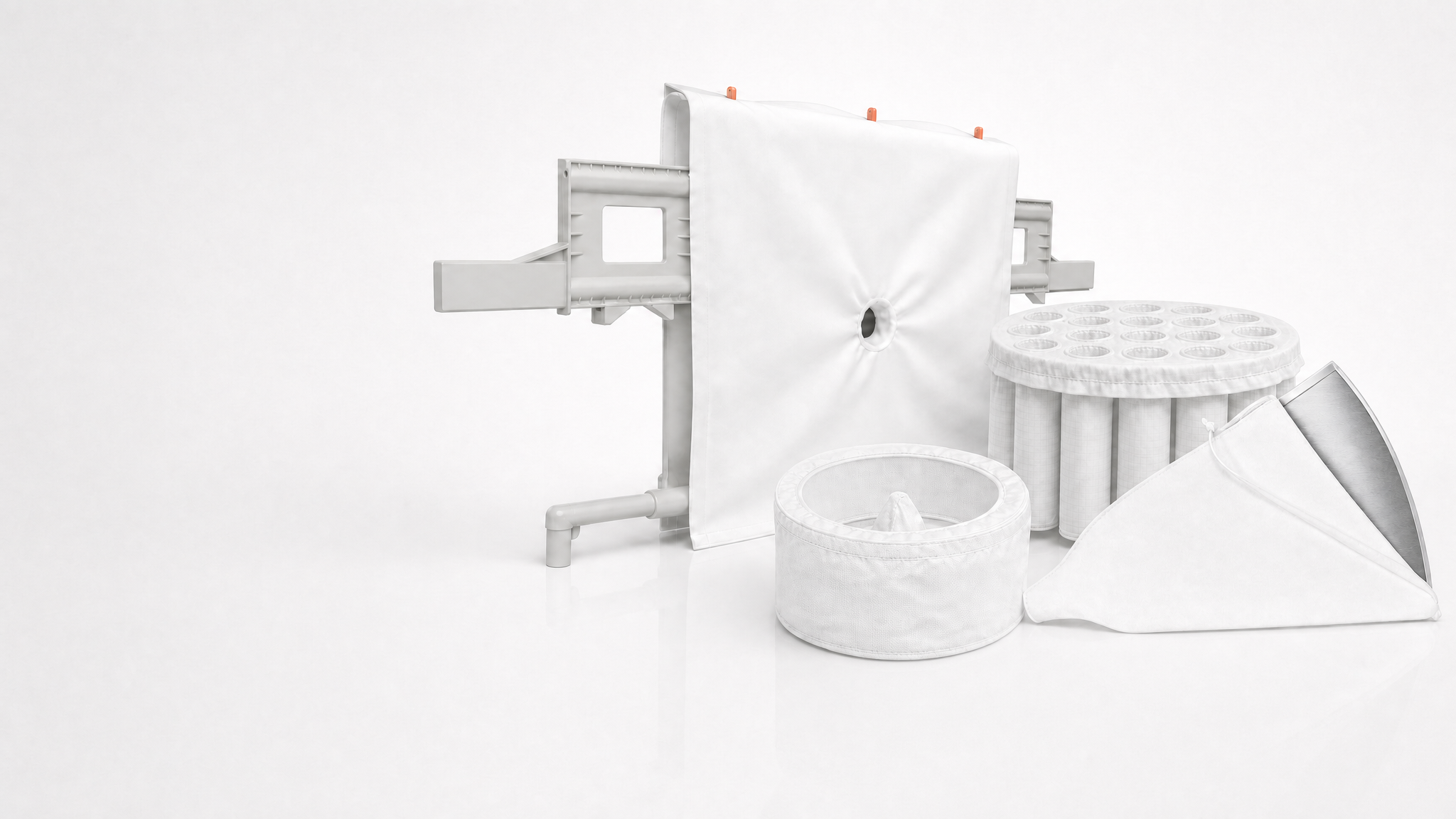
When a filter cake clings too tightly, moisture stays higher than it should, or the process product is too valuable to risk contamination, surface-treated filter fabrics can make the difference between stable operation and constant intervention. In daily plant operation, PTFE dip coating and ePTFE membrane lamination are two different tools for solving different separation problems. The right choice depends on your machine, slurry behavior, cleaning strategy, and the balance between performance gain and fabric cost.
🔑 Key Takeaways
- PTFE dip coating improves anti-stick behavior and chemical resistance with moderate cost impact.
- ePTFE membrane lamination creates a true surface filtration layer for cleaner cakes and lower residual moisture.
- Both options can help reduce cake-release problems, but they are not equally robust mechanically.
- The best choice depends on product value, cleaning frequency, temperature, and whether you need release or surface filtration.
💡 Tip: If your current fabric works mechanically but the cake still sticks, a surface treatment is often the fastest upgrade before changing the whole filter media construction.
⚙️ What PTFE Surface Treatments Actually Do
PTFE is valued in filtration because it is chemically inert, has a very low surface energy, and resists wetting by many aggressive process media. On filter fabrics, that can be used in two ways: as a PTFE dip coating applied to the fabric surface, or as an ePTFE membrane laminate bonded onto a support textile. Both are designed to reduce adhesion, but they behave differently in operation.
PTFE dip coating
A dip-coated fabric receives a thin PTFE-based treatment on the yarn surface. The goal is usually anti-stick performance: less adherence, easier cake discharge, and less build-up in the fabric pores. This is often a practical choice when you want to improve release without moving to a full membrane laminate.
ePTFE membrane lamination
With membrane lamination, a microporous expanded PTFE layer sits on top of the support fabric. Instead of relying mainly on deep filtration, the filter cake builds on the membrane surface. The result is more consistent cake release, better solids retention at the surface, and often lower moisture content after dewatering.
For operators running a RF-FF Series filter press fabric or a RF-BF Series belt filter fabric, this distinction is critical: dip coating helps release, while membrane lamination can actively change the filtration mechanism.
🔬 When to Choose Dip Coating vs. Membrane Lamination
| Criteria | PTFE Dip Coating | ePTFE Membrane Lamination |
|---|---|---|
| Cake release | Good | Very good to excellent |
| Surface filtration | Limited | Strong |
| Moisture reduction | Moderate | High potential |
| Mechanical durability | Usually better | More sensitive to abrasion and handling |
| Cost | Lower | Higher |
As a rule, if your main pain point is cloth clogging or poor release, start by assessing dip coating. If you need a visible process change in cake quality, filtrate clarity, or downstream drying load, membrane lamination is often the better technical answer.
Rule of thumb: Choose dip coating for release; choose membrane lamination for surface filtration.
🏭 Typical Applications: Wax, Pharma, and Food
Surface-treated fabrics are especially useful when product handling matters as much as separation efficiency. In wax filtration, sticky solids can bridge pores and smear across the cloth. A PTFE-coated surface helps prevent sticking and can reduce manual cleaning.
In pharmaceutical and fine chemical processing, the goal is often cleaner discharge and lower risk of carryover. On a Nutsche filter, for example, a membrane-laminated fabric can support more controlled cake formation and cleaner discharge, especially on high-value batches. R+F offers suitable solutions such as the RF-NF Series needle felt and the RF-ANF Series Nutsche pharma fabrics for these demanding environments.
For food applications, the priority is frequently non-contaminating contact behavior and easy cleaning. Here, PTFE-treated media can help reduce product hold-up and avoid unwanted residues. If you operate a pressure leaf filter or sparkler filter, the right surface finish can make batch changeovers more predictable.
- Wax filtration: anti-stick behavior and easier discharge.
- Pharmaceutical: cleaner release and reduced cross-contamination risk.
- Food: smoother cleaning and less product retention.
⚠️ Caution: Do not assume that a PTFE surface treatment is automatically suitable for every chemical, temperature, or cleaning regime. Always verify compatibility with the actual process media, solvents, CIP chemicals, and operating temperature.
🛠️ Practical Limits: Temperature, Chemistry, and Durability
PTFE is highly resistant, but no surface treatment is universal. Temperature, flexing, particle sharpness, and cleaning frequency all affect service life. In a mechanically aggressive process, a membrane laminate can be exposed at the edges or wear faster if the supporting fabric is not correctly selected. On the other hand, a coated fabric may survive rougher handling better, but it will not deliver the same surface-filtration effect.
📋 Pre-selection checklist for operators
- What is the dominant problem: sticking, fines passage, or moisture?
- How often is the cloth cleaned in place or removed for washing?
- Does the process involve sharp crystals, abrasive solids, or high flex cycles?
- Are there temperature spikes, solvents, or aggressive cleaners?
- Is the machine a filter press, belt filter, centrifuge, or vacuum system?
If your process runs on a centrifuge or a fluid bed dryer, the same logic applies differently: surface treatment can help with discharge and cleanability, but the fabric must still withstand the mechanical and thermal loading of the machine.
Confirm whether the issue is cake release, moisture content, contamination risk, or filter cloth clogging.
Use PTFE coating for anti-stick performance and membrane lamination for true surface filtration.
Confirm compatibility with your machine type, support structure, and cleaning method before ordering.
📊 Cost-Benefit: Untreated vs. Treated Fabrics
Untreated fabrics are typically the lowest-cost option upfront, but they can become expensive when they increase downtime, cleaning labor, or product loss. PTFE treatments should be evaluated against those hidden costs, not just purchase price.
For many operators, a coated or laminated fabric pays back through fewer interventions, more stable discharge, and less moisture carried into the next process step. That is especially relevant when filter cloth changeouts are labor-intensive or when downtime interrupts upstream production.
R+F FilterElements supplies both PTFE dip-coated and ePTFE membrane-laminated solutions for industrial solid-liquid separation. If your current setup already works structurally but struggles with release, upgrading the fabric surface may be the most efficient next step. To explore suitable options by machine type, you can also find and configure the right filter fabric with our Solution Finder and receive a pre-filled, non-binding inquiry.
📩 Need Help Choosing the Right Fabric?
Our technical team at R+F FilterElements can help you find the perfect filter fabric for your specific application. Get in touch for a free consultation — we will recommend the right solution based on your machine, process, and operating conditions.
If you want a faster starting point, use our Solution Finder to select your machine and configure the right filter fabric online. You’ll receive a pre-filled, non-binding specification that makes the inquiry process much easier.