
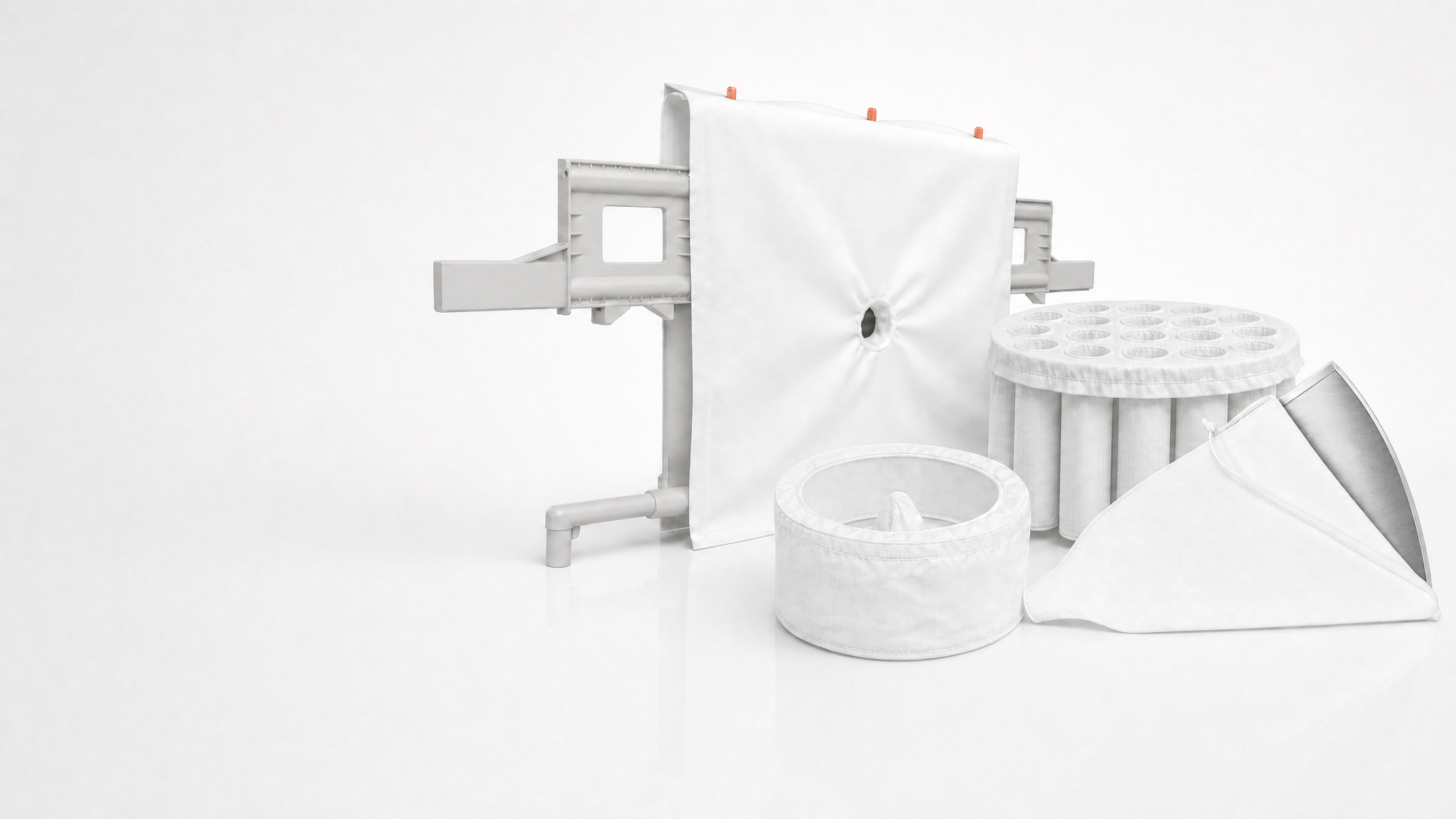
Pan filters and tipping pan filters look simple from the outside, but in operation they put very specific demands on the cloth. In mining and chemical processing, the right fabric must balance drainage, cake release, abrasion resistance, and resistance to fine particle blinding. Choosing the wrong cloth often means longer cycle times, wetter cake, and unnecessary cleaning downtime.
🔑 Key Takeaways
- Pan-type vacuum filters need cloths with strong drainage and stable support under repeated vacuum loading.
- For abrasive mining slurries, wear resistance and seam quality are just as important as permeability.
- In chemical processing, chemical compatibility and low contamination risk can outweigh maximum open area.
- The fastest way to narrow down options is to compare process data and use the configure your vacuum / drum filter filter fabric online tool.
🏭 What Pan Filters Ask of the Cloth
Pan filters and tipping pan filters are used when you need continuous or semi-continuous vacuum filtration with a stable, rotating or indexing filter surface. In practice, that means the cloth must perform under repeated wetting, suction, cake discharge, and sometimes mechanical tipping or scraping. If the fabric is too open, fine solids pass through; if it is too tight, drainage suffers and vacuum energy is wasted.
From an operator’s point of view, the cloth has to do four jobs at once: retain fines, drain quickly, release cake reliably, and survive the slurry. That is why pan filters often need a different cloth construction than a standard filter press or belt filter. For other vacuum applications, it is worth comparing with the fabric logic used on our vacuum filter machines and related solutions like RF-RD Series rotary disc filter fabrics.
🔬 Fabric Properties That Matter Most
1) Permeability and cake formation
Pan filters usually run best when the cloth allows fast filtrate flow without losing particle retention. In mining, where feed solids can vary from shift to shift, a balanced weave or engineered monofilament surface often performs better than a very open fabric that blinds quickly.
2) Surface release behavior
Good cake release is essential on tipping pans. If the cake hangs up, the tipping action becomes less effective and solids carry over into the next cycle. This is where surface finish, yarn construction, and cloth tension matter. If cake release is already a problem on your line, review our guidance on cake release problems.
3) Mechanical strength and seam quality
Pan filters see repeated loading at edges, clamps, and support points. The cloth must withstand flexing and localized stress without tearing. Poor stitching or weak seam execution can also create contamination paths, especially in fine chemicals. If this is a recurring issue, see contamination from stitching.
4) Chemical and thermal resistance
In chemical processing, compatibility with acids, alkalis, solvents, and temperature spikes can be decisive. A cloth that works well in ore beneficiation may fail quickly in aggressive media. When you are selecting fabric for chemical duty, it can help to compare the operating environment with the demands found in chemical industry applications.
| Operating condition | Preferred cloth traits | Operator priority |
|---|---|---|
| Abrasive mining slurry | High abrasion resistance, stable weave, durable edges | Long service life |
| Fine chemical slurry | Low contamination risk, controlled permeability, chemical resistance | Product purity |
| Fast-cycling tipping pan filter | Excellent drainage, reliable cake release, dimensional stability | Throughput |
| Variable feed solids | Balanced retention and open area, low blinding tendency | Process stability |
🛠️ Choosing Between Faster Drainage and Longer Life
In real operation, the “best” cloth depends on what hurts you most: poor filtrate rate, short cloth life, or sticky cake discharge. For many mines, a slightly more open fabric pays off because it keeps vacuum performance stable. In chemical production, a tighter, cleaner cloth may be worth the trade-off if it protects product quality and reduces contamination risk.
⚠️ Caution: Do not choose cloth solely by mesh openness. On pan filters, a fabric that drains well on day one can still fail early if it cannot handle abrasion, edge loading, or chemical attack.
Rule of thumb: If the cake is sticky, optimize surface release first; if the filtrate is slow, optimize permeability first; if both are acceptable, prioritize service life.
📋 Practical Selection Checklist for Operators
📋 Before you specify a pan filter cloth
- Record particle size distribution and % fines
- Note slurry chemistry, pH, and temperature range
- Check whether the discharge is tipping, scraping, or vacuum-assisted
- Measure current cycle time, cake moisture, and filtrate clarity
- Inspect existing cloth for wear pattern, seam damage, and blinding
- Confirm whether your issue is uptime, purity, or cake release
Use current operating values, not design values, especially if the slurry varies by ore body or reaction batch.
Slow drainage, short life, or cake carryover each point to a different fabric construction.
For pan filters, weak seams can become the first point of failure even when the fabric itself is suitable.
🧪 Product Paths and Online Specification Support
If you are comparing pan filter cloths with other vacuum fabric solutions, the right reference point can be helpful. For abrasive duty and stronger mechanical demand, many plants also look at RF-FF Series filter press fabrics and RF-BF Series belt filter fabrics to understand how weave structure and edge design affect lifespan. For fine filtration in closed systems, RF-PLF Series pressure leaf filter fabrics can offer a useful comparison.
When you want a fast starting point, you can configure your vacuum / drum filter filter fabric online. The configurator helps you define the operating conditions and receives a pre-filled, non-binding specification and inquiry — useful when you need to move quickly from problem diagnosis to a concrete fabric proposal.
For mining operators, it is also worth reviewing the broader context at mining applications, especially if your slurry is abrasive or the solids distribution changes seasonally. If you are seeing repeated cloth fouling, you may also want to compare against our guidance on filter cloth clogging and short filter lifespan.
✅ Final Operator Takeaway
The right cloth for a pan filter or tipping pan filter is rarely the one with the highest open area. It is the one that keeps vacuum performance steady, releases cake cleanly, and survives the actual slurry you run every day. In mining and chemical service alike, that usually means balancing permeability, chemical resistance, seam quality, and wear behavior instead of optimizing just one value.
If your pan filter is underperforming, start with the process data, inspect the cloth wear pattern, and compare your options carefully before the next shutdown. Small changes in fabric construction can make a noticeable difference in throughput, moisture, and uptime.
📩 Need Help Choosing the Right Fabric?
Our technical team at R+F FilterElements can help you find the perfect filter fabric for your specific application. Get in touch for a free consultation — we will recommend the right solution based on your machine, process, and operating conditions.
Prefer a quick digital starting point? configure your vacuum / drum filter filter fabric online and receive a pre-filled, non-binding specification request in just a few steps.