
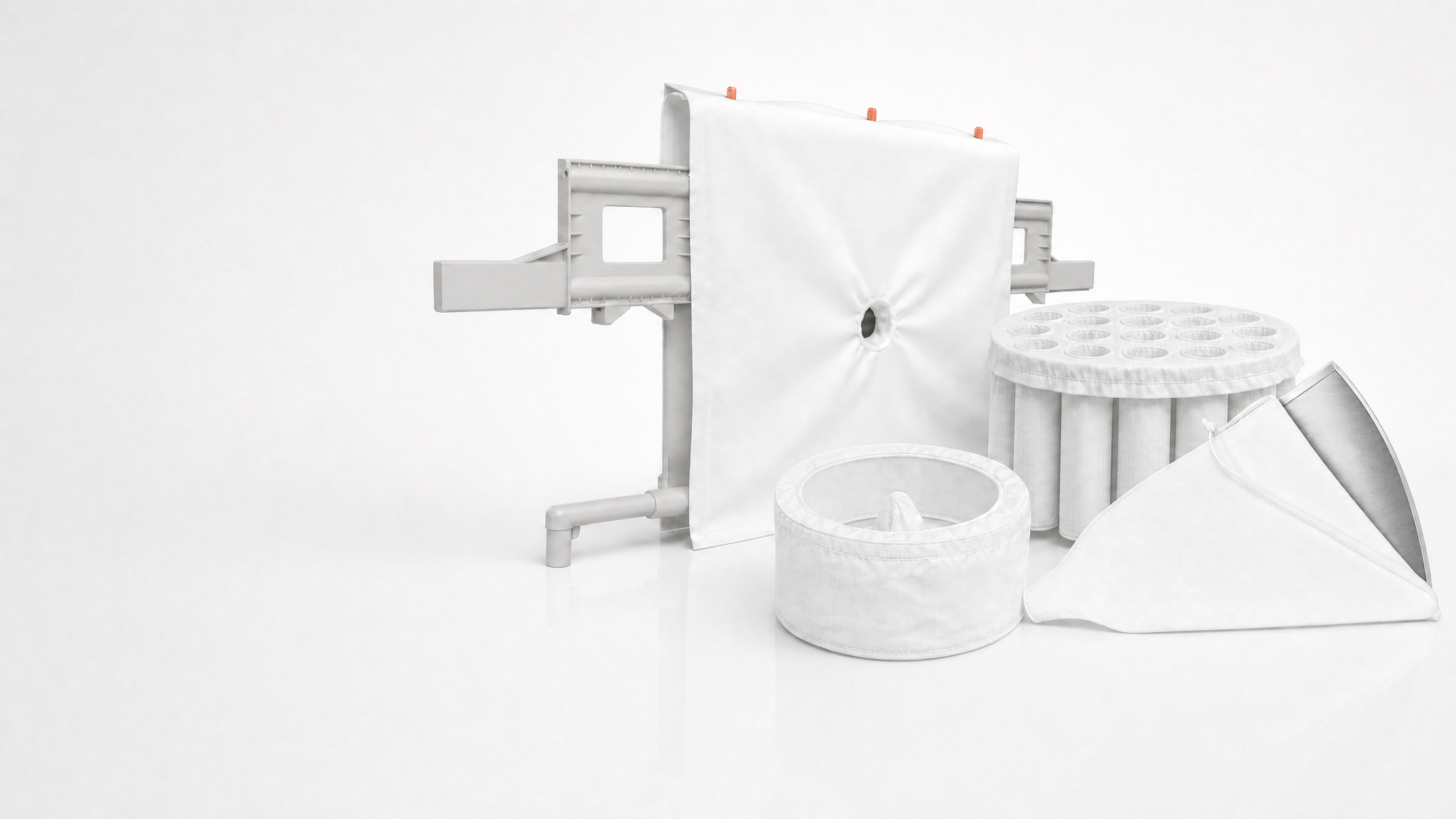
Table vacuum filters are built for one thing: moving a lot of liquid out of a slurry fast, consistently, and with a cake that can actually be handled downstream. For operators, fabric choice decides whether the vacuum zone drains cleanly or whether blinding, leakage, and poor cake release start eating into capacity. If you run a horizontal vacuum belt or table filter, the right cloth is not just a spare part — it is part of the separation process.
🔑 Key Takeaways
- Choose fabric permeability to match slurry fines, vacuum level, and required drainage rate.
- Large-area dewatering needs stable support, low blinding, and reliable cake release.
- Fabric construction must fit the machine geometry and sealing points to avoid drip leakage.
- Use the configure your vacuum / drum filter filter fabric online tool to generate a non-binding specification for your process.
🏭 How Table Vacuum Filters Work in Daily Operation
Horizontal vacuum belt and table filters are used when you need continuous dewatering over a large filter area. Vacuum pulls liquid through the fabric, solids build into a cake, and the drainage pattern depends heavily on fabric structure, yarn selection, and finishing.
For operators in mining, wastewater, and chemical industry plants, the fabric must balance three things at once: high flow, cake support, and long service life. If the cloth drains too slowly, throughput drops. If it drains too openly, fine solids can pass through or seal the structure too early.
💡 Tip: On table filters, a fabric that looks “open” on day one can still fail if it blinds quickly. Always evaluate drainage stability over time, not only initial permeability.
🔬 Selecting the Right Fabric Construction
Fabric choice for vacuum table filters starts with the slurry. Fine particles, compressibility, chemistry, temperature, and washing behavior all influence the best weave or structure. In practice, operators often need a fabric that drains aggressively at the inlet zone but still releases a reasonably dry cake at discharge.
What matters most
- Permeability: Enough air and liquid passage for fast dewatering, but not so open that fines migrate.
- Surface finish: Helps reduce cake adhesion and supports cleaner discharge.
- Dimensional stability: Important on wide table filters with long tracking paths.
- Chemical resistance: Essential for aggressive process liquors and cleaning cycles.
- Temperature tolerance: Critical where hot slurries or wash fluids are used.
For many plants, the best starting point is to compare a fabric designed for vacuum drainage against fabrics used in related equipment such as RF-BF Series belt filter fabrics and RF-FF Series filter press fabrics. Even though the machines are different, these product families help illustrate how pore structure, support, and release behavior change with duty.
| Selection Factor | What the Operator Needs | Typical Risk if Wrong |
|---|---|---|
| Permeability | Fast drainage without losing fines | Slow cycle or solids carryover |
| Surface release | Clean cake drop at discharge | Carryback, plugging, extra washing |
| Stability | Even tension and width control | Tracking issues and uneven wear |
| Chemical resistance | Compatibility with slurry and cleaning agents | Premature fabric failure |
🛠️ Avoid the Most Common Operational Problems
Most table filter complaints show up as the same few symptoms: slow drainage, wet cake, edge wear, and inconsistent discharge. These issues are often fabric-related, even when they first appear to be process problems.
⚠️ Caution: A fabric that is too fine for the slurry can blind quickly and cut vacuum efficiency. This often shows up as rising cycle time, unstable cake moisture, and more frequent washdowns.
Typical failure patterns and what they mean
- Filter cloth clogging usually points to solids that are too fine, too sticky, or poorly washed out.
- Cake release problems often indicate an unsuitable surface or a fabric that holds moisture too long.
- Drip leakage can result from poor edge sealing, incorrect dimensions, or worn cloth installation.
- Short filter lifespan may be caused by chemical attack, abrasion, or excessive mechanical loading.
Rule of thumb: If the filter needs frequent washdowns to recover performance, the cloth is probably too fine, too open to blinding, or both.
📋 A Practical Selection Checklist for Operators
Before ordering a new fabric, make sure the process data is complete. The more accurately you describe the slurry and machine, the better the fabric recommendation will be.
📋 Vacuum Table Filter Fabric Checklist
- Machine type and belt/table width
- Slurry solids content and particle size distribution
- Required cake moisture at discharge
- Vacuum level and drainage zone length
- Process temperature and cleaning chemicals
- Edge sealing and tracking requirements
- Need for antistatic or ATEX-safe operation where applicable
If you want to speed up specification work, you can configure your vacuum / drum filter filter fabric online and receive a pre-filled, non-binding inquiry with the key parameters already organized for your process.
✅ Fabric Choice by Operating Priority
Not every plant wants the same outcome. Some prioritize maximum throughput, others want the driest possible cake, and many need a balance between both. The right choice depends on what hurts production most.
When to think beyond the table filter
If your process uses additional solid-liquid separation stages, fabric selection should be aligned across equipment. For example, downstream solids handling may benefit from related fabrics such as RF-PLF Series pressure leaf filter fabrics or RF-RD Series rotary disc filter fabrics when the process chain includes multiple vacuum or pressure steps.
For operations with strict electrostatic or safety requirements, review the related antistatic and ATEX considerations before finalizing material and construction.
🔧 Final Operator Takeaway
In high-capacity dewatering, the fabric is not just a wear part — it controls how efficiently the vacuum table actually works. The best fabric is the one that drains fast, releases cleanly, stays dimensionally stable, and survives your cleaning and chemistry without constant intervention.
For table vacuum filters, start with the slurry, then work backward to permeability, structure, and sealing behavior. That approach will usually deliver better uptime than choosing by fabric type alone.
To streamline your next project, use our online tool to configure your vacuum / drum filter filter fabric online and send a pre-filled, non-binding specification request to the R+F technical team.
📩 Need Help Choosing the Right Fabric?
Our technical team at R+F FilterElements can help you find the perfect filter fabric for your specific application. Get in touch for a free consultation — we will recommend the right solution based on your machine, process, and operating conditions.