Gelatin clarification is a temperature-sensitive step that can make or break final product clarity, filtration speed, and yield. In a typical bone or hide gelatin line, the operator must keep the solution hot enough to stay fully liquid while removing fine solids, fibers, and trace haze-forming particles before polishing.
For pressure leaf and sparkler systems, the right filter cloth is just as important as the machine itself. The fabric must tolerate hot gelatin solutions, support precoat filtration with diatomaceous earth, and clean reliably so you can maintain stable throughput from batch to batch.
🔑 Key Takeaways
- Gelatin must be filtered hot, typically around 50–70°C, because it sets below 35°C.
- Food-grade, temperature-resistant woven fabrics are preferred for pressure leaf filters and sparkler filters.
- Fine retention and good cake release are essential for clarification and polishing.
- Precoat filtration with diatomaceous earth can improve clarity and protect the cloth.
💡 Tip: If your gelatin starts cooling in the filter loop, viscosity rises fast and the cloth blinds more easily. Keep transfer lines, filter housing, and discharge paths warm from the start.
⚙️ How Gelatin Filtration Works in Production
In gelatin production, raw material from bone or hide processing is first extracted into a hot solution. That solution still carries insoluble residues, fine proteins, and occasional mineral particles. The filtration stage usually follows extraction and concentration, with two goals: clarification and polishing.
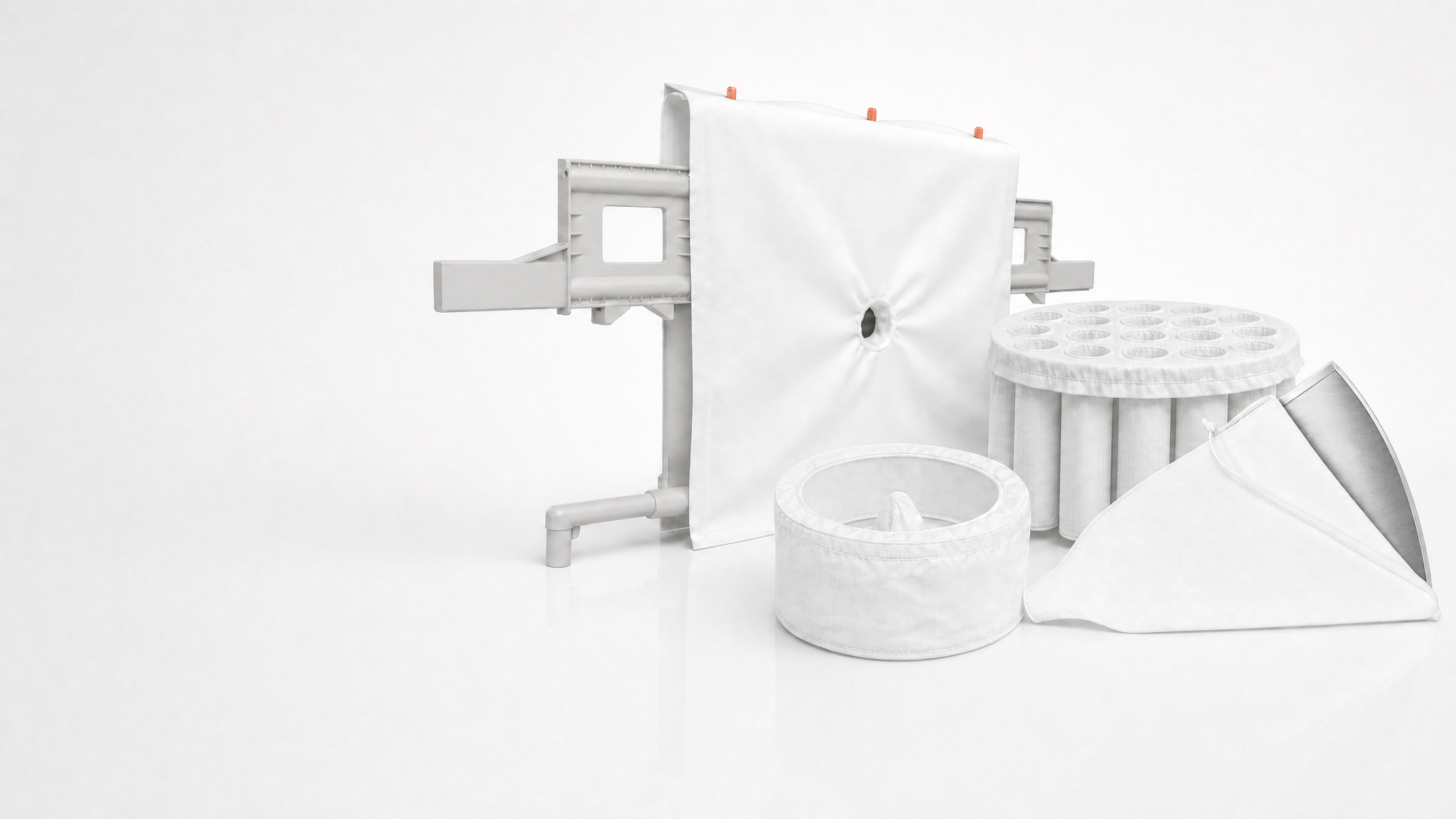
At this point, the operator is not trying to build a thick cake the way you would on a filter press. Instead, you want stable surface filtration, consistent flow, and very fine retention. That is why many plants rely on pressure leaf filters and sparkler filters, often using the RF-PLF Series pressure leaf filter fabrics or RF-SP Series sparkler filter fabrics.
🔬 Fabric Requirements for Hot Gelatin Solutions
Hot gelatin behaves differently from many industrial slurries: it is viscous, sensitive to temperature drop, and often processed to very high clarity standards. The filter cloth must therefore combine fine particle retention with easy cleaning and reliable dimensional stability.
What the operator should look for
- Food-grade construction suitable for sensitive process streams
- Temperature resistance for continuous hot filtration
- Fine, uniform weave for polishing clarity
- Low tendency to blind when used with precoat
- Good cake release during shutdown or cloth washing
For many plants, woven filter fabrics outperform heavier structures because they provide a smooth filtration surface and are easy to regenerate. If you are comparing fabric concepts for other process duties too, our product families for RF-FF Series filter press fabrics and RF-NF Series needle felt fabrics can help you identify the right construction for different solid-liquid separation tasks. For gelatin, however, woven cloths on leaf and sparkler systems are usually the first choice.
| Selection factor | Why it matters in gelatin filtration | Operator priority |
|---|---|---|
| Temperature resistance | Prevents premature setting and flow loss | Very high |
| Fine retention | Improves clarity and reduces haze | Very high |
| Cake release | Makes cleaning and batch turnaround easier | High |
| Cleanability | Supports repeatable performance across batches | Very high |
Rule of thumb: If the gelatin cloud point is approaching, do not “wait and see” — increase temperature control first, then assess cloth porosity and precoat performance.
🛠️ Precoat Filtration with Diatomaceous Earth
In clarification and polishing, many operators use a diatomaceous earth precoat on woven cloths. The precoat forms the true filtering layer, while the cloth acts as the support medium. This is especially useful in pressure leaf filters where the medium must keep fine haze-forming particles out of the final gelatin stream.
Install a clean, food-grade woven cloth and verify tension, sealing, and support condition.
Circulate diatomaceous earth until the leaves are evenly coated and flow stabilizes.
Maintain temperature and pressure so the precoat remains open and effective.
Watch clarity, differential pressure, and throughput; refresh the precoat before breakthrough.
📋 Precoat setup checklist
- Cloth is fully seated and free from old residue
- Process temperature is stable before feeding gelatin
- Diatomaceous earth dosage is consistent
- Differential pressure is monitored during operation
- Cleaning cycle restores cloth permeability between batches
📊 Pressure Leaf Filter vs. Sparkler Filter
Both machine types are common in gelatin plants, but they are not identical in operation. The best cloth choice depends on your batch size, required clarity, and cleaning routine. For many operators, the practical decision is between pressure leaf filter systems and sparkler filter systems fitted with purpose-matched woven fabrics.
For both systems, R+F positions the RF-PLF Series as a practical fit for pressure leaf applications and the RF-SP Series for sparkler filtration. These fabric series are designed to support fine retention, reliable cake handling, and repeated cleaning in food-processing environments.
✅ Common Operating Problems and How to Avoid Them
Most gelatin filtration issues come down to temperature loss, cloth selection, or poor precoat management. If your cloth starts clogging early, review the full filtration path and compare your symptoms with common process issues such as filter-cloth clogging and short filter lifespan.
⚠️ Caution: Do not let gelatin cool inside the filter, hoses, or discharge lines. Once the product starts to gel, cleaning becomes harder and you can lose both yield and clarity.
- Clogging: Usually caused by insufficient precoat control or overly fine solids loading.
- Poor clarity: Often linked to damaged cloth, incorrect pore structure, or incomplete precoat formation.
- Drip leakage: Check sealing surfaces, cloth fit, and housing closure integrity.
- Short cloth life: May result from aggressive cleaning, thermal stress, or incompatible media.
If you are expanding beyond gelatin into other temperature-sensitive or hygienic duties, you can also review our machine-specific solutions for Nutsche filters and fluid bed dryers for adjacent process steps. For operators managing broader filtration portfolios, our application guides for chemical industry filtration and pharmaceutical filtration may also be helpful.
🔧 Choosing the Right Fabric with R+F
The right cloth for gelatin depends on your machine, batch frequency, cleaning method, and desired clarity. If you need a quick way to match the machine to the correct fabric specification, you can find and configure the right filter fabric with our Solution Finder and receive a pre-filled, non-binding inquiry for review by our technical team.
For gelatin clarification and polishing, R+F focuses on food-grade compatible woven solutions that support hot filtration, precoat use, and repeatable cleaning. That makes the RF-PLF and RF-SP families a strong starting point for operators who need stable performance without sacrificing product purity.
📩 Need Help Choosing the Right Fabric?
Our technical team at R+F FilterElements can help you find the perfect filter fabric for your specific application. Get in touch for a free consultation — we will recommend the right solution based on your machine, process, and operating conditions.
Prefer to get started online? Use our Solution Finder to find and configure the right filter fabric for your gelatin filter and send a pre-filled, non-binding request in just a few steps.