
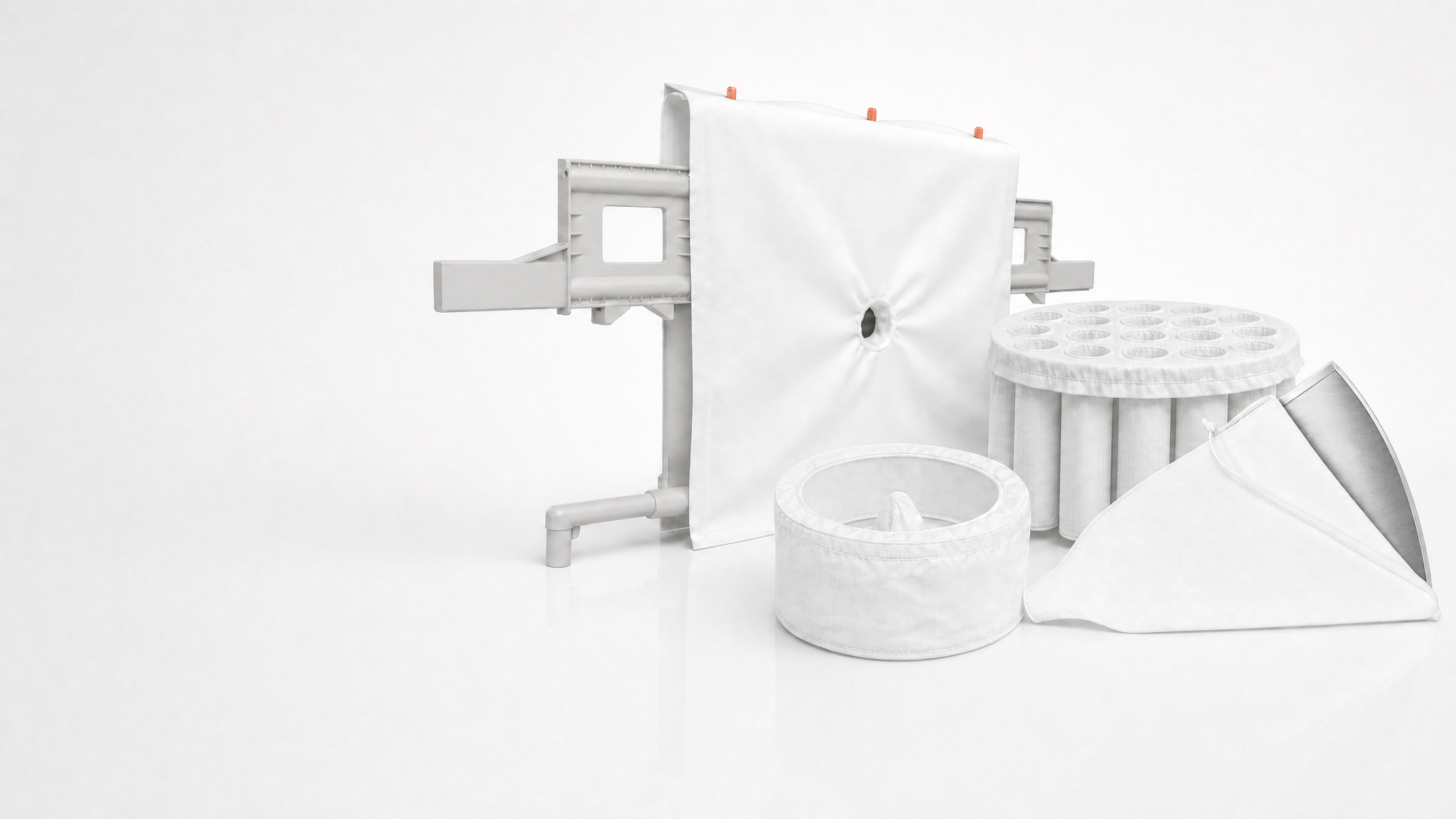
Wax filtration is one of those operations where everything depends on temperature, cloth design, and cake behavior. If the wax cools too early, paraffin, slack wax, or petroleum wax will start to solidify on the media, which quickly turns a stable separation step into a blinding and cake-release problem. For operators, the goal is simple: keep the product molten long enough to filter cleanly, then release it without leaving costly residue behind.
🔑 Key Takeaways
- Wax filtration usually needs 60–120°C to keep the product molten during separation.
- PET is a common choice for high-temperature filter cloths; PEEK is used for more demanding thermal cases.
- Typical machines include filter presses, pressure leaf filters, and sparkler filters.
- R+F optimises wax filtration filter cloth construction to reduce blinding, improve release, and extend service life.
💡 Tip: In wax service, the cloth is not just a separator — it is also a thermal interface. The right high temperature filtration textile helps keep viscosity low enough for throughput while avoiding premature solidification in the cake and pores.
🏭 Why wax filtration is so temperature-sensitive
Paraffin wax, slack wax, petroleum wax, and microcrystalline wax all behave differently, but they share one operating truth: once the temperature drops below the process window, viscosity rises sharply and flow collapses. That is why wax plants often run filtration in the 60–120°C range, depending on the product grade and upstream refining step.
In refinery and specialty wax service, the filtration stage may follow melting, de-oiling, or fractionation. For slack wax de-oiling, the separator must remove entrained oil without letting the wax phase set up in the medium. If the cloth cools too much at the frame, valve, or outlet zones, you get partial solidification, higher differential pressure, and a much harder cake to discharge.
🔬 Choosing the right fabric material for molten wax
The best paraffin wax filter fabric depends on the temperature profile, chemical exposure, and the type of filter machine. In many wax applications, PET is the workhorse material because it offers strong thermal resistance and stable dimensional behavior. In practice, PET-based constructions can withstand up to 150°C, which covers many wax filtration duties when the process is controlled correctly.
For more extreme hot zones or highly demanding operating windows, PEEK may be the preferred option. PEEK provides additional thermal margin where heat soak, long cycles, or aggressive cleaning conditions push standard materials too far. The key is not simply choosing the “highest temperature” fiber, but matching the fiber to the actual machine duty, residence time, and cake behavior.
⚙️ Machines used in wax filtration
Wax plants typically use closed, heated separation equipment to preserve melt conditions and to control product quality. The most common choices are filter presses, pressure leaf filters, and sparkler filters. Depending on throughput and wax type, operators may also encounter other systems where drainage, heating, and cake release requirements are equally important.
| Machine type | Typical wax duty | Main operator focus | Fabric priority |
|---|---|---|---|
| Filter press | Paraffin and slack wax polishing | Pressure stability and cake release | Open structure, thermal stability |
| Pressure leaf filter | Refinery wax clarification | Low blinding, easy discharge | Uniform permeability, clean release |
| Sparkler filter | Fine wax filtration | Fine retention and low leakage | Precise weave and seam integrity |
For operators running a filter press, the cloth has to tolerate pressure pulses and repeated hot wash cycles. On pressure leaf units, the fabric must stay open enough to preserve flow across the leaves while still trapping fine solids. In sparkler systems, the challenge shifts toward fine retention and leak-tight construction, especially when wax clarity is critical.
🛠️ Main challenges: solidification, blinding, and cake release
Wax service is tough on filtration media because the product is never static. As soon as local temperatures fall at the cloth surface or along the frame edges, wax begins to deposit. That can trigger pore narrowing, fast blinding, and uneven pressure drop across the element.
- Wax solidification on the cloth: cold spots create hard deposits that are difficult to re-melt.
- Blinding: fine wax crystals can block the openings and reduce throughput.
- Poor cake release: sticky or partially set wax cakes tend to cling to the medium.
- Drip leakage: if the fabric or seam design is not precise, molten wax can bypass at edges or stitching points.
⚠️ Caution: Do not let wax cool on the cloth between cycles. Once solidified, wax residue can be difficult to remove and may permanently reduce permeability. If you see repeat blinding, review temperature control, cloth construction, and discharge timing together.
Rule of thumb: If wax cake release gets worse after a few cycles, look first at cold spots, then at cloth openness, and finally at the cleaning and discharge sequence.
🔧 How R+F optimises cloth construction for wax applications
At R+F FilterElements, wax filtration cloths are engineered around the process, not just the machine model. That means selecting the right yarn material, weave, calendering level, seam style, and edge construction for the operating temperature and product consistency. The result is a cloth that keeps flow stable during the hot phase and releases the cake more reliably when the cycle ends.
For wax users, we focus on three practical outcomes: reduced blinding, better cake release, and longer service life. Depending on the duty, we may recommend a tighter or more open weave, reinforced edges, or a construction tuned for hot de-oiling service in refinery environments. If you are evaluating a new setup, you can also find and configure the right filter fabric with our Solution Finder and receive a pre-filled, non-binding specification request online.
📋 Wax cloth selection checklist
- Confirm operating temperature across the full cycle, not just during filtration
- Identify wax type: paraffin, slack wax, petroleum wax, or microcrystalline wax
- Check whether slack wax de-oiling is part of the duty
- Review machine type and cloth support geometry
- Assess cake release and cleaning method after each cycle
- Verify whether PET is sufficient or whether PEEK is required
📋 Practical setup tips for operators
Good wax filtration starts before the first batch. Preheating the equipment, maintaining stable inlet temperature, and avoiding cold metal surfaces near the outlet are often just as important as the cloth itself. On the fabric side, the best results usually come from a combination of thermal stability, controlled permeability, and construction details that help the cake leave cleanly.
Bring the machine and feed lines into the wax operating window before filtration begins.
Select the weave and fiber type for viscosity, retention, and discharge behavior.
Insulate or heat critical areas to avoid wax setting on the cloth or frame.
Track cycle times, pressure rise, and discharge quality to fine-tune the setup.
For related separation duties, operators can also review solutions for chemical industry filtration, where hot-process solids handling is often similar, or compare with filter cloth clogging and cake release issues when diagnosing poor wax performance.
📩 Need Help Choosing the Right Fabric?
Our technical team at R+F FilterElements can help you find the perfect filter fabric for your specific application. Get in touch for a free consultation — we will recommend the right solution based on your machine, process, and operating conditions.
Or use our online tool to find and configure the right filter fabric with our Solution Finder, choose your filtration machine, and receive a pre-filled, non-binding specification and inquiry.