
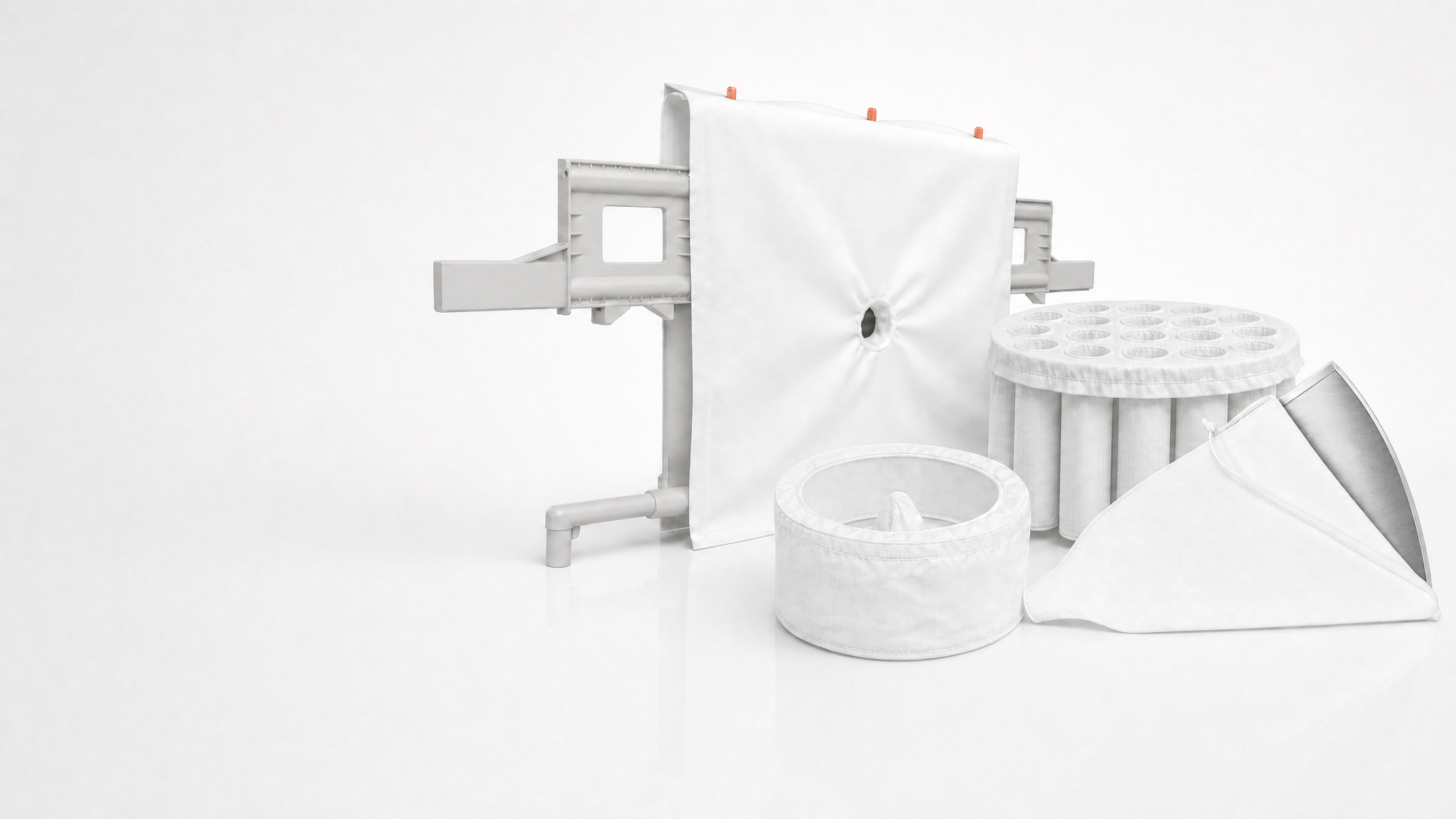
Choosing between woven and non-woven filter media is not just a materials decision — it directly affects throughput, cake release, downtime, and product quality. If you run a filter press, belt filter, centrifuge, or a dryer that needs dust handling, the right fabric technology can make daily operation much easier.
In practice, woven fabrics and needle felt serve different jobs. Woven media are typically the better fit for solid-liquid separation with defined cake formation, while non-woven needle felt is often the go-to for fine dust capture, airflow-driven drying, and hot gas filtration.
🔑 Key Takeaways
- Woven fabrics are usually chosen for filter presses, belt filters, and centrifuges.
- Needle felt is typically used in fluid bed dryers and dust collection where air permeability matters.
- The right media depends on process type, particle size, temperature, and cake release behavior.
- For a fast starting point, use the Solution Finder to find and configure the right filter fabric for your machine.
⚙️ Woven vs. Non-Woven: What Changes in Daily Operation?
As an operator, you feel the difference in the first shift. Woven filter fabrics usually provide a stable structure, predictable filtration behavior, and strong cake release when matched correctly to the process. Needle felt, by contrast, is a thicker, fibrous media that traps fine particles efficiently and tolerates air-based processes very well.
In solid-liquid separation, the fabric is part of the process control. In air filtration or fluidized processes, the media often acts as the main barrier against fines. That is why woven and non-woven cannot simply be swapped without checking the machine and application first.
📋 What to check before choosing media
- Is your process liquid filtration or gas/dust filtration?
- Do you need cake discharge or fine dust retention?
- What are the temperature and chemical conditions?
- Is airflow or pressure drop a limiting factor?
🏭 Where Woven Fabrics Work Best
Woven fabrics are usually the first choice when you need a mechanically stable cloth with controlled permeability and clean cake release. They are widely used in filter press systems, belt filters, centrifuges, and other solid-liquid separation machines.
For example, if you are running a filter press and fighting poor cake release, a woven media with the right surface finish can reduce manual cleaning and short cycle interruptions. If you are working on a belt filter, fabric stability and seam quality also matter because continuous movement puts constant stress on the cloth.
💡 Tip: If your main pain point is cake release, focus on surface structure and fabric construction before changing process settings.
When woven media is the better option
- You need robust fabrics for repeated mechanical loading.
- You are separating solids from liquids in batch or continuous filtration.
- You want predictable dewatering and easy cake release.
- Your machine is a filter press, belt filter, pressure leaf filter, or centrifuge.
🔬 Where Needle Felt Makes More Sense
Needle felt is a non-woven media made from entangled fibers. It is commonly used where fine dust retention, high airflow, and thermal resistance are critical — especially in fluid bed dryers and dust handling systems. If you are selecting media for the RF-NF Series needle felt filter media, you are usually looking at gas-side filtration rather than cake filtration.
In these applications, the goal is different: capture fine particles, protect downstream equipment, and keep pressure drop under control for as long as possible. That is why needle felt often performs better than woven cloth in gas filtration or drying systems.
⚠️ Caution: Do not assume a woven filter cloth will perform well in a dust collection or fluid bed dryer application. Air filtration needs different pore structure, cleaning behavior, and temperature resistance.
Needle felt is also relevant when antistatic performance is needed in explosive atmospheres. If that is part of your operating environment, review antistatic and ATEX requirements early in the selection process.
Rule of thumb: If the process uses air to move, dry, or capture particles, start with needle felt. If the process uses pressure or centrifugal force to separate slurry, start with woven fabric.
📊 Side-by-Side Comparison for Operators
Use the table below as a quick field guide when deciding between both technologies.
| Criterion | Woven Fabric | Needle Felt |
|---|---|---|
| Typical use | Filter press, belt filter, centrifuge | Fluid bed dryer, dust collection |
| Main strength | Cake release, mechanical stability | Fine particle capture, air filtration |
| Process medium | Slurry / liquid-solid separation | Gas / air / dust handling |
| Pressure drop behavior | Generally lower and more process-specific | Can rise with dust loading, needs cleaning |
| Common risk | Poor cake discharge or blinding | Clogging, reduced airflow, leakage if undersized |
🛠️ How to Choose the Right Media in 3 Steps
If you want to avoid trial-and-error, use a structured approach. This also helps when you are discussing the setup with maintenance, production, or process engineering.
Confirm whether you are dealing with filtration, drying, or dust collection. Then match the media to the machine type.
Review temperature, chemical exposure, particle size, and whether cake release or airflow is the main challenge.
Use our Solution Finder to find and configure the right filter fabric and receive a pre-filled, non-binding inquiry.
💡 Tip: If your current fabric fails too early, check short filter lifespan and filter cloth clogging before you replace the machine settings.
✅ Practical Selection Guide for Common Machines
Here is the simplest operator view: use woven fabrics for liquid-solid separation equipment and needle felt for air-handling equipment. That rule covers most real-world cases, but the details still matter.
- Filter press: usually woven cloth for cake formation and release.
- Belt filter: woven media with stable tracking and drainage behavior.
- Centrifuge: woven fabrics designed for mechanical stress and discharge.
- Fluid bed dryer: needle felt for air permeability and particle capture.
- Dust collection: needle felt for fine retention and cleaning performance.
For wet-process industries such as mining, wastewater, and the chemical industry, woven fabrics are often the default starting point. For thermal processing and pneumatic solids handling, needle felt is usually the more practical option.
📩 Need Help Choosing the Right Fabric?
Our technical team at R+F FilterElements can help you find the perfect filter fabric for your specific application. Get in touch for a free consultation — we will recommend the right solution based on your machine, process, and operating conditions.
Prefer a faster starting point? Use our Solution Finder to find and configure the right filter fabric, select your filtration machine, and send a pre-filled, non-binding inquiry in just a few steps.