
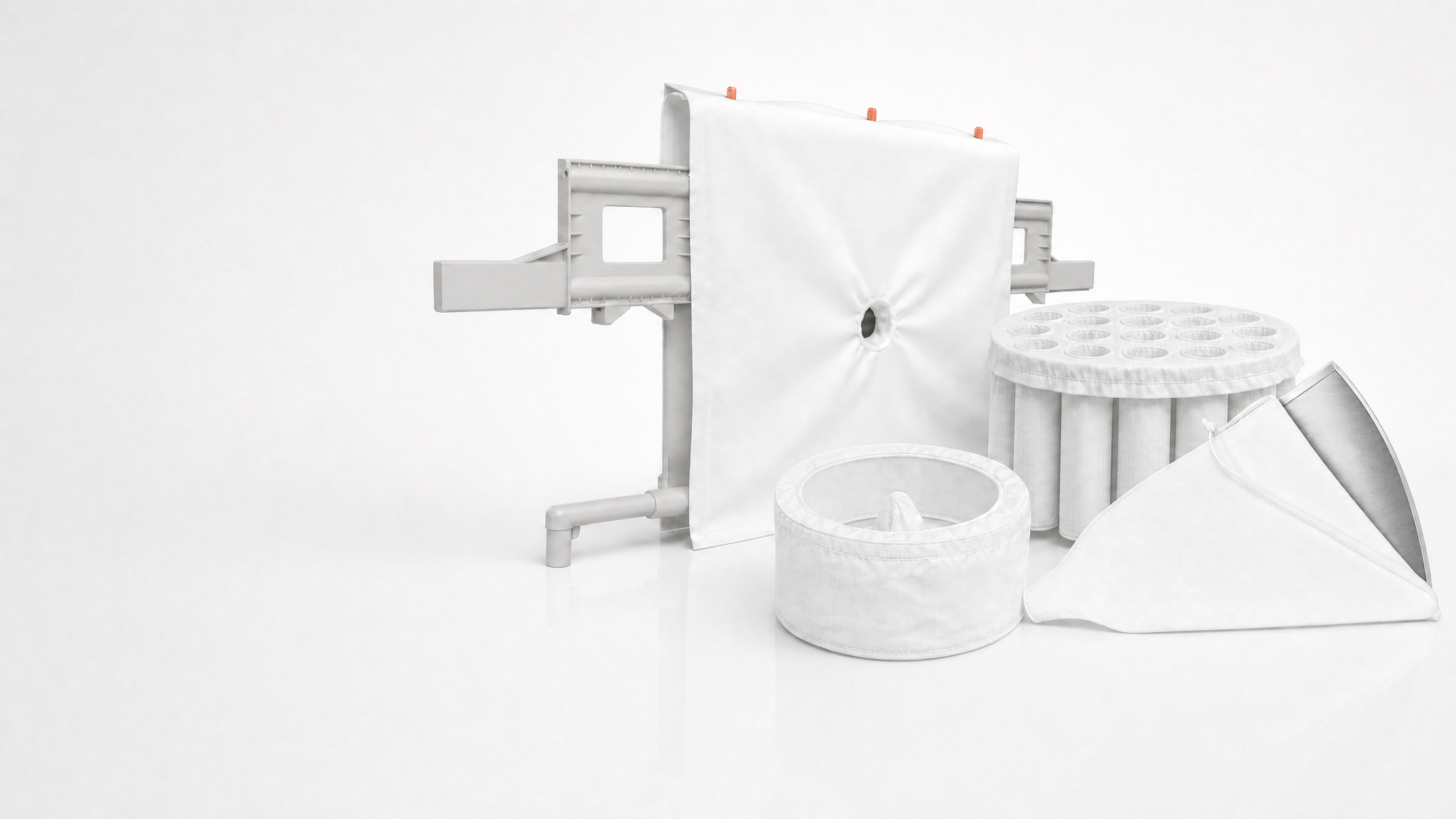
When you read a filter fabric data sheet, the three numbers that matter most in day-to-day operation are usually weight, permeability, and pore size. If you know what these values mean in practice, you can better predict cake release, throughput, cloth life, and whether the fabric will keep your process stable.
For operators running a filter press, centrifuge, or belt filter, these specs are not just catalog data — they are the difference between a smooth shift and recurring problems like cloth clogging or poor cake discharge. If you want a faster way to narrow the options, you can find and configure the right filter fabric with our Solution Finder and receive a pre-filled, non-binding inquiry.
🔑 Key Takeaways
- g/m² tells you how robust and heavy the fabric is, but not automatically how well it filters.
- Permeability shows how easily liquid or air passes through the fabric and strongly affects cycle time.
- Pore size is a practical indicator for retention, but real performance also depends on cake formation.
- The best choice depends on your machine type, slurry, cake release behavior, and cleaning routine.
⚙️ What the Main Spec Numbers Really Mean
On a data sheet, operators often see technical values that look straightforward but can be misunderstood. A higher number is not always better. The right fabric is the one that matches your separation target and your operating conditions.
Weight in g/m²
g/m² describes how much one square meter of fabric weighs. In practice, a higher weight often means a denser, more durable fabric with better abrasion resistance. That can be useful in harsh service such as mining, cement, or aggressive chemical slurries.
Rule of thumb: Higher fabric weight usually supports better mechanical stability, but it does not automatically guarantee finer filtration or lower blinding.
Permeability in cfm/ft²
Permeability indicates how easily air or liquid can pass through the fabric under test conditions. In many data sheets, you will see cfm/ft², which is an air-permeability value. Lower permeability generally means a tighter fabric structure, which can improve retention but may increase pressure drop, reduce flow, and slow drying.
For a RF-FBD Series fluid bed dryer fabric, permeability is especially important because air distribution affects product movement and drying uniformity. On filtration equipment like RF-FF Series filter press fabrics, it can influence filtrate rate, cake formation, and cloth cleaning frequency.
Pore size in microns
Pore size, usually shown in microns (µm), helps estimate what the fabric can retain. Smaller numbers suggest finer retention, but in real operation the cake often becomes the actual filtering layer. That means the slurry solids, particle shape, and operating pressure can matter just as much as the textile rating.
⚠️ Caution: Do not select a fabric based on micron rating alone. A very fine fabric may look ideal on paper, but in the plant it can blind too quickly, increase cycle times, and reduce overall throughput.
📊 How to Read a Data Sheet in Practice
When you compare fabrics, do it in the context of your machine and process. A fabric that works well on a pressure leaf filter may behave differently on a rotary disc filter or Nutsche filter. The same is true when moving between batch and continuous systems.
| Spec | What it tells you | Operational effect |
|---|---|---|
| g/m² | Fabric mass and often mechanical robustness | Influences wear life, handling, and resistance to damage |
| cfm/ft² | How open the fabric structure is | Impacts flow rate, drying speed, and pressure drop |
| µm | Approximate retention capability | Helps estimate fines capture and filtrate clarity |
| Surface finish | How smooth or structured the surface is | Affects cake release and cleaning behavior |
Matching the spec to the machine
- Filter press: Focus on cake release, cloth sealing, and blinding resistance.
- Centrifuge: Prioritize mechanical strength, seam quality, and stable particle retention.
- Belt filter: Balance permeability, drainage, and continuous solids transport.
- Fluid bed dryer: Check air distribution and temperature resistance carefully.
🧪 Choosing Between Higher Retention and Higher Throughput
Operators often face the same trade-off: tighter fabric for clearer filtrate, or more open fabric for faster flow. The right answer depends on whether your bottleneck is solids loss, cycle time, or cloth cleaning frequency.
💡 Tip: If your cloth clogs quickly, the problem may not be “too fine” fabric alone. It can also point to feed chemistry, particle distribution, or insufficient precoat/cake conditioning. See filter cloth clogging for a practical troubleshooting view.
What operators should watch during start-up
Record filtrate clarity, cycle time, differential pressure, and cake release on the first runs.
If flow drops fast, the fabric may be too tight, or the solids may be loading the surface excessively.
Sticky cakes often require a different surface structure or finish to improve release.
🛠️ A Quick Selection Checklist for Operators
Before you approve a fabric change, make sure the specification aligns with the plant reality. The best data sheet is the one that matches your actual slurry, cleaning method, and machine geometry.
📋 Data Sheet Check Before Ordering
- Machine type and filtration mode confirmed
- Target particle size or solids retention understood
- Required permeability range checked
- Temperature, pH, and chemical exposure reviewed
- Cake release and washability considered
- Seam, edge, and fit requirements verified
💡 Tip: For pharma and high-purity processes, surface cleanliness and traceability matter as much as permeability. See our pharmaceutical applications and the RF-ANF Series Nutsche Pharma fabrics for controlled-process requirements.
✅ Bringing the Numbers Together
The easiest way to interpret a data sheet is to read the values as a system, not in isolation. Weight tells you something about robustness, permeability tells you how open the structure is, and pore size gives a clue about retention. Together, they help you estimate whether the fabric will support stable operation or create recurring problems.
If your current setup on a fluid bed dryer, air slide, or filter press is struggling with blinding, poor discharge, or short service life, a specification review is often the fastest place to start. The right fabric choice can improve uptime, reduce maintenance, and make your process easier to control.
For operator-oriented examples across different machine types, you can also review the wastewater, mining, and chemical industry applications pages.
📩 Need Help Choosing the Right Fabric?
Our technical team at R+F FilterElements can help you find the perfect filter fabric for your specific application. Get in touch for a free consultation — we will recommend the right solution based on your machine, process, and operating conditions.
Prefer to start online? find and configure the right filter fabric with our Solution Finder to select your filtration machine and generate a pre-filled, non-binding specification and inquiry.