
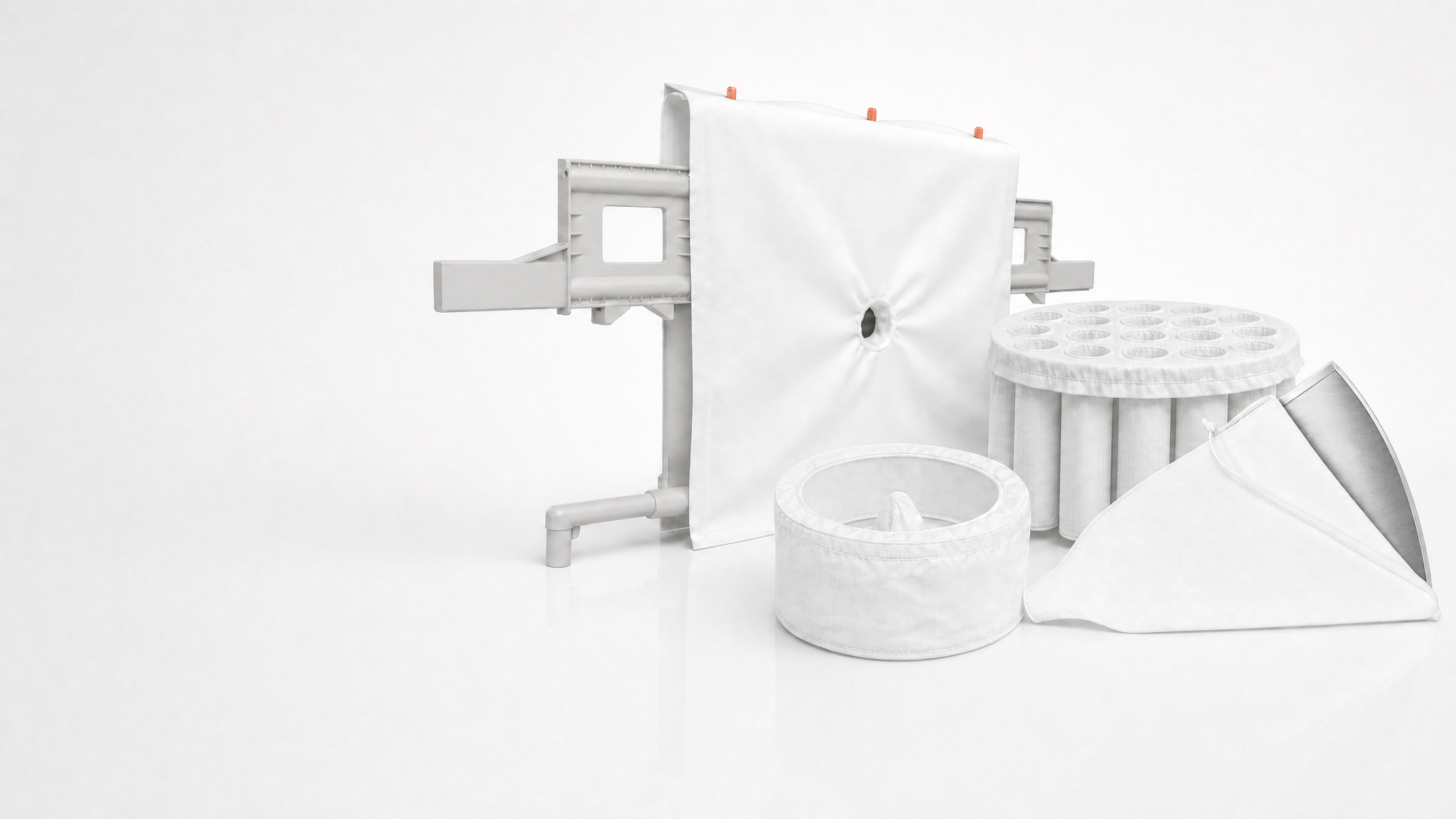
Choosing the right cloth for a rotary vacuum drum filter is a practical decision that shows up immediately in filtration rate, cake release, and maintenance effort. If you run an RVD in mining, wastewater, chemicals, or bulk solids, the wrong fabric can mean wrap instability, scraper wear, and unnecessary downtime.
This guide helps you decide between mono and multi filament constructions, and between PP and PET fabrics, so you can match the cloth to your drum, slurry, and operating window. If you are working on a broader system setup, also see our rotary drum filter machines overview and the related wastewater applications page.
🔑 Key Takeaways
- Mono filament fabrics usually give better cake release and easier cleaning.
- Multi filament fabrics often provide higher particle capture and better fine retention.
- PP is often preferred for chemical resistance and lower density; PET can offer better dimensional stability and temperature resistance.
- For RVDs, drum wrap stability and scraper resistance are just as important as filtration efficiency.
⚙️ What matters most on a rotary vacuum drum filter?
On an RVD, the cloth is not only a filtering medium. It is also a mechanical component that has to stay tight on the drum, survive scraper contact, and keep performing through repeated cycles of vacuum, washing, and discharge. That is why cloth selection for a rotary vacuum drum filter is different from choosing a fabric for a filter press or belt unit, such as our RF-FF Series filter press fabrics or RF-BF Series belt filter fabrics.
📋 RVD selection checklist
- Slurry solids size and shape
- Required cake release behavior
- Scraper type and contact pressure
- Drum speed and cloth tension
- Process temperature and chemistry
- Cleaning method and interval
If the cake is sticky, abrasive, or unevenly built up, the fabric must do more than retain solids. It must also keep the cake release predictable and maintain a stable wrap around the drum over long runs.
🔬 Mono or multi filament: how to choose
The first decision is usually the yarn structure. Monofilament fabrics use smooth, single filaments and are typically easier to clean, while multifilament fabrics have many finer filaments twisted together and can improve capture of finer particles.
| Option | Typical advantage | Typical trade-off | Best fit on RVDs |
|---|---|---|---|
| Monofilament | Better cake release, easier scraper discharge, lower blinding tendency | May retain fewer ultra-fines | Sticky cakes, frequent discharge, high uptime needs |
| Multifilament | Improved fine solids capture, softer surface | More prone to clogging and cake hold-up | Fine filtration where retention is the priority |
As a rule, operators in abrasive services often prefer a smoother monofilament surface to reduce buildup and keep the scraper working consistently. For applications where the cloth sees more cake handling than cleaning stress, monofilament is often the safer starting point.
Rule of thumb: If the drum is fighting cake release or the scraper leaves streaks, move toward a smoother mono construction before changing anything else.
🧪 PP or PET: polymer choice under real operating conditions
For rotary drum filters, PP and PET are the most common polymer options. PP is often selected for chemical resistance and low weight, while PET is valued where better dimensional stability and temperature tolerance help keep the drum wrap consistent.
Those product families are not drum-filter-specific in every case, but they are useful references if you are comparing fabric behavior across vacuum and pressure equipment. For example, if your site also runs a pressure leaf filter or a rotary disc filter, you can compare how the same slurry behaves under different media.
⚠️ Caution: Do not choose polymer based on chemistry alone. On an RVD, heat, moisture, scraper load, and drum tension can be just as important as chemical resistance.
PP is often the better fit when...
- you need strong resistance to many acids and alkalis,
- the process runs at moderate temperatures,
- weight reduction helps with installation and handling,
- the main issue is cake release rather than high fabric stiffness.
PET is often the better fit when...
- the cloth must keep its dimensions under load,
- drum wrap stability is critical over long shifts,
- temperature is higher or fluctuates more,
- the system benefits from a firmer, more stable fabric structure.
🛠️ Drum wrap stability and scraper resistance in practice
Many cloth problems on drum filters are not actually filtration problems. They are mechanical. If the wrap creeps, the seam tracks poorly, or the scraper starts to bite into the fabric, the machine will lose performance even if the cloth is technically “correct” on paper.
Make sure the cloth sits evenly on the drum and that tracking is stable before judging retention performance.
Look for cutting, polishing, or localized wear. A smoother mono surface often tolerates scraper action better.
Frequent clogging or incomplete cake release can point to the wrong yarn structure or polymer choice.
If you are troubleshooting a related issue, our pages on cake release problems and short filter lifespan are a good next step. In many plants, a small change in surface structure solves what looks like a bigger machine issue.
💡 Tip: When the scraper is your main discharge method, prioritize surface smoothness and wrap stability before chasing maximum fine retention.
📊 A practical selection approach for operators
If you want a fast way to narrow the choice, start with the process goal. Then check the machine behavior under load, not just the slurry spec sheet. The same cake can behave very differently depending on vacuum level, drum speed, and scraper setup.
Is your priority cake release, fine retention, or cloth life?
Start with mono for release and cleaning; choose multi when finer capture is the priority.
Select PP for broad chemical resistance and low weight, or PET for improved dimensional stability.
Check wrap, scraper wear, and discharge after commissioning, then adjust if needed.
If your plant also uses other vacuum or solids-handling systems, similar logic applies on vacuum filters and in applications like mining or chemical industry, where abrasion and chemistry often compete in the selection process.
Need a faster path to a specification?
You can configure your vacuum / drum filter filter fabric online and receive a pre-filled, non-binding specification and inquiry. It is a convenient way to capture your machine data, operating conditions, and material preferences before you talk to engineering.
📩 Need Help Choosing the Right Fabric?
Our technical team at R+F FilterElements can help you find the perfect filter fabric for your specific application. Get in touch for a free consultation — we will recommend the right solution based on your machine, process, and operating conditions.
Prefer to move quickly? Configure your vacuum / drum filter filter fabric online and send us your specification in just a few clicks.