
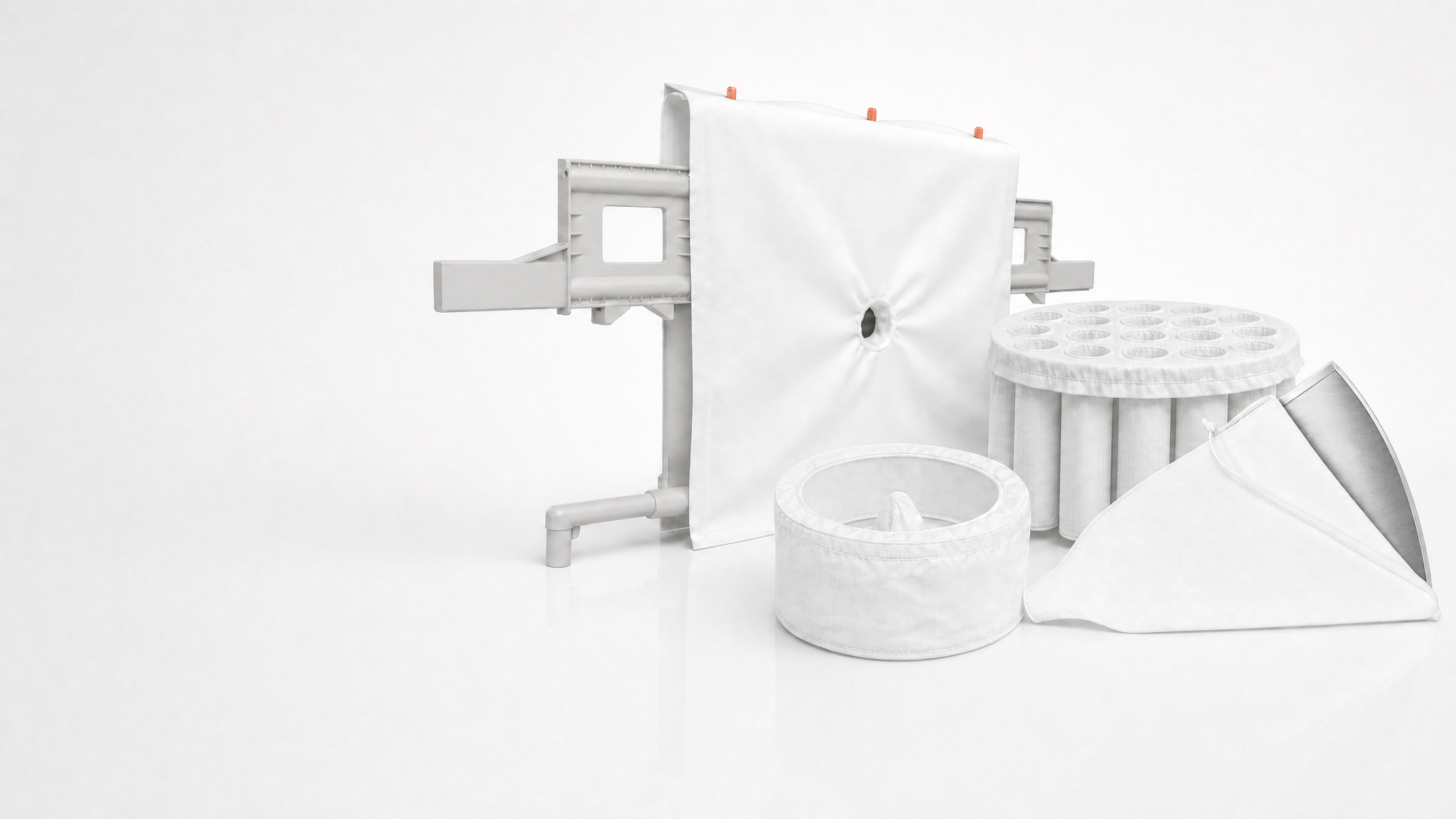
Sugar production is a filtration-heavy process, whether you run a beet line with carbonatation mud or a cane plant with high-color syrups. From raw juice clarification to final syrup polishing, the fabric has to handle heat, chemistry, and fast cake discharge without slowing the line down.
🔑 Key Takeaways
- Raw juice clarification in sugar plants often relies on filter presses, pressure leaf filters, or rotary vacuum filters to remove carbonatation mud efficiently.
- For 80–100°C syrups, filter fabrics must deliver stable dimensional behavior, chemical resistance, and reliable cake release.
- Beet sugar and cane sugar processes differ in solids load, color, and mud characteristics, which affects fabric selection.
- R+F RF-FF and RF-PLF series are well suited for demanding sugar filtration stages, especially where cake discharge and uptime matter.
🏭 Where filtration fits in sugar production
In a sugar plant, filtration is not a single step — it is a chain of separation duties. After extraction and liming, raw juice must be clarified, mud must be dewatered, and later syrup and liquor streams need polishing before crystallization or refining. On the operator side, the goal is simple: keep solids out, keep throughput up, and avoid unnecessary sugar losses.
For beet sugar, the challenge is usually carbonatation mud: a fine, compressible cake made up of calcium carbonate, organics, and trapped juice. Cane sugar lines often deal with darker, more variable syrup streams and higher color loads, so the fabric must support polishing filtration with consistent retention and easy cleaning. For plant layouts using a filter press, pressure leaf filter, or rotary vacuum filter, the choice of cloth has a direct impact on cycle time and cake release.
🔬 Raw juice purification: carbonatation mud removal
Raw juice purification is where many plants see the heaviest solids load. In beet sugar carbonatation, lime and CO2 form calcium carbonate particles that help trap impurities, but they also create a dense mud cake that can blind the fabric if the weave or surface finish is not right. The fabric needs to withstand alkaline conditions, repeated hot wash cycles, and fast discharge of sticky mud.
⚙️ Typical machines for mud filtration
- Filter presses for large-scale batch mud dewatering and cake washing.
- Rotary vacuum filters for continuous separation in high-throughput lines.
- Pressure leaf filters for compact, enclosed clarification systems.
💡 Tip: For carbonatation mud, prioritize excellent cake release over maximum fine retention alone. A cloth that discharges cleanly often delivers better real-world throughput than a tighter fabric that blinds quickly.
In this stage, the best fabrics support a stable cake layer and resist scaling from calcium carbonate. If your press struggles with residual cake after discharge, review the process first, then check the fabric surface and weave structure. For recurring buildup, also see filter cloth clogging and cake release problems.
| Filtration stage | Main objective | Typical challenge | Fabric priority |
|---|---|---|---|
| Raw juice purification | Remove carbonatation mud | Fine, sticky, alkaline solids | Cake release and chemical resistance |
| Syrup polishing | Reduce suspended solids and haze | Hot, viscous liquor | Temperature stability and smooth flow |
| Refined liquor clarification | Protect downstream crystallization | Low solids, high quality requirement | Fine retention and low contamination risk |
📊 Syrup polishing and refined liquor clarification
Once the process moves into syrup polishing, the picture changes. Solids are lower, but the liquid is more viscous and often hot enough to stress the fabric mechanically. At this point, operators typically look for a fabric that keeps flow resistance low while still catching haze, fines, or carbon fines that can affect crystal quality and product appearance.
This is where a well-designed RF-PLF Series pressure leaf filter fabric can be a strong choice, especially in enclosed systems where clean filtrate and consistent cake release matter. For batch clarification duties, the RF-FF Series filter press fabrics are a proven option for demanding sugar service.
If you are unsure how to match the machine and fabric, use our online tool to find and configure the right filter fabric with our Solution Finder. It helps you select the filtration machine and generate a pre-filled, non-binding inquiry in a few steps.
🛠️ Fabric requirements in sugar service
Sugar filtration is a tough operating environment for any textile. In practice, the fabric has to balance release, retention, and durability without becoming a maintenance burden. Operators should look for the following properties:
- High-temperature resistance for syrups and liquors running around 80–100°C.
- Chemical resistance against lime, CO2-related process conditions, and cleaning agents.
- Excellent cake release for calcium carbonate mud and sticky organics.
- Low tendency to blind to preserve cycle time and filtrate flow.
- Food-process suitability with stable, cleanable material behavior.
⚠️ Caution: If a fabric is exposed to hot syrup, alkaline wash solutions, and repeated mechanical cake discharge, premature shrinkage or hardening can quickly reduce service life. Always check the full process window, not just the nominal filtration temperature.
For plants that also run adjacent solids-handling steps, the same engineering mindset used in chemical industry filtration or industrial wastewater dewatering can be helpful: verify chemistry, temperature, and discharge behavior before standardizing a fabric.
✅ Beet sugar vs. cane sugar: what changes for the operator?
Although both processes aim to produce clean sugar, the filtration behavior is different. Beet sugar plants usually see more carbonatation mud and benefit from fabrics tuned for cake release and dewatering. Cane sugar plants often face darker liquor, more variable non-sugars, and stronger emphasis on syrup polishing and color control.
Determine whether you are dealing mainly with calcium carbonate mud, fiber fines, or syrup haze.
Batch dewatering, continuous polishing, and enclosed clarification each call for different fabric behavior.
Run a trial long enough to see whether cake discharge stays clean after multiple cycles.
Evaluate shrinkage, seam stability, and blinded areas under actual hot-syrup conditions.
📋 Pre-selection checklist for sugar filtration
- What is the machine type: filter press, vacuum filter, or pressure leaf filter?
- What is the operating temperature during normal and cleaning cycles?
- Is the main challenge cake release, fine retention, or throughput?
- Are you filtering raw juice, syrup, or refined liquor?
- Do alkaline cleaning chemicals or lime exposure affect fabric choice?
Rule of thumb: In sugar plants, choose the fabric for the worst realistic shift, not just the best lab sample. Hot syrup, sticky mud, and rapid cycle changes will expose weak fabrics quickly.
R+F FilterElements supports sugar operators with engineered fabrics for demanding clarification and polishing duties, including the RF-FF Series for filter press applications and the RF-PLF Series for pressure leaf systems. If your plant also uses related equipment like a disc filter or sparkler filter, we can help assess the best compatible fabric concept for your process.
📩 Need Help Choosing the Right Fabric?
Our technical team at R+F FilterElements can help you find the perfect filter fabric for your specific application. Get in touch for a free consultation — we will recommend the right solution based on your machine, process, and operating conditions.
Prefer a faster start? Use our Solution Finder to configure the right filter fabric online and receive a pre-filled, non-binding specification and inquiry for your sugar application.