
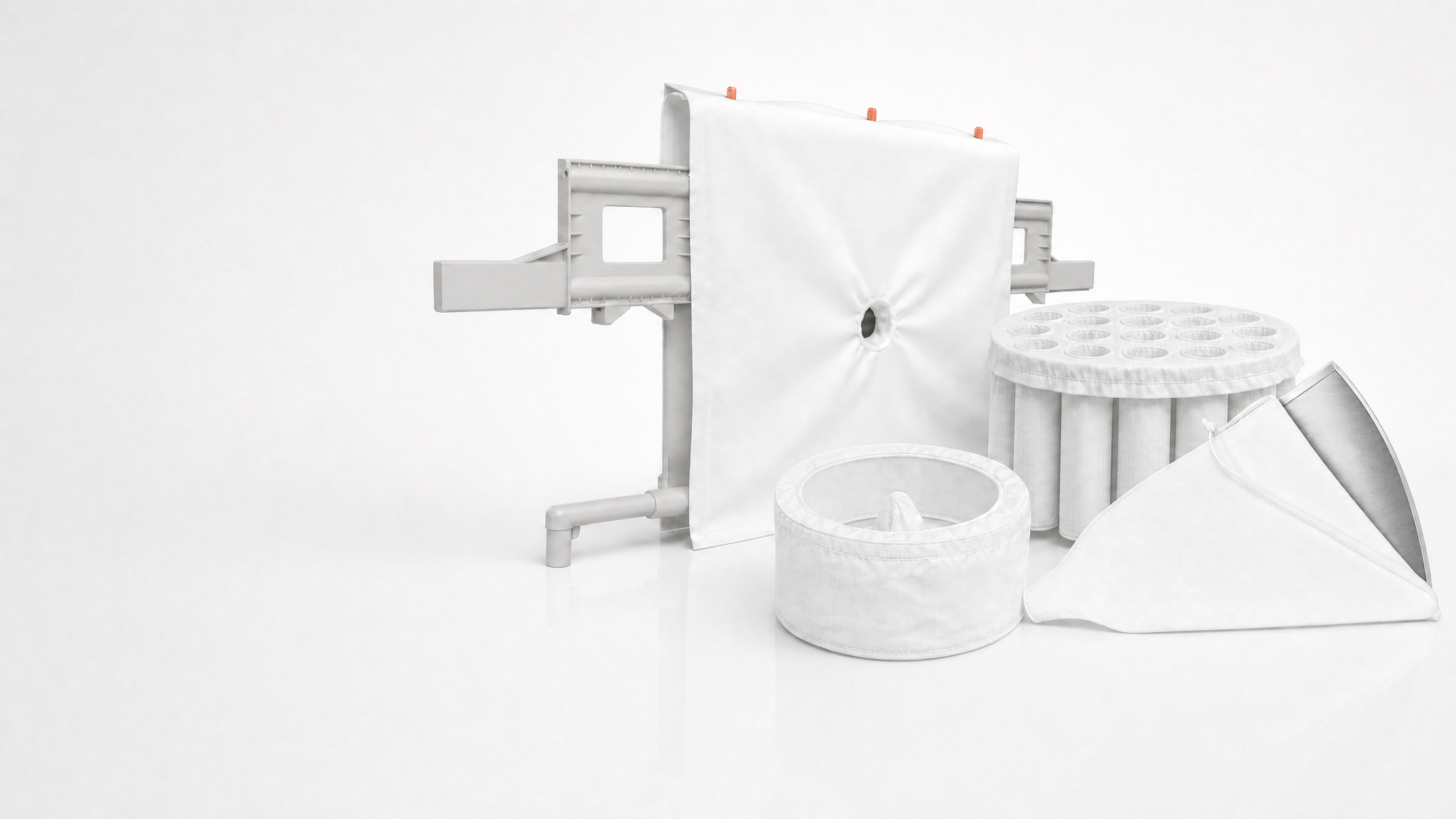
In pharmaceutical solid-liquid separation, the filter fabric is not just a consumable — it is part of your GMP control strategy. If you run a filter press, centrifuge, Nutsche filter, or fluid bed dryer, your fabric choice can affect product purity, batch consistency, and how easily you pass audits. That is why operators need filter media that are traceable, cleanly manufactured, and documented for regulated production.
🔑 Key Takeaways
- Pharma filtration fabrics must support GMP-compliant processes with traceable materials and controlled manufacturing.
- Ultrasonic welding helps reduce contamination risk by minimizing stitched seams and loose fibers.
- Material certifications and batch records make audits easier and strengthen your documentation package.
- The right fabric for your machine — from filter press to RF-ANF Series Nutsche Pharma fabrics — improves process reliability and cleanability.
🏭 Why GMP and FDA Compliance Starts with the Fabric
In a regulated plant, the filter fabric is part of the product-contact chain. If the media sheds fibers, traps residue, or arrives without clear traceability, you inherit extra cleaning effort and audit risk. That is especially important in pharmaceutical applications, where the same machine may run multiple batches and cleaning validation must be repeatable.
For operators, the goal is simple: stable separation, clean release, and documented material control. Fabrics used on filter presses, centrifuges, and Nutsche filters need to perform consistently while also fitting the plant’s documentation and hygiene requirements.
🔬 What Makes a Filter Fabric Pharma-Ready?
Pharma-ready fabrics are built and finished to reduce contamination risk and support documentation. In practice, that means the media, seams, cut edges, and packaging all need the same level of control you expect from the rest of the process equipment.
Ultrasonic welding instead of conventional stitching
For many pharmaceutical jobs, ultrasonic welding is preferred because it can seal edges without needle holes and without the fiber migration associated with open stitching. On critical machines such as RF-FF Series filter press fabrics or RF-NF Series needle felt media, this can help reduce drip leakage and simplify cleaning.
💡 Tip: If your main audit concern is contamination control, ask for seam details, edge-finishing method, and the exact manufacturing route for each fabric style.
Material certifications and documentation
Operators should expect a clear documentation set: material specification, batch reference, and where relevant, declarations about raw material consistency. When you need to show that the same fabric type was used across batches, traceability matters as much as filtration performance.
- Batch number on delivery documents
- Material specification tied to the fabric style
- Controlled manufacturing and inspection records
- Packaging that protects the fabric before installation
Cleanable construction for repeat use
For reusable media in process equipment, the surface finish and seam design should support fast washdown and consistent cake release. That is particularly relevant on belt filters and pressure leaf filters, where residue build-up can quickly affect throughput.
| Requirement | Why it matters in pharma | Operator benefit |
|---|---|---|
| Ultrasonic welded edges | Reduces stitch-related contamination points | Cleaner operation and easier validation |
| Batch traceability | Supports GMP documentation and audits | Faster investigation and release decisions |
| Material certification | Confirms consistent raw material basis | Lower risk of supply variation |
| Controlled packaging | Protects product-contact surfaces before installation | Less contamination during handling |
⚙️ Matching the Fabric to the Machine
Different machines place different demands on the fabric. A filter press needs excellent cake release and dimensional stability. A centrifuge needs secure retention at high speed. A Nutsche filter needs clean seams and reliable sealing. The right fabric is never just “one material for everything.”
On high-purity lines, many operators prefer dedicated solutions like RF-ANF Series Nutsche Pharma fabrics or machine-specific media for RF-BF Series belt filter fabrics. If your site runs multiple products, standardizing fabric families across similar units can also simplify spare parts handling and training.
📋 Pre-Selection Checklist for Pharma Filtration
- Identify the machine type and product-contact area
- Confirm required retention, flow, and cake-release behavior
- Check cleaning method and temperature exposure
- Request batch traceability and material documentation
- Verify seam or edge finishing requirements
- Match fabric design to validation and audit needs
🛠️ Practical GMP Tips for Operators
Most filtration problems in pharma are not caused by one big failure. They come from small mismatches: an edge that frays, a seam that traps residue, or a fabric that is hard to clean between batches. The best preventive action is to standardize your inspection routine and keep the documentation together with the spare cloth inventory.
Check for edge quality, seam integrity, correct labeling, and clean packaging before the fabric enters the clean area.
Log the fabric batch number, machine ID, and installation date so you can trace performance later.
Monitor cake release, filtrate clarity, and any signs of leakage during the first production cycle after changeout.
If residue remains after cleaning, reassess seam design, weave choice, or felt structure for the next replacement.
⚠️ Caution: Never assume a fabric is GMP-suitable just because it is made from a clean polymer. In regulated production, seam construction, traceability, packaging, and documentation are part of compliance — not optional extras.
Rule of thumb: If the fabric is hard to clean, hard to identify, or hard to document, it will be hard to defend in an audit.
📊 How to Reduce Audit Risk and Downtime
The best operator outcome is predictable filtration with minimal deviation between batches. That comes from selecting the right media and keeping the supply chain under control. If you are seeing recurring filter cloth clogging, poor cake release, or short filter lifespan, the root cause is often a combination of fabric selection, handling, and cleaning regime.
For teams responsible for both quality and uptime, it helps to treat filter cloths like other critical spare parts: approved supplier, known specification, documented lot, and clear replacement criteria. That approach reduces surprises and supports consistent output across campaigns.
💡 Tip: If you operate multiple pharma lines, keep a master fabric specification by machine type. It speeds up reordering and avoids substitution errors during urgent changeouts.
✅ Choose a Solution That Fits Your Validation Workflow
Whether you run a fluid bed dryer, a centrifuge, or a filter press, the fabric should support your validation strategy instead of complicating it. R+F offers application-oriented fabrics for regulated environments, including RF-FBD Series fluid bed dryer fabrics and other machine-specific media designed for controlled industrial separation.
If you want a faster way to narrow down the right media, you can find and configure the right filter fabric with our Solution Finder. Select your filtration machine, define the operating conditions, and receive a pre-filled, non-binding inquiry specification that you can share with your team or quality department.
📩 Need Help Choosing the Right Fabric?
Our technical team at R+F FilterElements can help you find the perfect filter fabric for your specific application. Get in touch for a free consultation — we will recommend the right solution based on your machine, process, and operating conditions.
If you already know your machine type, you can also find and configure the right filter fabric with our Solution Finder and send a non-binding specification request in just a few steps.