
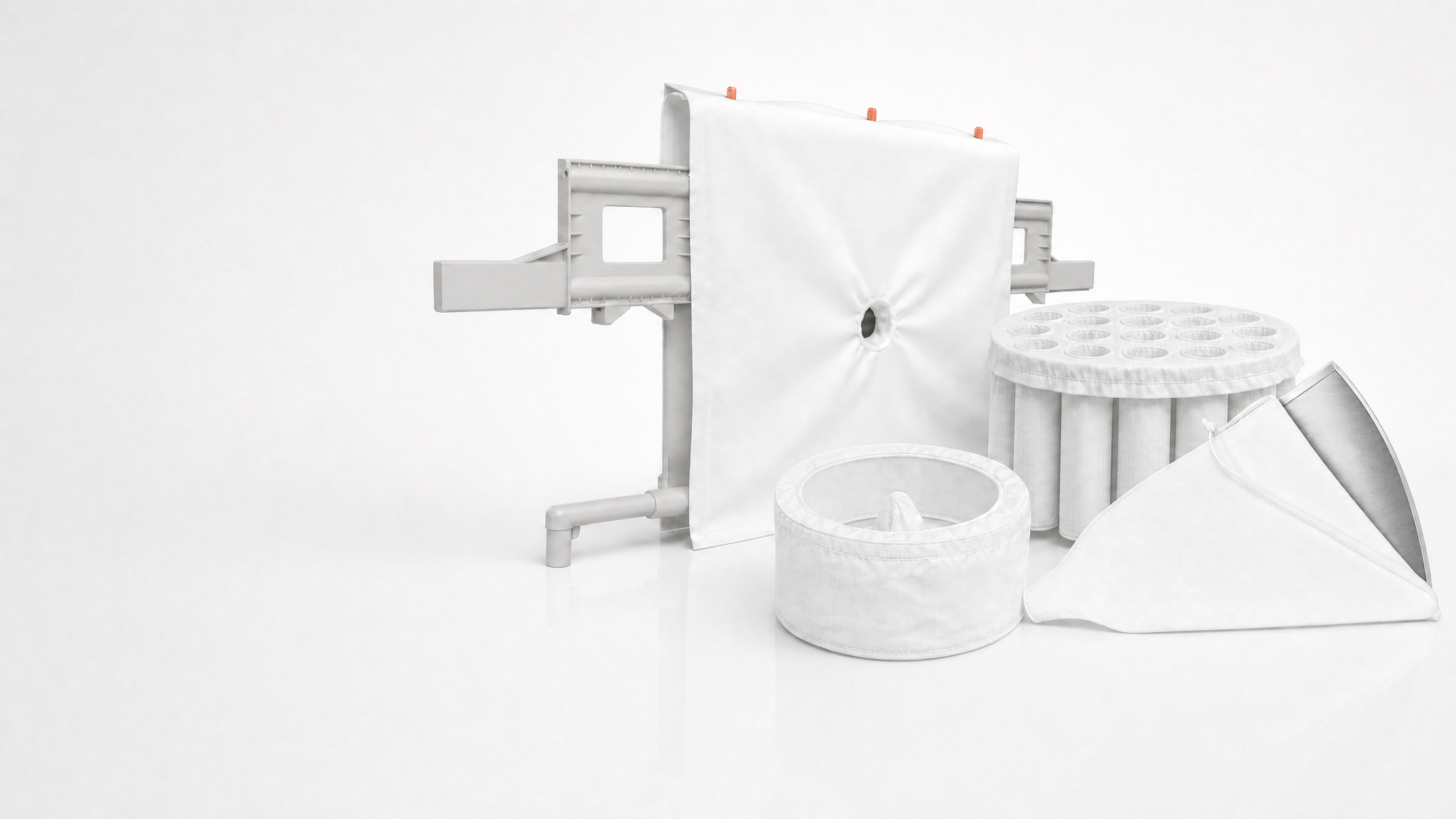
Choosing the right centrifuge filter media is a balancing act between heat, chemistry, lifetime, and cost. In practice, PEEK, PP, and PET each solve a different problem on the shop floor — and the wrong choice can show up as poor cake release, early wear, or unnecessary downtime.
If you run a centrifuge in chemical, wastewater, or fine-chemical service, the best fabric is the one that matches your process conditions, not just the price tag. For an application-specific starting point, see our RF-CF Series centrifuge fabrics.
🔑 Key Takeaways
- PP is the cost-efficient default for many standard centrifuge duties, especially where temperatures stay moderate.
- PET offers better dimensional stability and abrasion resistance than PP, making it a strong middle ground.
- PEEK is the premium choice for hot, aggressive, or highly demanding centrifuge environments.
- The right fabric depends on temperature, chemistry, cake behavior, and expected service life — not on material name alone.
⚙️ What Changes Between PEEK, PP, and PET?
From an operator’s point of view, these three materials behave very differently under centrifugal force, wash cycles, and cleaning chemicals. The biggest differences are heat resistance, chemical compatibility, and mechanical durability.
| Material | Temperature behavior | Chemical resistance | Cost level | Best fit |
|---|---|---|---|---|
| PP | Good for moderate temperatures; softens earlier than PET or PEEK | Very good with many acids and alkalis | Low | General-purpose centrifuge duties, cost-sensitive plants |
| PET | Better heat and dimensional stability than PP | Good overall, but not as universal as PEEK | Medium | Balanced performance where wear and heat are a concern |
| PEEK | Excellent at elevated temperatures and under load | Outstanding in harsh chemical service | High | Severe-duty centrifuges, aggressive media, long-life targets |
💡 Tip: If your centrifuge sees hot CIP cycles or solvent-heavy cleaning, check the fabric’s continuous service temperature and not just the process temperature. Cleaning can be the real stress test.
🔬 When to Choose PP, PET, or PEEK
There is no universal winner. The right choice depends on whether your pain point is cost, heat, chemicals, or mechanical wear. In many plants, PP is still the smart baseline, PET is the practical upgrade, and PEEK is the insurance policy for harsh operating conditions.
For chemical-industry applications, PET often becomes the practical compromise when PP starts to distort or fatigue too quickly. PEEK is the material to consider when you cannot afford performance drift, especially in demanding centrifuge cycles with aggressive media.
⚠️ Caution: Do not select a material based on chemical compatibility alone. In a centrifuge, temperature, speed, seam design, and fabric tension can be just as important as resistance charts.
🛠️ Operator Guide: How to Avoid Early Wear
Short service life usually comes from a combination of heat, abrasion, and poor cake release. If you are seeing premature failures, review the whole separation cycle — especially start-up, discharge, and cleaning.
Record maximum temperature, cleaning media, and spin speed. What the panel shows is not always what the fabric experiences.
Poor release can point to the wrong surface finish or an unsuitable material choice. See also cake release issues.
Check seams, edge wear, and local abrasion. If failures are recurring, review short filter lifespan causes.
Rule of thumb: If PP survives, PET often gives you a safer buffer. If PET survives but maintenance is still too frequent, PEEK is usually the next step — especially in severe chemical service.
📋 Pre-Selection Checklist for Centrifuge Media
- Maximum process temperature and cleaning temperature
- pH range and exposure to solvents or oxidizers
- Required cake release and dryness
- Expected abrasion from solids
- Target service life and maintenance window
- Machine type and basket geometry
📊 Cost vs. Lifetime: What Actually Pays Off?
PP usually wins on purchase price, but that does not always mean the lowest total cost. PET often reduces changeouts, while PEEK can pay back where downtime is expensive and chemical exposure is severe. In other words, the cheapest fabric is not always the cheapest run.
If you are troubleshooting frequent shutdowns, it may help to look beyond material choice and review sealing, fit, and installation quality. For related wear and contamination concerns, see filter cloth clogging and contamination from stitching.
Practical buying logic
- Choose PP when budget matters most and the process is stable.
- Choose PET when you need better durability without jumping to premium pricing.
- Choose PEEK when the process is harsh enough that downtime is more expensive than fabric price.
For plants working across multiple solids-liquid separation steps, we often see PP or PET in the centrifuge and more specialized fabrics in other equipment such as a RF-BF Series belt filter fabrics. Matching the media to the machine is the fastest way to improve consistency across the site.
🏭 How R+F Helps You Match the Right Centrifuge Fabric
The RF-CF Series is built for centrifuge duty, where fabric choice must hold up under rotation, discharge, and repeated cleaning. If your operation includes both centrifuge and drying steps, it can also help to compare the fabric behavior with other product families such as fluid bed dryers or related wastewater applications where contamination and retention targets differ.
For operators, the best outcome is usually a fabric that balances stable performance, easy cake discharge, and acceptable replacement intervals. In most cases, that means starting with PP, stepping up to PET when the process gets harder, and specifying PEEK when the environment leaves no margin for failure.
📩 Need Help Choosing the Right Fabric?
Our technical team at R+F FilterElements can help you find the perfect filter fabric for your specific application. Get in touch for a free consultation — we will recommend the right solution based on your machine, process, and operating conditions.