
Crude glycerin from biodiesel production or fat splitting is rarely ready for sale or reuse as-is. It usually contains methanol, soaps, salts, water, color bodies, and activated carbon fines that must be removed before the product can meet technical or pharmaceutical specifications.
In the operator’s day-to-day reality, that means stable clarification, low pressure drop, and a fabric that can handle hot glycerin mixtures without swelling, blinding, or shedding fibers. The right filter media is often the difference between a clean glycerol stream and repeated shutdowns for cloth cleaning or replacement.
🔑 Key Takeaways
- Crude glycerin needs multi-stage purification: clarification, carbon treatment, and polishing.
- Filter fabrics must resist glycerin/methanol mixtures and retain very fine carbon particles.
- Pressure leaf filters, sparkler filters, and filter presses are common machines in glycerol refining.
- For pharma-grade glycerin, cleanability, low contamination risk, and consistent retention are critical.
💡 Tip: If your glycerin line is running warm and solvent-rich, always confirm fabric compatibility with the full liquid package, not just pure glycerol. Methanol content can change swelling behavior and service life significantly.
🏭 Why Glycerin Needs Filtration Before It Becomes a Product
In oleochemical processing, crude glycerin is typically generated during fat splitting or biodiesel transesterification. That crude stream often carries suspended solids, residual catalyst, soaps, salts, and traces of methanol. If you are trying to recover usable glycerin, filtration is not optional — it is the foundation for every later purification step.
Most plants use a sequence of clarification and polishing steps before final drying or concentration. In practice, that may include a pressure leaf filter for high-throughput clarification, a sparkler filter for fine polishing, or a filter press when batch operation and cake handling are part of the process. For more process context, see our chemical industry filtration applications.
🔬 Filtration Steps in Crude Glycerin Refining
Remove coarse solids, soap scum, and precipitated salts before downstream treatment.
Adsorb color bodies and trace organics, then filter out carbon fines efficiently.
Use fine-retention media to produce a clear glycerin stream with low turbidity and minimal carryover.
After carbon dosing, operators often see a very fine, compressible solids load. This is where fabric selection becomes critical. A poor cloth can blind quickly, causing rising differential pressure and unstable flow. If that sounds familiar, our page on filter cloth clogging explains the root causes in more detail.
Rule of thumb: The finer the carbon, the more important the fabric structure becomes. If the cake is thin but the filtrate is still hazy, do not immediately blame dosing — check retention and pore structure first.
🛠️ Choosing the Right Machine and Fabric Combination
For glycerin purification, the machine choice depends on throughput, solids load, and whether the plant runs batch or continuous. Pressure leaf filters are common for larger flow rates and stable filtration behavior. Sparkler filters are often used for fine polishing, while filter presses are useful when a distinct cake discharge is desired.
| Machine | Best Use in Glycerin Processing | Fabric Requirement |
|---|---|---|
| Pressure leaf filter | Clarification and carbon removal at higher throughputs | Fine retention, low blinding, strong seam integrity |
| Sparkler filter | Polishing stage for clearer filtrate | Very fine particle retention, low extractables, easy cleaning |
| Filter press | Batch clarification and cake collection | Chemical resistance, cake release, dimensional stability |
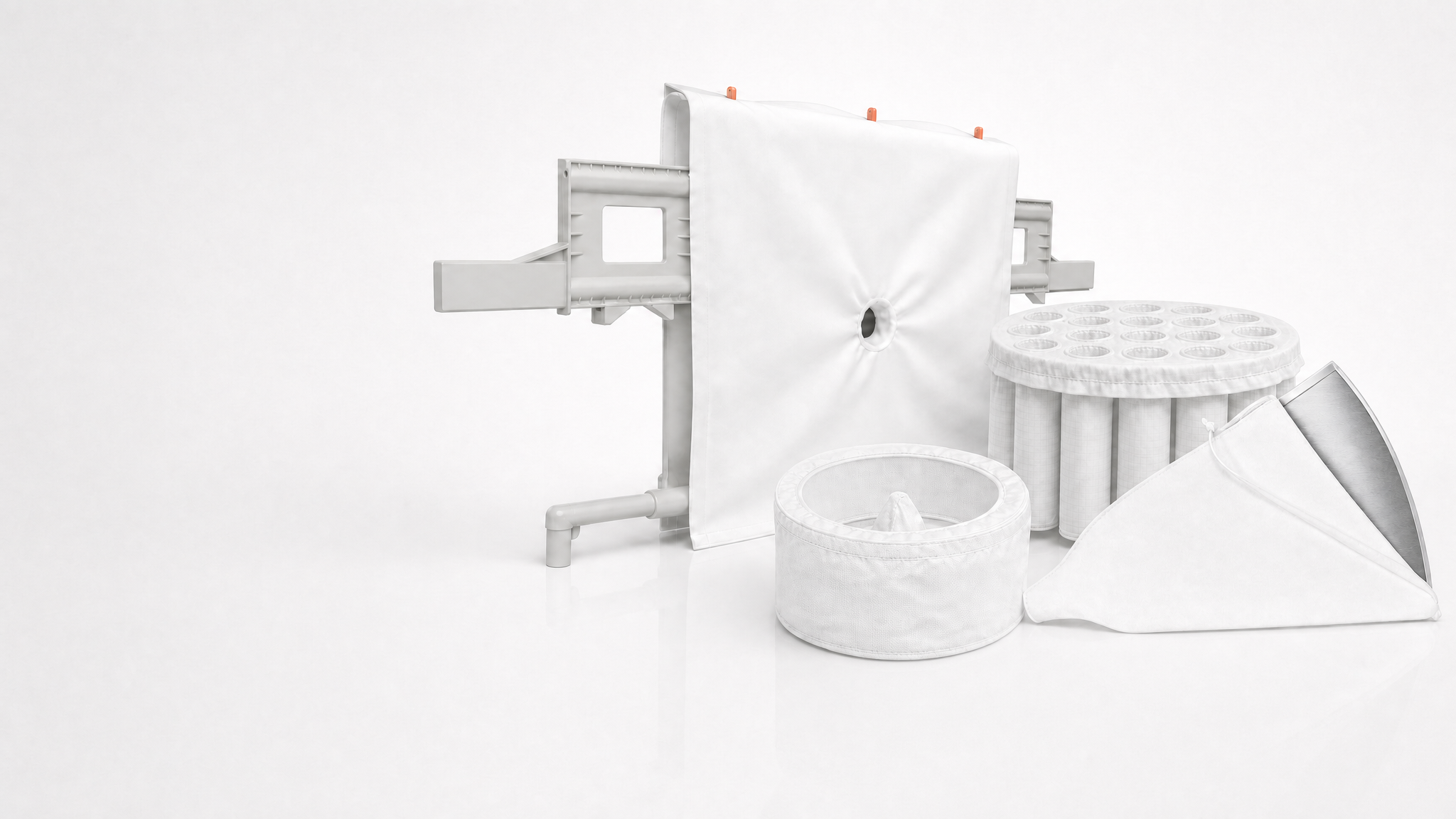
R+F’s RF-PLF Series pressure leaf filter fabrics are designed for demanding clarification service where filtrate clarity and mechanical stability matter. For final polishing, RF-SP Series sparkler filter fabrics support fine retention and consistent performance in hot, solvent-containing glycerin streams.
Depending on the unit design, you may also need to think about cake discharge and drip control. If your problem is not clarity but carryover or losses, see drip leakage and cake release.
🧪 What the Fabric Must Withstand
Glycerin itself is viscous and hygroscopic, but the real challenge is the process blend around it. In biodiesel-derived streams, residual methanol and process additives can stress standard textiles. That is why operator-side selection focuses on chemical resistance, fine retention, and temperature stability together — not one at the expense of the others.
- Chemical resistance: Compatibility with glycerin/methanol mixtures and process additives.
- Fine particle retention: Reliable capture of activated carbon fines and colloidal carryover.
- Thermal resistance: Stable performance in warm service and frequent temperature cycling.
- Low contamination risk: Clean seams, low linting, and controlled extractables for sensitive product grades.
For operators pursuing pharmaceutical-grade glycerin, requirements become stricter. The filtration step must support low turbidity, minimal contamination, and repeatable cleaning. In those cases, process hygiene and fabric consistency matter just as much as retention. Explore our pharmaceutical filtration applications for more context on high-purity duty.
⚠️ Caution: If methanol is still present in significant amounts, treat the system as a solvent service. Confirm ventilation, ATEX measures, and material compatibility before opening housings or changing fabrics.
📋 Practical Selection Checklist for Operators
📋 Glycerin Filtration Readiness Checklist
- Check actual solids type: salts, soaps, activated carbon, or mixed fines
- Verify operating temperature and methanol content
- Confirm required filtrate clarity or pharmaceutical specification
- Assess cake release behavior and cleaning frequency
- Match fabric structure to machine design and differential pressure
When you are comparing fabrics for a pressure leaf filter or sparkler unit, small differences in weave structure and seam quality can change the way the system behaves over weeks of production. If your current cloth fails early, our guide on short filter lifespan can help you diagnose the usual causes.
For operators who want to compare options quickly, the easiest next step is to find and configure the right filter fabric with our Solution Finder. Select your machine, enter your process conditions, and receive a pre-filled, non-binding inquiry for the most suitable fabric specification.
📩 Need Help Choosing the Right Fabric?
Our technical team at R+F FilterElements can help you find the perfect filter fabric for your specific application. Get in touch for a free consultation — we will recommend the right solution based on your machine, process, and operating conditions.
Prefer to start online? Use our Solution Finder to configure the right filter fabric for your glycerin purification line and send a pre-filled inquiry in minutes.