
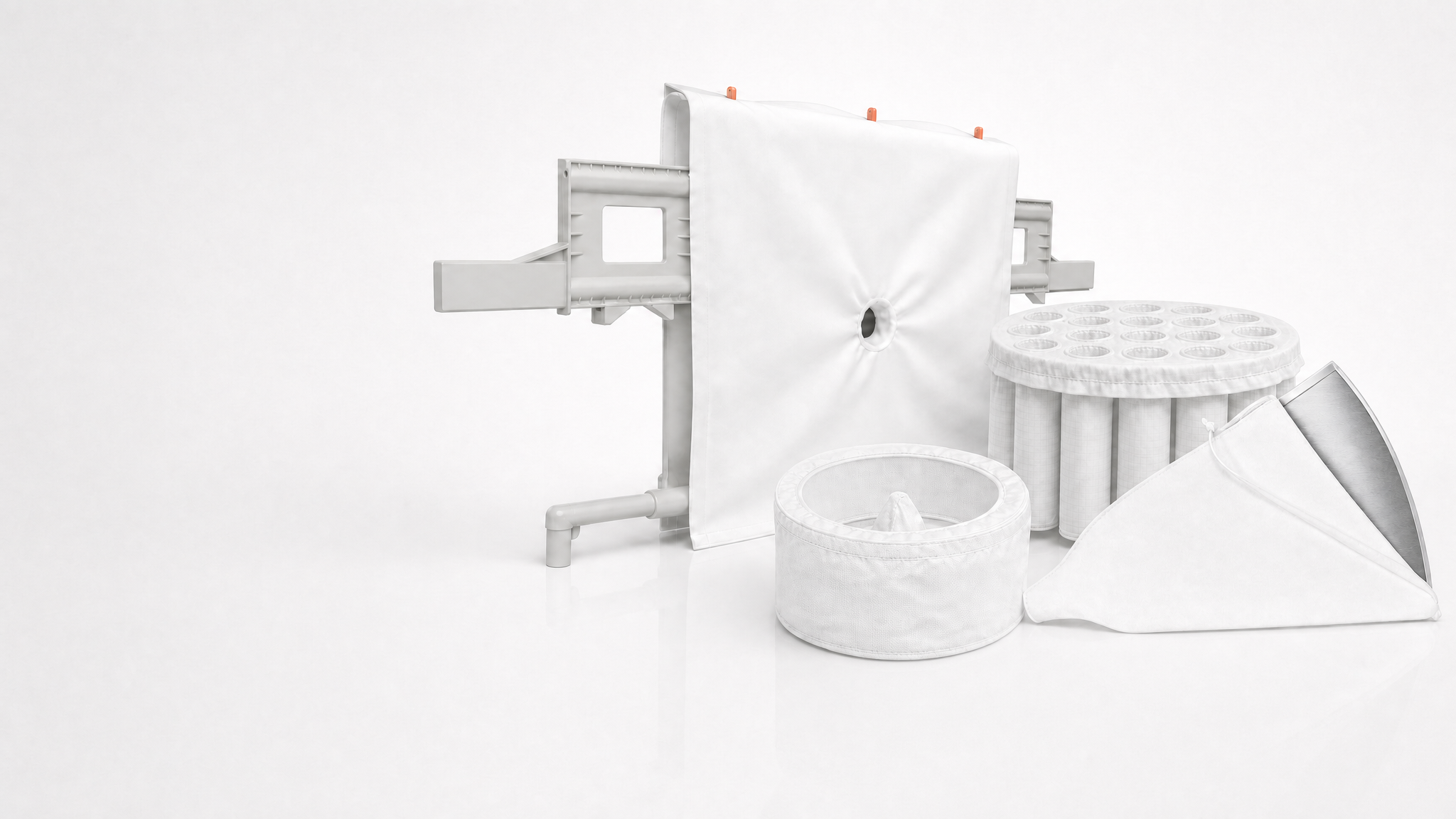
Titanium dioxide (TiO2) pigment production is a tough filtration job: abrasive solids, hot slurries, and highly corrosive media can punish cloths fast. Whether you run the sulphate route or the chloride route, stable filtration performance depends on selecting a fabric that balances chemical resistance, abrasion resistance, and predictable cake release.
🔑 Key Takeaways
- TiO2 filtration stages include feed purification, slurry separation, washing, and final dewatering.
- PP fabrics are a strong choice where acid resistance is critical, especially in sulphate-route service.
- Heavy-duty multifilament weaves help withstand the extreme abrasion caused by TiO2 particles.
- R+F supports large filter presses and belt filters with application-matched fabrics for high-duty pigment plants.
🏭 TiO2 Production: Why Filtration Is So Demanding
In TiO2 pigment plants, filtration is not a side operation — it is one of the main points where yield, purity, and operating cost are won or lost. The process environment is harsh: fine pigment particles are extremely abrasive, sulphate-route circuits can be strongly acidic due to H2SO4, and many stages run at elevated temperatures.
Both major production routes create different challenges. The sulphate process typically demands strong acid resistance and reliable washing behavior. The chloride process reduces acid exposure in some stages, but still creates highly abrasive solids and demanding dewatering conditions. For operators, that means the filter fabric must perform consistently across long cycles, not just pass a short lab test.
⚠️ Caution: TiO2 slurry can accelerate wear very quickly. If the fabric structure is too light, you may see premature thinning, seam damage, blinding, or unstable cake release.
🔬 The Main Filtration Stages in TiO2 Plants
TiO2 filtration is usually a sequence of several unit operations. Each stage places different demands on the cloth or belt surface, so a “one-fabric-fits-all” approach rarely works well.
Remove unwanted solids before the reaction or finishing step. Here, stable flow and low pressure loss matter more than ultra-fine capture.
Separate pigment from process liquor after reaction or hydrolysis. This is often where abrasion and chemical attack peak.
Wash out residual acids and salts while maintaining cake structure. Poor fabric selection can cause channeling or excessive solids loss.
Reduce moisture before downstream handling, drying, or packaging. At this point, cake release and drainage efficiency are critical.
Sulphate route: acid resistance first
In sulphate-route plants, the cloth often sees acidic conditions for extended periods. That is why PP fabrics are frequently preferred when the process chemistry is aggressive. Polypropylene offers strong resistance to many acids and can be a practical base material for demanding TiO2 circuits.
Chloride route: abrasion and temperature still dominate
Chloride-route systems may reduce direct acid exposure in some areas, but the solids remain hard on the fabric. The abrasive nature of TiO2 pigment means the weave construction still needs to be robust, especially in high-throughput dewatering and washing stages.
⚙️ Machine Choices: Filter Presses and Belt Filters
For large-scale TiO2 plants, two machine types stand out: filter presses and belt filters. Filter presses are often chosen when operators need high dryness, robust batch separation, and reliable washing performance. Belt filters are favored where continuous operation and steady throughput are more important.
| Machine | Typical Strength in TiO2 Service | Main Fabric Requirement |
|---|---|---|
| Large filter press | High cake dryness, strong wash efficiency, batch control | Pressure stability, low blinding, excellent cake release |
| Belt filter | Continuous operation, high throughput, stable discharge | Abrasion resistance, drainage consistency, seam durability |
| Centrifuge | Rapid dewatering in some pigment-related duties | High mechanical strength and balanced permeability |
For operators looking to match cloth design to the machine, the Solution Finder helps you find and configure the right filter fabric online and generates a pre-filled, non-binding inquiry based on your process.
🧵 Fabric Selection: PP and Heavy-Duty Multifilament Weaves
For TiO2 duty, material selection is usually a balance between chemistry and wear. PP is the go-to material where acid resistance is a priority, especially in sulphate-route filtration or acidic wash circuits. At the same time, the fabric construction must resist grinding wear from pigment solids.
Heavy-duty multifilament weaves are often the better choice than light constructions because they can better absorb mechanical stress, resist edge damage, and provide more stable service life. In practice, this can reduce cloth changes, lower unplanned shutdowns, and improve process consistency.
Rule of thumb: If TiO2 solids feel “soft” in the tank but destroy the cloth in service, the problem is usually abrasion — not just chemistry — and the weave construction needs to be upgraded.
Common operator pain points
- Filter cloth clogging from ultra-fine pigment particles
- Short filter lifespan caused by abrasion and acid exposure
- Poor cake release after washing or dewatering
- Drip leakage at seams, edges, or poorly tensioned installations
🛠️ Practical Selection Checklist for TiO2 Plants
Before specifying a new cloth or belt, it helps to review the process conditions that matter most. This keeps the selection grounded in real operating data, not assumptions from the datasheet alone.
📋 TiO2 Fabric Selection Checklist
- Route: sulphate or chloride process
- pH and acid exposure, including H2SO4 concentration
- Operating temperature in each filtration stage
- Particle size and abrasion severity
- Required cake dryness and wash efficiency
- Machine type: filter press or belt filter
- Need for improved cake release or longer cloth life
R+F’s RF-FF Series filter press fabrics are well suited to high-pressure batch separation, while RF-BF Series belt filter fabrics are built for continuous dewatering duties where wear resistance and drainage stability are essential. For related process areas, you can also review our chemical industry filtration solutions.
💡 Tip: When a TiO2 line is losing performance, check the fabric wear pattern first. Uneven abrasion, edge fraying, and blinded zones often reveal more about the real process issue than the slurry report does.
✅ R+F Positioning for TiO2 Filtration
In TiO2 pigment production, the fabric is a process component, not just a consumable. R+F FilterElements supplies engineered fabrics for demanding separation tasks, with a focus on durability, chemical resistance, and process stability. For operators running large filter presses, the RF-FF Series offers a strong option for high-duty batch filtration. For continuous systems, the RF-BF Series supports belt filter operation with robust wear behavior.
If you are comparing options across other solid-liquid separation machines, you may also want to review our pages for pressure leaf filters or rotary disc filters when your plant layout includes specialty clarification duties. For broader industrial contexts, see our mining applications and wastewater applications.
📩 Need Help Choosing the Right Fabric?
Our technical team at R+F FilterElements can help you find the perfect filter fabric for your specific application. Get in touch for a free consultation — we will recommend the right solution based on your machine, process, and operating conditions.
Or use our online Solution Finder to find and configure the right filter fabric for your TiO2 line and receive a pre-filled, non-binding specification and inquiry.