
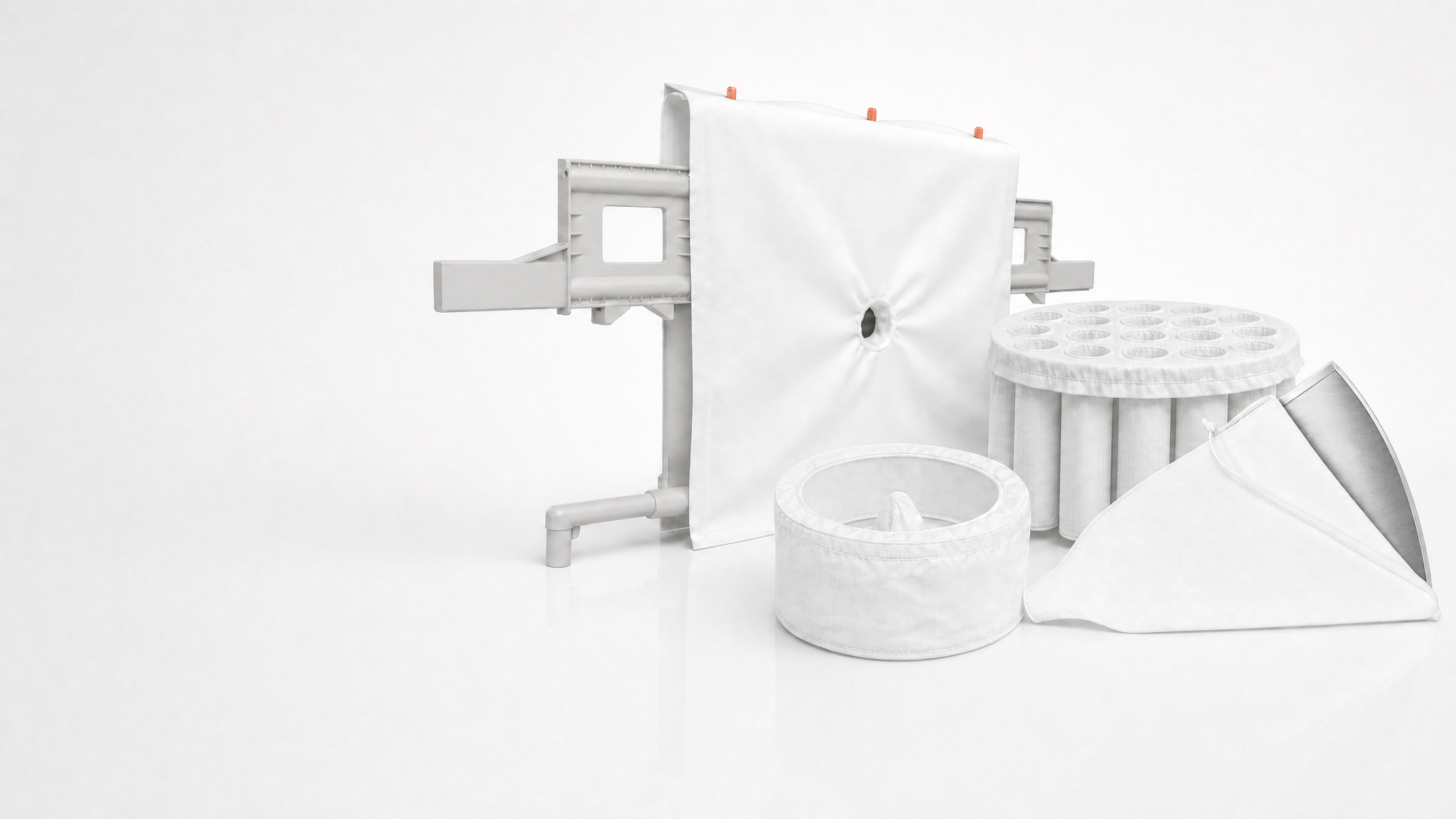
When you are running a fruit juice, wine, or beverage clarification line, the difference between a bright product and a hazy one often comes down to the filter fabric. The right filter pad or cloth must deliver consistent retention, stable flow, and zero off-taste while handling pectin, proteins, yeast, and fine colloids without breaking down.
🔑 Key Takeaways
- Clarification performance depends on the retention grade, pore consistency, and depth structure of the filter media.
- Sparkler-type filter pads are widely used for rough, fine, and polish filtration in juice, wine, and beverage applications.
- Food-grade media must be FDA-compliant, neutral in taste and odour, and stable under process temperatures and cleaning cycles.
- R+F offers RF-SP sparkler pads and custom filter sheets for crystal-clear, stable beverage filtration.
💡 Tip: If your beverage looks clear right after filtration but develops haze later, the issue is often not the liquid itself — it is usually the retention grade, depth structure, or loading capacity of the filter medium.
🏭 Why Clarification Demands the Right Filter Fabric
In beverage production, clarity is not just a visual quality factor — it is also linked to shelf life, consumer perception, and process reliability. Whether you are filtering apple juice, grape juice, citrus juice, wine, cider, or other beverages, the filter fabric has to separate fine solids without stripping flavor or causing excessive pressure drop.
On sparkler-type systems such as a sparkler filter, the filter pad acts as a depth medium rather than a simple surface sieve. That means it traps particles throughout the media thickness, which is especially useful for haze-forming components like pectin, proteins, yeast, and fine pulp.
For operators, the practical goals are straightforward:
- stable clarification from batch to batch
- low product loss in the cake and pad
- no taste or odour transfer
- safe contact with food and beverage products
- consistent flow behavior over the full service life
🔬 How Sparkler Filter Pads Work in Depth Filtration
Sparkler pads are designed for depth filtration, which means solids are captured inside the structure of the sheet rather than only on the surface. This is why they are so effective for beverages with fine suspended matter and haze precursors. In practice, the pad behaves like a graded filter bed: larger particles are retained near the inlet side, while finer particles are caught deeper in the media.
This principle is useful for juice and wine clarification because the solids load is often mixed: larger pulp fragments, small yeast cells, protein complexes, and colloidal haze all behave differently. A well-matched filter pad helps the operator remove these fractions in a controlled way, while protecting downstream polishing steps.
Retention grades for beverage filtration
Selection usually depends on the desired end clarity and the solids burden in the feed. In general:
- Rough filtration is used to remove larger suspended solids and reduce load on downstream stages.
- Fine filtration targets smaller particles, yeast, and haze-forming matter.
- Polish filtration is intended for the brightest possible product before filling or final storage.
| Filtration Stage | Main Objective | Typical Solids Removed | Operator Benefit |
|---|---|---|---|
| Rough | Pre-clarification | Pulp, coarse sediment, large yeast aggregates | Protects fine pads and reduces fouling |
| Fine | Clarification | Yeast, proteins, colloidal haze, fine particulates | Improves brightness and stability |
| Polish | Final brightening | Very fine haze particles | Delivers crystal-clear appearance |
Rule of thumb: Start with the coarsest media that still meets your clarity target. Over-fine filtration can raise pressure too quickly, shorten pad life, and reduce throughput.
📊 Material Requirements for Food-Grade Beverage Filtration
For fruit juice and beverage applications, material selection is not optional — it is central to product safety and product quality. The filter fabric must be suitable for food contact and remain stable in wet conditions, during CIP-compatible cleaning, and under temperature fluctuations typical of beverage plants.
The most important requirements are:
- FDA-compliant or otherwise suitable for food contact, depending on your market and regulatory regime
- no taste, odour, or colour transfer to the product
- consistent pore structure for repeatable retention
- good wet strength and dimensional stability
- uniform thickness for controlled flow and sealing
In many plants, the same media must also handle variations in product load. Apple juice can be high in pectin, grape products may carry yeast and tannins, and citrus beverages often challenge the system with very fine cloud particles and sticky residues. This is where a high-quality sheet structure matters: if the pad density is inconsistent, one batch may run beautifully while the next blinds early or allows breakthrough.
⚠️ Caution: Do not assume “clear at the outlet” means “stable shelf life.” Haze can reappear if proteins, pectin, or colloids are not removed at the right stage or if the chosen pad is too coarse for the product.
🛠️ R+F RF-SP Sparkler Pads and Custom Filter Sheets
R+F FilterElements supplies RF-SP series sparkler filter pads designed for beverage clarification where reliable depth filtration and consistent retention are critical. These pads are built for stable performance in systems used for juice, wine, and other liquid foods that must meet high visual and sensory standards.
For operators who need a tailored media profile, R+F also offers custom filter sheets that can be matched to your process conditions, solids load, and target clarity. If you are running a sparkler filter, you can also review the machine-specific options on our sparkler filter page and use the find and configure the right filter fabric with our Solution Finder to generate a pre-filled, non-binding inquiry.
Although beverage clarification is a different task than solid-liquid separation in minerals or chemicals, the same engineering mindset applies: the media must fit the machine, the process, and the product. That is why our fabrics are designed for controlled pore structure, reproducible quality, and dependable sealing behavior.
Where filter pads help most
- Apple juice: reduction of pectin haze and fine pulp carryover
- Grape juice and wine: removal of yeast, proteins, and colloidal haze
- Citrus beverages: control of cloud particles and fine suspended solids
- Other beverages: polishing before filling, blending, or bottling
📋 Selection Checklist for Beverage Clarification
- Define the target clarity: rough, fine, or polish filtration
- Confirm product compatibility and food-contact requirements
- Check whether haze is mainly pectin, protein, yeast, or pulp
- Match pad retention to solids load and required throughput
- Verify sealing, support plate fit, and wet stability
- Plan for cleaning, changeover, and service-life monitoring
Identify whether the main challenge is coarse solids, haze, or final polishing before bottling.
Choose rough, fine, or polish media based on clarity target and solids load.
Confirm FDA-compliant materials, neutral sensory behavior, and stable pore structure.
Track pressure rise, throughput, and final clarity to fine-tune the next run.
✅ Practical Operator Guidance for Stable Clarity
If you are seeing inconsistent brightness, short pad life, or filter breakthrough, the issue is often process mismatch rather than the machine itself. Check whether the pad is too coarse for the solids profile, whether pre-clarification is needed, and whether the feed temperature or viscosity is affecting flow.
💡 Tip: For high-pectin juices, a roughing stage before fine clarification can significantly improve throughput and extend the life of your final pads.
When comparing options, remember that clarity, throughput, and service life must be balanced together. A very tight media may give brilliant product early on, but if it blinds too quickly, it can create more downtime and higher cost per batch. A properly selected pad, by contrast, keeps the line running smoothly and supports reproducible results.
For related process equipment, you may also want to review our fabric solutions for filter press systems, belt filters, and centrifuges when your plant uses multiple separation steps upstream or downstream of beverage clarification. In some plants, pre-separation on a pressure leaf filter can also reduce load before final polishing.
📩 Need Help Choosing the Right Fabric?
Our technical team at R+F FilterElements can help you find the perfect filter fabric for your specific application. Get in touch for a free consultation — we will recommend the right solution based on your machine, process, and operating conditions.
Prefer a fast online start? Use our Solution Finder to find and configure the right filter fabric online and receive a pre-filled, non-binding specification and inquiry for your machine.