
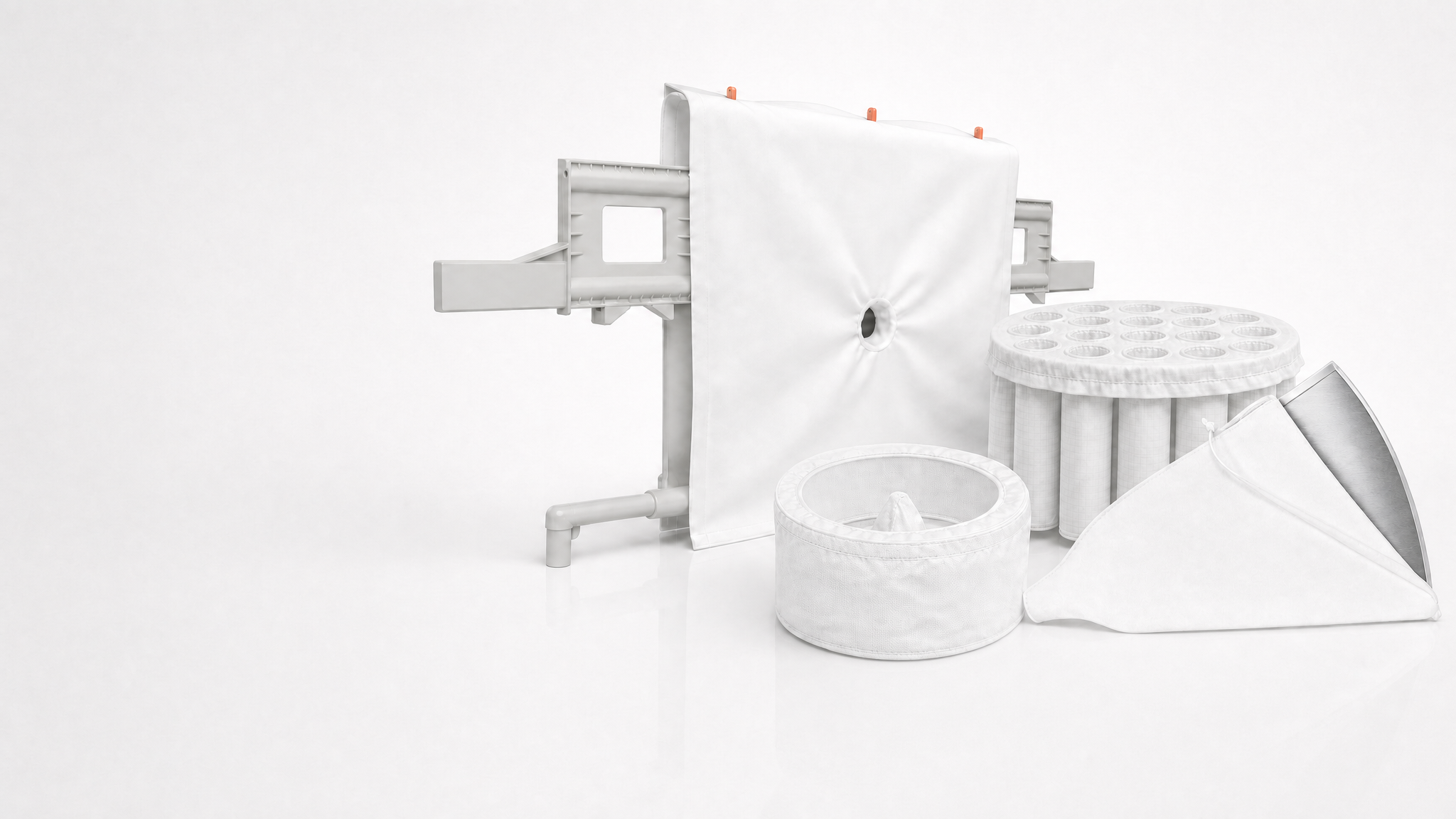
In API isolation, the filtration step is more than a separation task — it directly affects product purity, recovery, and GMP compliance. Whether you run an agitated nutsche filter or a centrifuge, the right filter fabric must support clean crystallisation, reliable cake release, and fully documented batch production.
For operators, the challenge is simple to describe and hard to solve: keep the solids in, keep contaminants out, and keep the process reproducible. That is exactly where engineered fabrics for pharmaceutical solid-liquid separation make the difference.
🔑 Key Takeaways
- API isolation starts with crystallisation, then solid-liquid separation under tightly controlled GMP conditions.
- Filter fabric quality affects purity, yield, cake release, and the risk of fiber or particle contamination.
- For highly potent APIs, containment and seam integrity are critical to operator safety and product protection.
- R+F RF-ANF and RF-CF series support nutsche filters and centrifuges with documentation for regulated production.
⚙️ API Isolation Starts with Crystallisation and Solid-Liquid Separation
In pharma production, API isolation usually begins after crystallisation. Once the target compound has formed crystals, the slurry must be separated efficiently without losing fine product or introducing contamination. In practice, this is done most often in agitated nutsche filters or centrifuges, depending on crystal size, solvent system, and containment strategy.
For nutsche filters, the fabric must handle vacuum, pressure, agitation, and repeated washing cycles. For centrifuges, the cloth must resist high g-forces, provide fast drainage, and release cake cleanly. In both cases, the fabric is not a passive component — it is part of the product-contact system.
🔬 GMP Requirements for Filter Fabrics in Pharmaceutical Production
GMP environments demand more than mechanical fit. Operators need validated cleaning, documented raw materials, stable performance, and a construction that does not shed particles into the batch. That is why seams, edge finishing, and traceable manufacturing are so important.
What to look for in a GMP-ready fabric
- FDA/EU-compliant materials suitable for product contact
- Batch traceability from base fabric to finished element
- Validated cleaning capability for repeated use in regulated plants
- Ultrasonic welded seams instead of stitching where particle shedding must be avoided
- Consistent pore structure to protect purity and filtration reproducibility
⚠️ Caution: In API production, a weak seam, frayed edge, or unstable fabric finish can create contamination risks, trigger batch deviation, or reduce recovery. Treat the filter cloth as a critical quality component, not a consumable afterthought.
| Requirement | Nutsche Filter | Centrifuge | Why It Matters |
|---|---|---|---|
| Seam construction | Ultrasonic welded preferred | Low-shedding, durable finish | Reduces contamination risk |
| Cleaning validation | Essential for repeated campaigns | Essential for repeated campaigns | Supports GMP compliance |
| Documentation | Batch records and material certificates | Batch records and material certificates | Enables traceability and audits |
| Containment | Often critical for potent APIs | Often critical for potent APIs | Protects operators and environment |
🏭 Containment for Highly Potent APIs: OEB Matters
When handling highly potent APIs, containment is not optional. Depending on the compound toxicity and exposure limits, plants may need equipment and fabric solutions designed around specific OEB levels. The practical goal is to prevent dusting during discharge, washing, drying, and maintenance.
For operators, this means paying attention to fabric edges, closure details, and how the cloth integrates into the vessel. A well-designed filter element should support clean handling and minimize exposure during installation and removal.
If you are still defining the optimum specification, you can configure your nutsche filter fabric online and receive a pre-filled, non-binding specification and inquiry for your process.
💡 Why Fabric Quality Directly Impacts API Purity and Yield
In API isolation, the cloth controls what passes and what stays behind. A fabric that is too open can let fines escape into the filtrate; a fabric that blinds too quickly can slow the batch, increase wash solvent use, and trap valuable product in the cake. Both scenarios hurt yield and economics.
Common operator problems caused by poor fabric selection
- Filter cloth clogging during crystallisation or washing
- Poor cake release at discharge
- Short filter lifespan in repeated GMP campaigns
- Contamination from stitching or seam wear
Rule of thumb: If the cloth changes the drainage rate, the cake moisture, or the wash efficiency, it is influencing product quality — not just filtration speed.
🛠️ R+F RF-ANF and RF-CF Series for Regulated API Production
R+F supports pharmaceutical solid-liquid separation with engineered fabrics for nutsche filters and centrifuges. The RF-ANF Series nutsche pharma fabrics are designed for agitated nutsche filter systems where cleanliness, seam integrity, and reproducible performance matter. For centrifugal separation, the RF-CF Series centrifuge fabrics are built for strong drainage, stable cake retention, and process reliability.
Both series can be supplied with full documentation packages to support GMP workflows — including material identification, batch traceability, and project-specific technical records. For adjacent pharma processing steps, you may also review the RF-FBD Series for fluid bed dryers if your line extends into drying after isolation.
📋 Pre-Selection Checklist for API Isolation
- Machine type confirmed: nutsche filter or centrifuge
- API potency and containment requirement defined
- Cleaning strategy and validation needs documented
- Required materials and regulatory references confirmed
- Batch documentation and traceability expectations agreed
- Desired cake release and filtrate clarity targets set
For plant teams working across multiple separation technologies, R+F also offers related solutions for pharmaceutical processing and other process industries, allowing a more consistent approach to qualification and spare-part management.
📩 Need Help Choosing the Right Fabric?
Our technical team at R+F FilterElements can help you find the perfect filter fabric for your specific application. Get in touch for a free consultation — we will recommend the right solution based on your machine, process, and operating conditions.
If you want a fast starting point, you can also configure your nutsche filter fabric online and instantly generate a pre-filled, non-binding specification for your inquiry.