
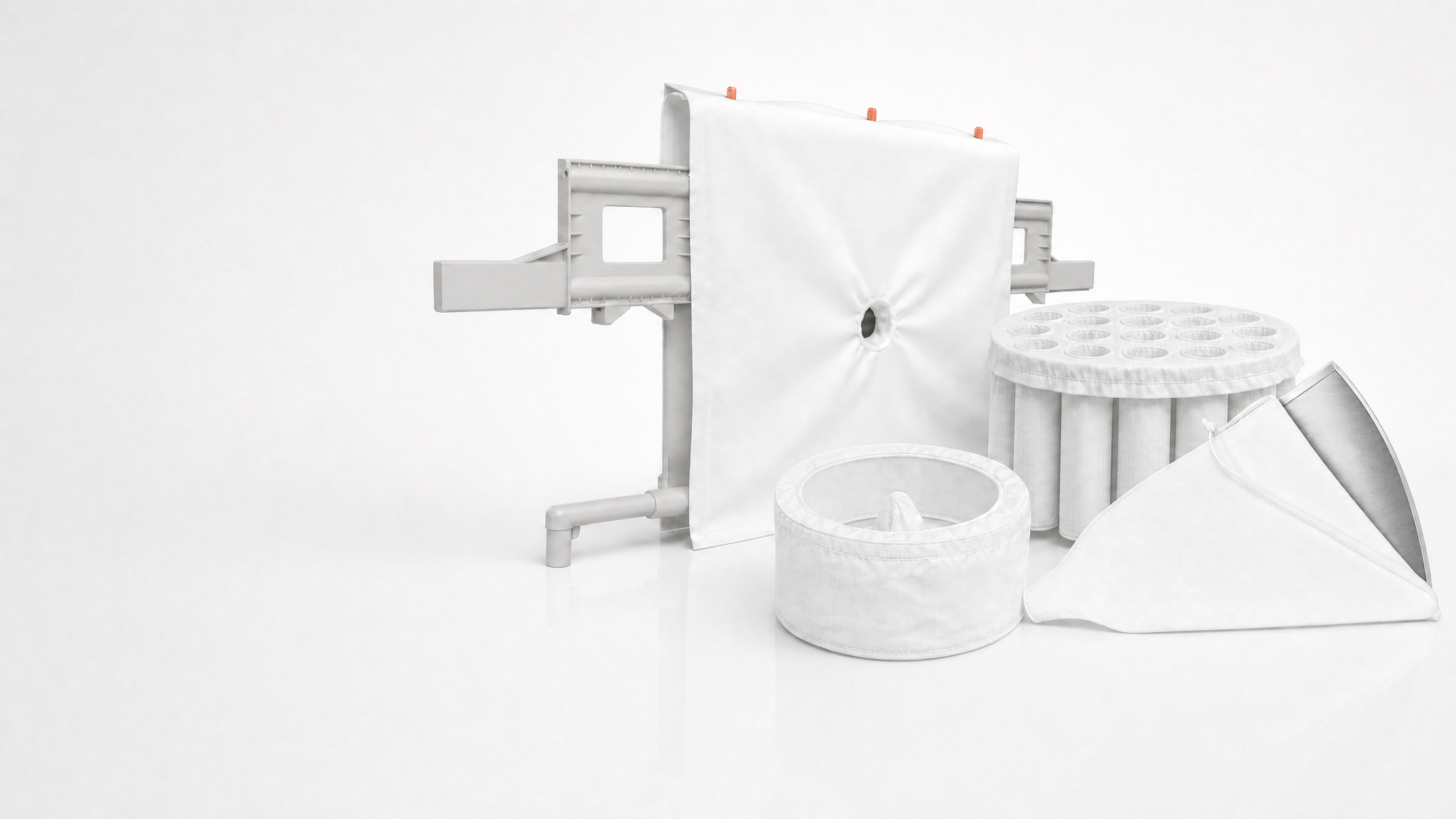
When you run a Nutsche filter on aggressive solvents, the fabric is not just a consumable — it is part of the process safety and product quality chain. The wrong material can swell, embrittle, contaminate the product, or fail early, leading to downtime and messy cake discharge problems. Choosing between PP, PET, PA, and PTFE starts with chemistry, but it ends with your real operating conditions: temperature, solvent mix, cleaning regime, and cake release behavior.
🔑 Key Takeaways
- PTFE is the safest choice for the broadest solvent resistance, especially in harsh or mixed chemical environments.
- PP is economical and works well for many solvents, but it has clear limits with strong aromatics and higher temperatures.
- PET offers good mechanical stability, but chemical resistance is not as broad as PTFE and must be checked carefully.
- PA can be useful in some applications, but it is usually the least attractive option for aggressive solvent service.
🧪 What Aggressive Solvents Do to Filter Fabrics
In a Nutsche filter, solvent exposure is not occasional — it is continuous during filtration, cake washing, and often drying. That means the fabric must keep its structure, permeability, and release behavior while being exposed to chemicals that can attack the polymer backbone or alter the surface.
From an operator’s point of view, the most common failure signs are easy to spot: loss of throughput, drip leakage, sticky cake release, or a sudden drop in clarity. If you are already seeing these symptoms, it is worth checking the fabric against common failure modes such as short filter lifespan and cake release problems.
💡 Tip: Always evaluate the full solvent system — not just the main product solvent. Washing liquids, mother liquor, and trace additives can change the resistance picture dramatically.
📊 PP, PET, PA, and PTFE: Practical Resistance Comparison
The table below gives an operator-level view of how the four common polymer families usually behave in aggressive solvent service. Exact compatibility depends on concentration, temperature, exposure time, and mechanical load, so treat this as a practical starting point, not a final approval.
| Material | Solvent Resistance | Temperature Stability | Cake Release | Best Use Case |
|---|---|---|---|---|
| PP | Good for many aqueous and mild solvent systems; limited with strong hydrocarbons and aromatics | Moderate | Good when surface finish is optimized | Cost-sensitive processes with moderate solvent stress |
| PET | Better mechanical stability, but solvent resistance must be checked carefully | Good | Moderate | Applications needing dimensional stability and consistent filtration |
| PA | Variable; can be vulnerable in acidic or strongly solvent-loaded environments | Good mechanical toughness | Often acceptable, but chemistry-limited | Niche service where toughness matters more than broad chemical resistance |
| PTFE | Excellent across a very wide range of aggressive solvents | Excellent | Excellent, especially with low-adhesion surfaces | Harsh solvent service, pharma, high-value chemicals, difficult cake release |
⚙️ Selecting the Right Material for Your Nutsche Filter
For operators, the decision usually comes down to three questions: What is the solvent? How hot is the process? and How clean must the cake discharge be? The answer is often different from what a chemical compatibility chart alone suggests.
List the main solvent, wash media, and any additives. Compare against polymer compatibility, especially for aromatics, chlorinated solvents, and strong cleaning agents.
Higher temperature accelerates chemical attack and can reduce fabric life even when the solvent itself seems acceptable at room temperature.
If the cake must discharge cleanly and consistently, low-adhesion materials and surface finishing become as important as basic resistance.
⚠️ Caution: Do not assume a fabric that survives one solvent will survive the full batch cycle. Cleaning-in-place, steam, and hot caustic or acidic residues can be more damaging than the main product solvent.
For many chemical plants, the best long-term solution is a purpose-built Nutsche fabric such as the RF-ANF Series Nutsche Pharma fabric, especially when product purity and solvent resistance both matter. If you are comparing fabric families across different machine types, the same chemical logic also applies to RF-CF Series centrifuge fabrics and other process-specific media.
🔧 Operator Rules That Prevent Early Failure
Fabric selection is only half the story. The other half is how you run the filter day to day. In solvent service, small process changes can have a big effect on permeability and release.
Rule of thumb: If the solvent is aggressive enough that you hesitate to leave a wetted sample in a beaker overnight, assume you need a higher-grade fabric — often PTFE or a specially engineered multilayer solution.
📋 Pre-start checklist for solvent service
- Confirm all wetted materials are compatible with the full solvent and wash sequence
- Check stitching, seams, and edge finishing for contamination risk
- Inspect for swelling, hardening, or surface damage before installation
- Validate drainage and cake release on the first batch after changeout
- Review ATEX and static safety if flammable solvents are used
If your process also involves flammable atmospheres, do not ignore static risk. Materials and construction should be reviewed alongside ATEX-related antistatic requirements, especially in pharmaceutical and fine chemical plants described under chemical industry applications.
💡 When to Use PTFE and When a Simpler Polymer Is Enough
PTFE is the safest answer when you need broad chemical compatibility, low surface energy, and maximum process robustness. It is especially valuable where product value is high, contamination cannot be tolerated, or repeated cleaning makes the fabric work hard between batches.
That said, PTFE is not automatically the best choice for every plant. If your solvent system is mild, your process temperature is controlled, and your budget pressure is real, PP or PET may deliver a better total cost of ownership. The right choice is the one that balances chemical resistance, cake release, and service life — not just raw chemical compatibility.
For operators building a new setup or replacing a worn fabric, it helps to use a structured selection tool. You can configure your nutsche filter fabric online and instantly receive a pre-filled, non-binding specification and inquiry for your process.
To understand how these fabrics fit into broader process environments, see our Nutsche filter machine overview and related chemical industry applications.
📩 Need Help Choosing the Right Fabric?
Our technical team at R+F FilterElements can help you find the perfect filter fabric for your specific application. Get in touch for a free consultation — we will recommend the right solution based on your machine, process, and operating conditions.
Ready to move faster? Configure your nutsche filter fabric online and get a non-binding specification tailored to your solvent service.