
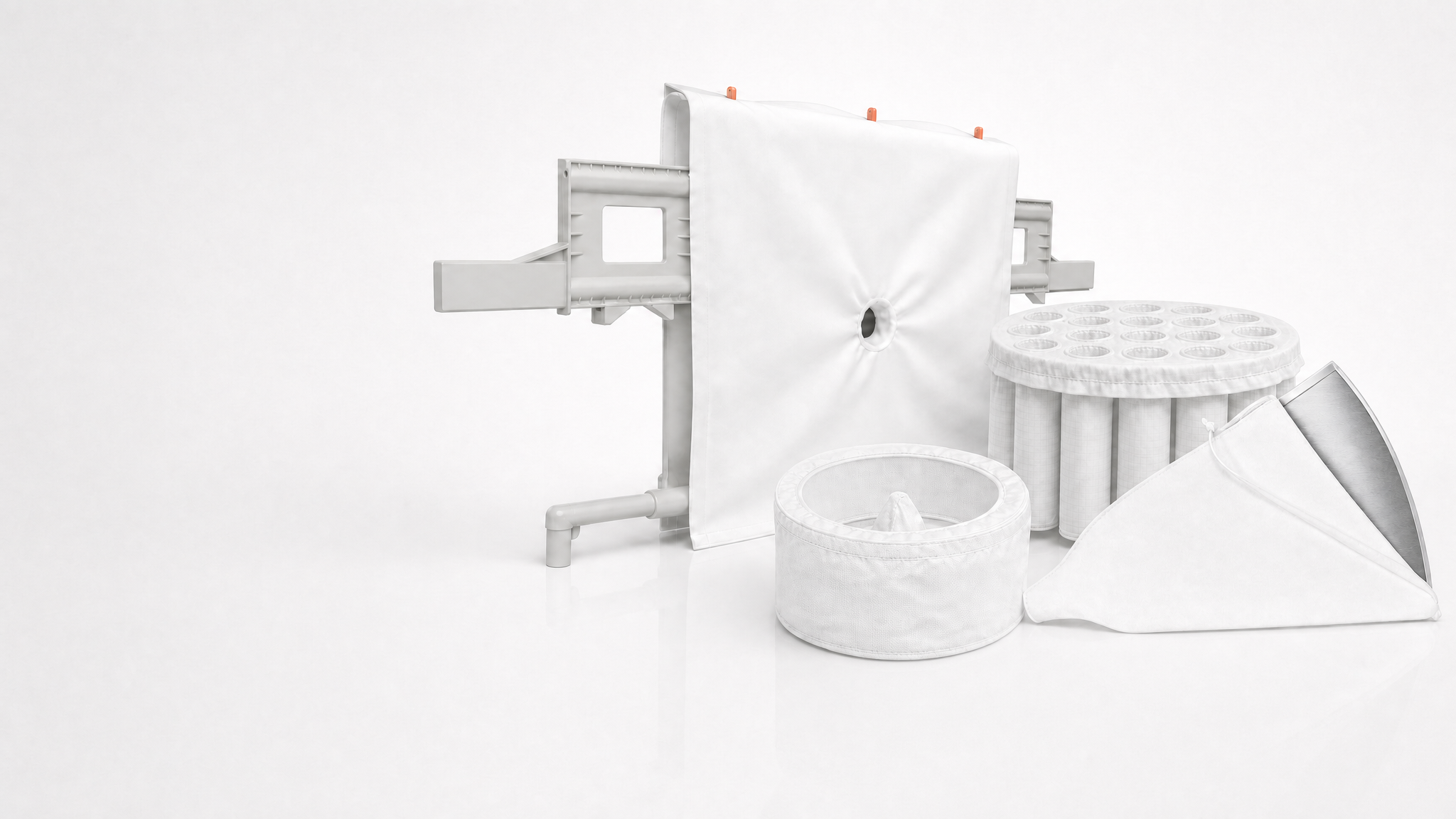
Adhesive and resin filtration is all about protecting downstream quality: removing gels, black specks, fibre contamination, and undissolved particles before they show up in the final coating, laminate, or molded part. In high-viscosity polymer solutions, the challenge is to hold back fine contamination without creating an excessive pressure drop or slowing the line down.
🔑 Key Takeaways
- Adhesives, resins, and polymer solutions need fine filtration to remove gels, specks, fibres, and unmelted solids.
- Sparkler filters and pressure leaf filters are common choices for batch and continuous polishing filtration.
- Filter fabrics must handle aggressive solvents such as acetone, toluene, and MEK, plus elevated temperatures in hot melt processes.
- R+F RF-SP Series sparkler filter fabrics and RF-PLF Series pressure leaf filter fabrics are designed for demanding polymer applications.
🧪 Why Adhesive and Resin Filtration Matters
In adhesive and resin production, even a few visible contaminants can cause serious problems. Gels can block nozzles, black specks can ruin appearance, fibres can weaken a bond line, and undissolved particles can create weak points or surface defects. If you run a process with tight quality limits, filtration is not optional — it is part of process control.
This is especially true in polymer solutions and hot melt adhesives, where the product may be highly viscous, temperature-sensitive, or solvent-based. A stable filter fabric helps you keep throughput consistent while protecting product quality and reducing rework.
Common contaminants operators want to remove
- Gels from incomplete mixing or polymerization anomalies
- Black specks from degraded material or contamination
- Fibre contamination from bags, liners, or upstream handling
- Undissolved particles from resin, additives, or pigments
⚙️ Typical Machines: Sparkler Filters and Pressure Leaf Filters
For adhesive and resin service, the most common setups are sparkler filters and pressure leaf filters. Both are used to polish the product before filling, coating, or conversion. If your line includes a sparkler unit, you can pair it with sparkler filter machines and matching RF-SP Series sparkler filter fabrics for dependable solids retention.
For larger batches or continuous operation, pressure leaf systems are often preferred. They provide a strong balance between filtration area and throughput, especially when the fluid is thick or loaded with fine solids. In that case, pressure leaf filter machines combined with RF-PLF Series pressure leaf filter fabrics are a practical choice.
| Machine type | Typical use | Key fabric challenge | R+F series |
|---|---|---|---|
| Sparkler filter | Polishing resins and adhesives | Fine retention with low pressure drop | RF-SP Series |
| Pressure leaf filter | Higher-volume polymer solutions | Solids load and long run time | RF-PLF Series |
| Hot melt adhesive system | Elevated-temperature filtration | Heat stability and dimensional stability | RF-SP / RF-PLF depending on design |
🔬 Fabric Challenges: Solvents, Viscosity, and Fine Retention
Filter fabrics for adhesives and resins need to survive tough operating conditions. Many formulations use acetone, toluene, or MEK, so chemical resistance matters just as much as pore structure. At the same time, the cloth must retain fine particles without choking too quickly and causing a pressure spike.
⚠️ Caution: If solvent compatibility is ignored, the fabric can swell, weaken, or lose dimensional stability. That can lead to bypass, premature failure, or contaminated product.
Rule of thumb: In resin filtration, choose the finest fabric that still allows a stable flow rate — over-tight cloth can increase pressure drop faster than it improves product quality.
Operators often have to balance three competing demands:
- Fine retention for gels and specks
- Low pressure drop for stable throughput
- Chemical resistance for aggressive solvents and cleaning media
If your process is showing visible contamination or frequent cloth blinding, it may be linked to the fabric structure rather than the machine itself. See also filter cloth clogging and short filter lifespan for common troubleshooting paths.
🏭 Hot Melt Adhesive Filtration at Elevated Temperatures
Hot melt adhesive lines bring extra complexity because the product is filtered while warm or hot. Elevated temperatures can improve flow, but they also increase the demand on the fabric’s thermal stability. For operators, that means checking not only filtration efficiency but also whether the fabric keeps its shape, seam integrity, and pore consistency during repeated heating cycles.
💡 Tip: In hot melt service, keep the filter housing temperature stable. Rapid cooling can increase viscosity at the cloth surface and accelerate blinding.
This is where the right fabric construction pays off. A well-matched filter media helps maintain performance during start-up, steady operation, and shutdown, even when the adhesive becomes more demanding as temperature changes. If your process also needs antistatic protection, review antistatic and ATEX-related requirements.
What to check before startup
📋 Operator Checklist
- Confirm solvent compatibility with the full formulation
- Verify temperature range at startup and steady state
- Inspect seams, support rings, and sealing edges
- Check differential pressure limits before the batch begins
- Review cleaning method and drying step after shutdown
✅ How R+F RF-SP and RF-PLF Series Fit the Job
R+F develops engineered filter fabrics for industrial solid-liquid separation, including demanding adhesive and resin applications. The RF-SP Series is a strong fit for sparkler filter systems where consistent fine filtration is needed. The RF-PLF Series is designed for pressure leaf filters where longer runs, solids loading, and process stability are important.
Operators looking for a broader system match can also explore related machine-specific options such as pressure leaf filter machines and sparkler filter machines. If your plant handles other liquid-solid separation duties, you may also want to review our solutions for chemical industry applications.
Identify gels, specks, fibres, and particles so the fabric retention level matches the real problem.
Confirm compatibility with acetone, toluene, MEK, and any cleaning or flushing agents.
Choose a construction that keeps pressure drop manageable over the full batch cycle.
Not sure which fabric suits your machine and process conditions? Use our Solution Finder to find and configure the right filter fabric online and receive a pre-filled, non-binding specification and inquiry.
📩 Need Help Choosing the Right Fabric?
Our technical team at R+F FilterElements can help you find the perfect filter fabric for your specific application. Get in touch for a free consultation — we will recommend the right solution based on your machine, process, and operating conditions.
For a fast next step, use the Solution Finder to select your machine, define the operating conditions, and send a non-binding inquiry with the right specification already prepared.