
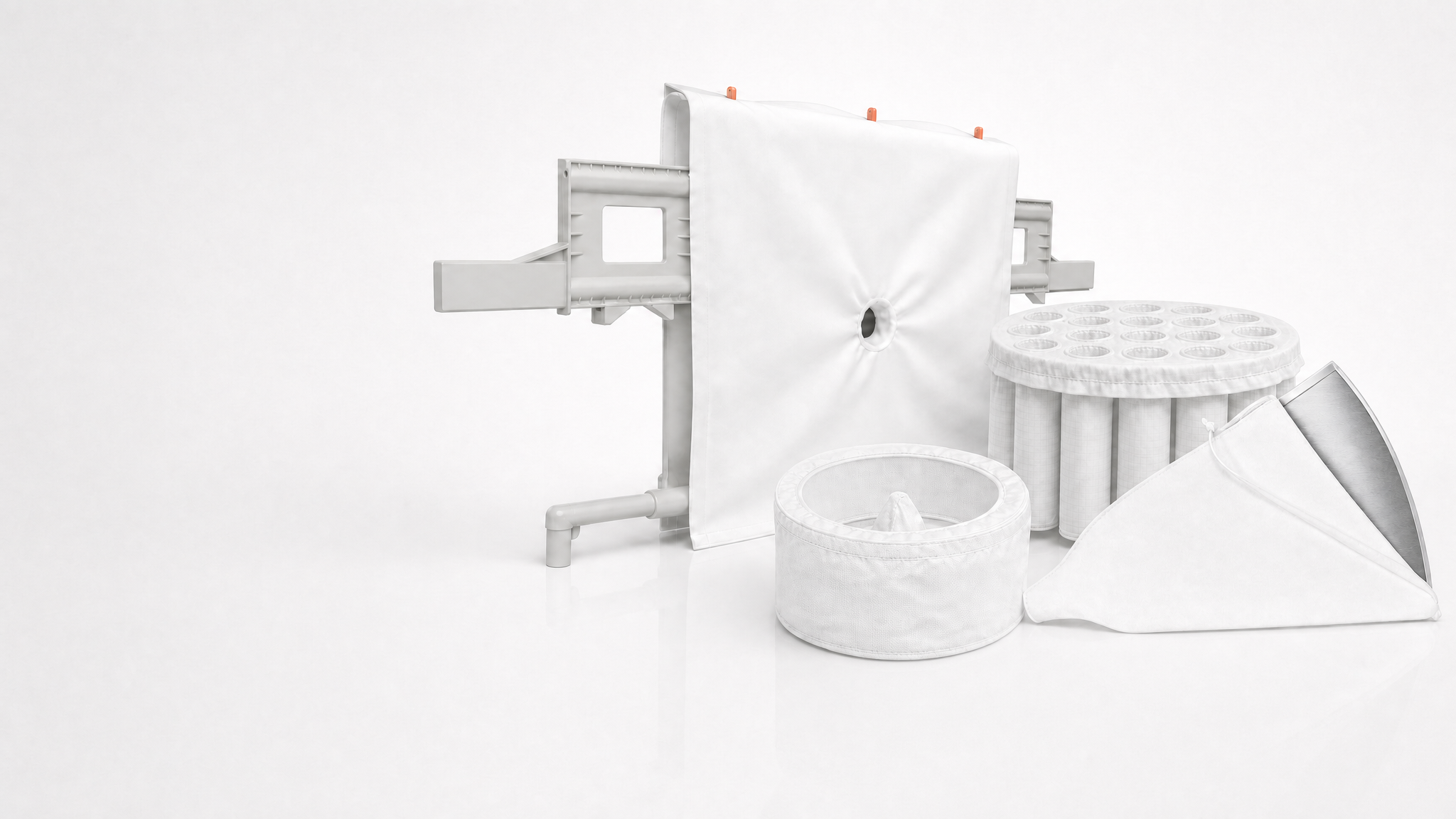
In cosmetics production, filtration is not just a finishing step — it is what protects product clarity, stability, and premium feel. Whether you are polishing a lotion, clarifying an essential oil, or hot-filtering a wax base, the right filter fabric helps you keep batches clean, consistent, and GMP-ready.
For operators working with sparkler filters and small pressure leaf filters, fabric choice matters as much as the machine itself. In the following sections, we look at what cosmetic plants need from filter media and where R+F RF-SP Series sparkler filter fabrics and R+F RF-PLF Series pressure leaf filter fabrics fit into the process.
🔑 Key Takeaways
- Cosmetic filtration must deliver clarity, cleanliness, and low extractables.
- Food/cosmetic-grade fabrics help support ISO 22716 GMP expectations.
- Essential oils, fragrances, and waxes often need fine retention and temperature resistance.
- Sparkler filters and pressure leaf filters are common choices for polish-grade filtration.
⚠️ Caution: In cosmetics, a “clean” filtration setup is not enough. If the fabric sheds fibers, contains unwanted extractables, or traps residues between batches, the final product can fail internal quality checks or customer expectations.
⚙️ What Cosmetic Filtration Has to Achieve
Unlike bulk chemical filtration, cosmetic processing is usually about polish-grade clarity and product appearance. A lotion may need to look smooth and uniform, an essential oil must stay bright and free of haze, and a fragrance concentrate must not carry visible particles into filling.
- Low particle carryover for clear, attractive end products
- Low extractables to protect odor, color, and formulation integrity
- Gentle flow behavior to avoid damaging delicate emulsions
- Temperature stability for waxes, balms, and hot oils
If you also run filtration in other regulated sectors, the same discipline applies in pharmaceutical applications and can inform your cosmetic QA practices as well.
🔬 Where Sparkler Filters and Pressure Leaf Filters Fit
For cosmetic plants, the most common machines are sparkler filters for polishing liquids and small pressure leaf filters for deeper clarification or batch cleaning. Both systems benefit from fabrics that balance retention, throughput, and cleanability.
| Application | Typical machine | Fabric priorities | Operator goal |
|---|---|---|---|
| Cream / lotion polishing | Sparkler filter | Fine retention, smooth flow, easy cleaning | Clear, stable, premium appearance |
| Essential oil clarification | Pressure leaf filter | Low extractables, fine particle capture | Bright, residue-free oil |
| Fragrance compound filtration | Sparkler filter | Odor neutrality, polish-grade clarity | Consistent fragrance quality |
| Wax-based products | Pressure leaf filter | Temperature resistance, dimensional stability | Clean hot filtration without collapse |
R+F RF-SP Series is a strong choice when you need a fabric that supports final polishing on sparkler units. For deeper batch clarification, RF-PLF Series is designed for pressure leaf filter use where stable support and reliable cake formation are essential.
💡 Tip: If your process changes from cold fragrance filtration to hot wax service, verify both the temperature profile and the cleaning method before selecting the fabric. A media that works well at room temperature may deform or blind faster in hot service.
🧪 Cosmetic Applications: Creams, Oils, Fragrances, and Waxes
Polishing creams and lotions
For creams and lotions, the main objective is to remove stray particles, unmixed solids, or process debris without disturbing the emulsion. The fabric must allow enough flow to avoid long cycle times while still delivering a polished appearance.
Clarifying essential oils
Essential oils are sensitive products. Operators need filtration that does not contribute odor, color shift, or unwanted extractables. This is where food/cosmetic-grade materials become critical, especially when the product is destined for high-end personal care or aromatherapy blends.
Filtering fragrance compounds
Fragrance concentrates are often judged by appearance, stability, and purity. Even small particulate contamination can create off-spec product or cause issues in downstream filling and blending. Here, a fine, consistent filter structure helps keep the batch clean.
Hot filtration of lipsticks and balms
Wax-based products require special attention. During hot filtration, the fabric must withstand elevated temperatures and maintain mechanical strength. If the media softens too much, it can distort, leak, or reduce filtration performance.
📋 GMP and ISO 22716: What Operators Should Watch
Cosmetic plants working under ISO 22716 need filtration components that fit a controlled manufacturing system. That means documented materials, cleanability, traceability, and predictable performance from batch to batch. It also means reducing the risk of cross-contamination during changeovers.
📋 Pre-Use Checklist for Cosmetic Filtration Fabrics
- Confirm cosmetic- or food-grade material compatibility
- Check temperature resistance for hot wax or oil service
- Verify fine retention requirements for polish-grade clarity
- Review cleaning and replacement intervals
- Document lot traceability and installation records
Rule of thumb: If the product is judged by appearance, choose the fabric one step finer than you think you need — then validate flow rate and batch time in real operation.
For other process environments where hygiene and material control matter, operators often compare cosmetic setups with pressure leaf filter machines or sparkler filter systems used in adjacent clean-process industries.
🛠️ Practical Selection and Changeover Tips
In the plant, the best fabric is the one that performs consistently and is easy to live with during cleaning, inspection, and replacement. A fabric that improves clarity but blinds too fast may slow production; a fabric that flows well but releases fibers or particles can jeopardize quality.
Clarify whether you need polishing, clarification, or hot filtration.
Confirm whether the system is a sparkler filter or pressure leaf filter.
Record temperature, viscosity, solids load, and cleaning chemicals.
Run a trial and inspect clarity, throughput, and residue behavior.
💡 Tip: When moving between fragrances and waxes on the same equipment, keep a dedicated fabric specification for each service. That reduces contamination risk and improves repeatability.
Need help choosing the right media for your process? You can find and configure the right filter fabric with our Solution Finder by selecting your machine, operating conditions, and target product quality. The tool generates a pre-filled, non-binding specification and inquiry for a faster start.
For a quick comparison of our product families, you can also explore RF-SP Series sparkler filter fabrics and RF-PLF Series pressure leaf filter fabrics as the two most relevant options for cosmetic clarification and polishing.
📩 Need Help Choosing the Right Fabric?
Our technical team at R+F FilterElements can help you find the perfect filter fabric for your specific application. Get in touch for a free consultation — we will recommend the right solution based on your machine, process, and operating conditions.
Ready to simplify selection? Use our Solution Finder to find and configure the right filter fabric online and receive a pre-filled, non-binding inquiry for your cosmetic filtration setup.