
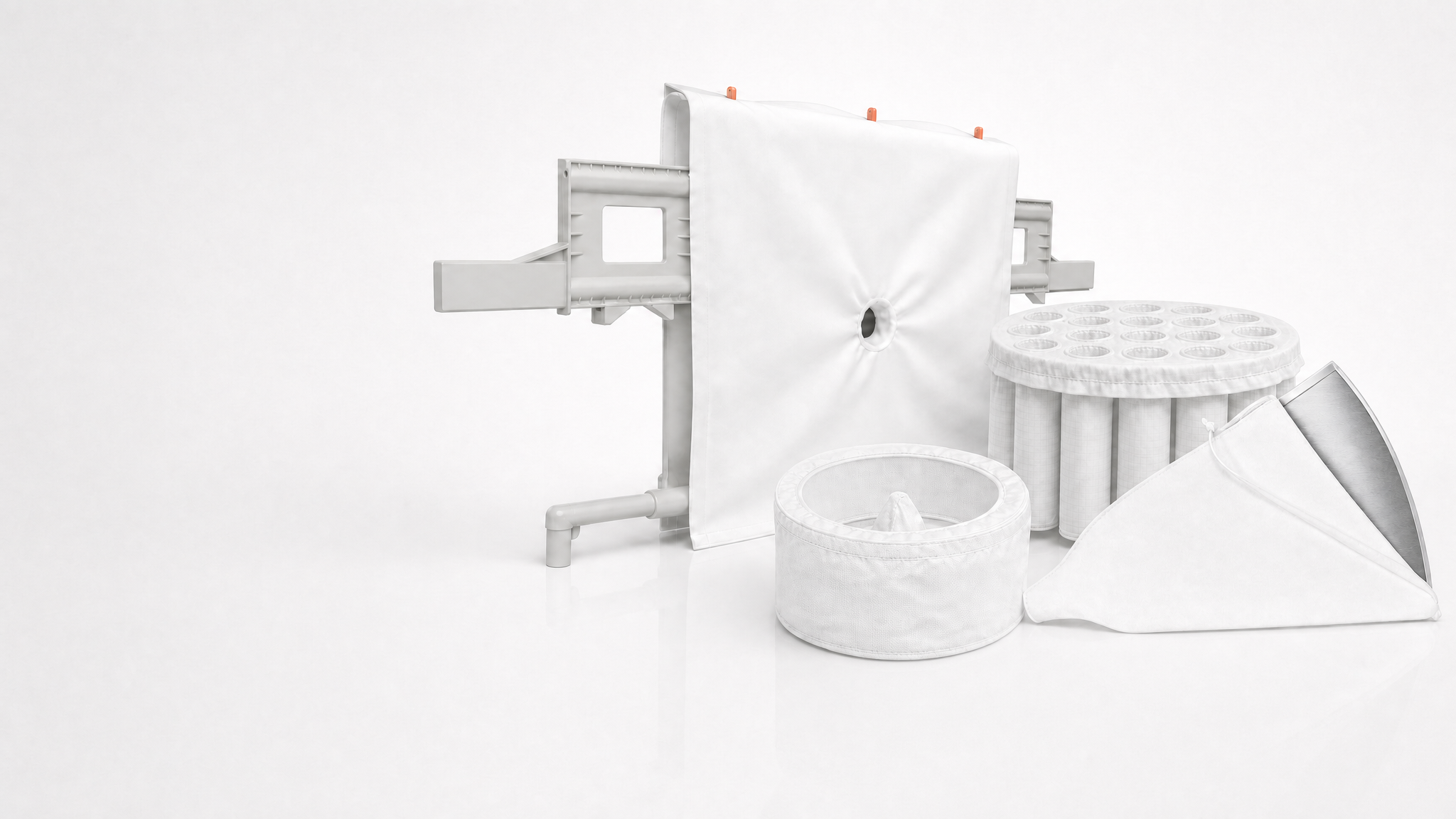
In paint, coating, and ink production, even tiny contamination can show up as visible defects: specks, gels, agglomerates, streaks, or nozzle clogging. If you run a sparkler filter, pressure leaf filter, or bag filter, the right filter fabric is what keeps product quality stable from batch to batch.
For operators, the goal is simple: fine retention without sacrificing flow, chemical resistance, or repeatability. That becomes especially important when you move from industrial coating to high-spec automotive paint systems.
🔑 Key Takeaways
- Paint, coating, and ink filtration removes agglomerates, gel particles, and contamination before they create defects.
- Typical retention ranges are 1–25 µm, depending on product viscosity and final surface quality requirements.
- Filter fabrics must resist solvents, resins, additives, and cleaning chemistry while keeping pore size consistent.
- R+F RF-SP Series sparkler filter fabrics and RF-PLF Series pressure leaf filter fabrics are built for demanding liquid filtration.
📋 Pre-Selection Checklist
- What particle size must be removed: gels, agglomerates, or foreign contamination?
- Which machine is in use: sparkler filter, pressure leaf filter, or bag filter?
- Which chemicals are present: solvents, binders, resins, dispersants, or cleaning agents?
- Is the target application automotive paint, decorative coating, or printing ink?
- Do you need repeatable pore size for every batch and every changeover?
⚙️ Why Filtration Matters in Paint, Coating, and Ink
In production, the biggest filtration problems are usually not obvious at first. A small gel particle, undispersed pigment cluster, or external contamination may pass through mixing and only appear later as a defect on the final surface. That means extra rework, wasted material, or a rejected batch.
As an operator, you need a fabric that supports stable separation and predictable flow behavior. This is where a consistent pore structure makes a difference. If pore size varies too much, you may get either premature blinding or poor particle retention.
For more demanding process lines, the fabric choice also affects downstream efficiency. When filter cloths clog too quickly, operators face shorter cycles and more downtime. For practical guidance on that issue, see our page on filter cloth clogging.
🔬 Typical Machines: Sparkler Filters, Pressure Leaf Filters, and Bag Filters
Paint, coating, and ink producers often rely on sparkler filters and pressure leaf filters for fine clarification. Bag filters are also used upstream or for pre-filtration, especially where solids loading is higher and the process needs an economical first barrier.
The fabric must match the machine design. For example, a sparkler filter needs a fabric that seals well and maintains fine separation under repeated pressure cycles. A pressure leaf filter may demand a larger filtration area and a fabric that holds its structure over long service intervals. You can explore the machine-specific setup on our sparkler filter machine page and pressure leaf filter machine page.
🧪 Fabric Requirements: Fine Retention, Chemical Resistance, Consistent Pore Size
For paint and ink systems, the fabric has to do more than trap particles. It must survive solvents, resins, and repeated washing without changing its filtration behavior. A fabric that swells, softens, or loses structure can quickly become a process problem.
What operators should look for
- Fine retention: usually in the 1–25 µm range, depending on product finish and line sensitivity.
- Chemical resistance: compatibility with solvents, binders, resins, and cleaning media.
- Stable pore size: reliable particle retention from the first batch to the last.
- Low risk of contamination: clean construction and controlled fiber behavior.
⚠️ Caution: If the fabric is not resistant to the coating chemistry, swelling or fiber degradation can change pore size and cause premature failure, leakage, or contamination of the final product.
💡 Tip: When you validate a new fabric, test it under real process temperature, solvent exposure, and cleaning conditions — not only in water or a simplified lab sample.
If you are seeing poor release or product carryover during filter cleaning, review cake release issues and drip leakage before changing the entire process setup.
🏭 Automotive Paint vs. Industrial Coating: Different Demands
Not all coatings need the same filtration precision. Automotive paint typically requires the highest visual quality, very low defect tolerance, and extremely stable batch-to-batch results. Even minor specks can become visible on a glossy topcoat.
Industrial coatings may allow slightly broader filtration tolerances, but they often bring tougher chemistry, higher solids, or more abrasive pigments. That means the fabric may need stronger chemical compatibility and a longer service life even if the cosmetic requirement is less strict.
| Requirement | Automotive Paint | Industrial Coating |
|---|---|---|
| Defect tolerance | Very low | Low to medium |
| Filtration fineness | Typically finer | Often process-dependent |
| Chemical exposure | Solvents, resins, additives | Often stronger or more varied chemistry |
| Priority | Surface appearance and consistency | Durability, throughput, and chemical resistance |
For plants handling broader chemical streams, our chemical industry applications page gives a useful overview of typical operating conditions.
🛠️ How to Choose the Right Fabric for Your Line
The right fabric choice starts with your machine, then moves to process chemistry, and finally to the final quality target. If you are unsure whether the line needs a finer or coarser retention level, begin with the defect you are trying to eliminate.
Determine whether you are fighting gels, agglomerates, foreign particles, or haze in the finished product.
Confirm whether the system uses a sparkler filter, pressure leaf filter, or bag filter, then select a fabric built for that geometry.
Review solvents, binders, and cleaning agents to avoid swelling, softening, or early wear.
Choose a fabric with consistent pore size so each batch behaves the same and filtration results stay predictable.
Rule of thumb: If the coating has a high gloss or the ink is used for fine-print applications, choose the most stable pore structure you can run without sacrificing throughput.
For operators who want an efficient way to narrow down options, you can find and configure the right filter fabric with our Solution Finder and receive a pre-filled, non-binding specification request based on your machine and process.
✅ Why R+F RF-SP and RF-PLF Series Fit These Applications
R+F focuses on engineered filter fabrics for industrial solid-liquid separation, and the RF-SP Series and RF-PLF Series are especially relevant for fine liquid clarification in paint, coating, and ink production.
- RF-SP Series: a strong fit for sparkler filter installations where fine retention and surface quality matter.
- RF-PLF Series: suited for pressure leaf filter systems that need reliable clarification and stable running behavior.
- Process stability: both series are designed to support repeatable quality in demanding production environments.
- Operator-friendly selection: helpful when the goal is to reduce defects without overcomplicating the filter setup.
If you are comparing machine types or considering a retrofit, it can also help to review your existing setup against the relevant machine page, such as pressure leaf filters or sparkler filters.
💡 Tip: If you see fine specks after filtration, don’t only increase pressure — first check whether the fabric pore structure is matched to the actual contaminant size.
📩 Need Help Choosing the Right Fabric?
Our technical team at R+F FilterElements can help you find the perfect filter fabric for your specific application. Get in touch for a free consultation — we will recommend the right solution based on your machine, process, and operating conditions.
Prefer a faster starting point? Use our Solution Finder to select your filtration machine, configure the right fabric online, and receive a pre-filled, non-binding inquiry.