
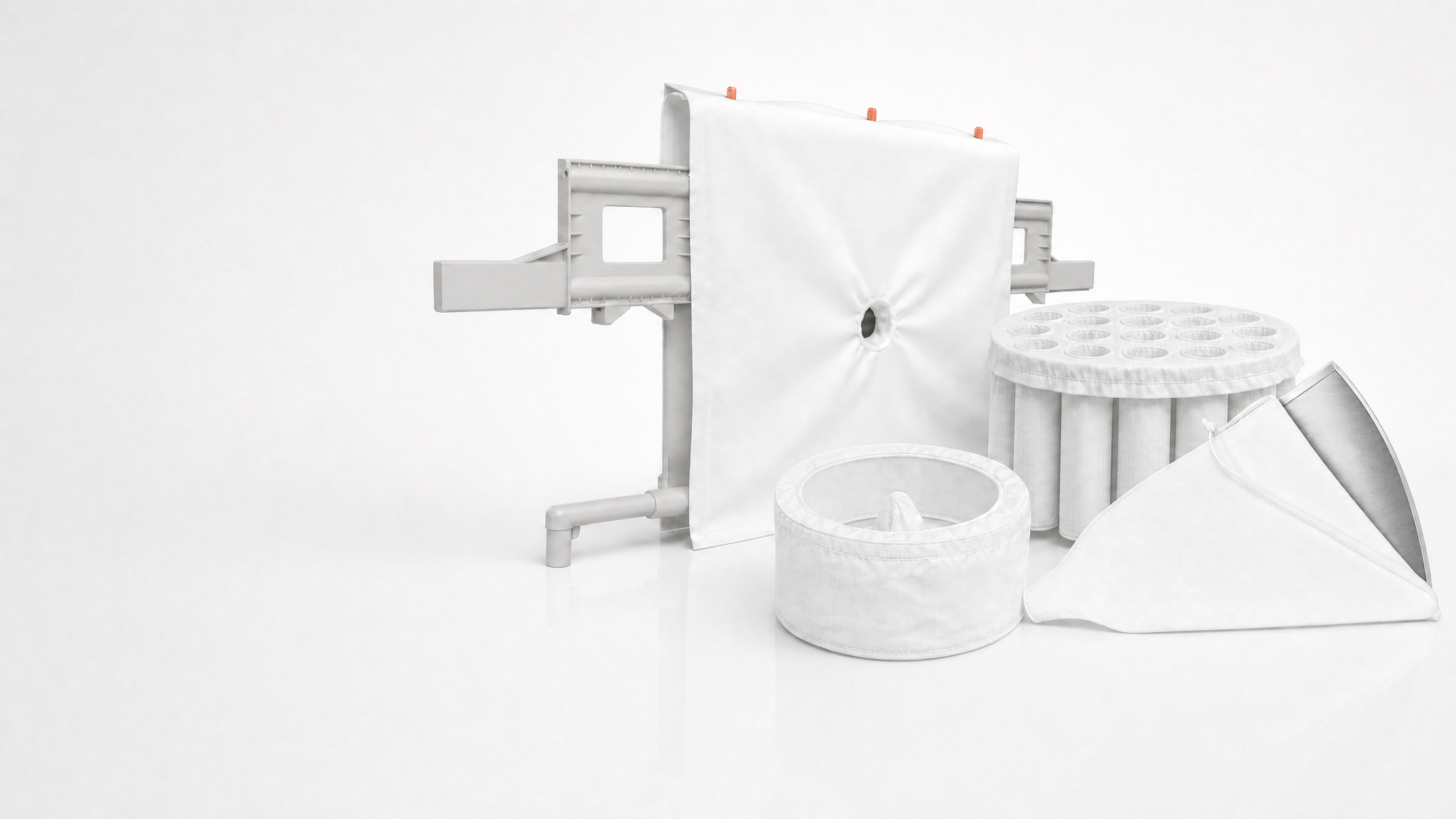
In slack wax de-oiling, the filter press sits at the heart of the refinery’s wax recovery loop. The process depends on a controlled sweating and pressing cycle that removes oil while preserving wax quality, and the filter cloth must survive heat, solvent exposure, and repeated cake release cycles.
For operators, the right fabric can make the difference between stable throughput and a press that slowly loses permeability, cakes badly, or demands constant cleaning. That is why many plants specify purpose-built RF-FF Series filter press fabrics for high-temperature wax service.
🔑 Key Takeaways
- Slack wax de-oiling in refineries typically runs at 70–100°C and demands heat-stable filter press cloths.
- Successful wax release depends on a smooth, low-adhesion fabric surface, often achieved by calendering or PTFE coating.
- Wax penetration into pores and progressive blinding reduce permeability, so cleaning and fabric selection are critical.
- R+F supplies custom filter press cloths for demanding refinery duty, built for better cake release and longer service life.
⚙️ How Slack Wax De-Oiling Works in the Press
Slack wax is the wax-rich fraction recovered from lubricating oil refining. In the de-oiling step, the material is first conditioned so the oil can separate from the wax crystals, then fed into a filter press where pressure assists liquid removal and cake consolidation. The key operational challenge is that wax is not a conventional slurry: it can soften, smear, and re-enter the fabric if temperature and cycle timing are not controlled.
In practice, the sequence is a combination of:
- Sweating — holding the wax at controlled temperature so trapped oil migrates outward.
- Pressing — using the filter press to force out the residual oil-rich phase.
- Cake discharge — releasing a coherent wax cake without tearing or leaving residue.
For this reason, many operators prefer a filter press over alternative separation equipment when they need a robust batch process, a dense cake, and precise control over temperature and residence time. If you also run other solid-liquid separation steps, it can help to compare press fabrics with RF-PLF Series pressure leaf filter fabrics or filter press machine layouts to confirm the best fit for your duty.
🔬 Why Filter Presses Are Preferred in Refineries
In slack wax service, operators often choose a filter press because it offers strong mechanical dewatering, repeatable batch control, and good separation efficiency at elevated temperatures. Compared with continuously moving systems, the press gives you a defined fill, hold, and discharge sequence that matches the wax conditioning window.
The cloth is a process component, not just a support medium. It must tolerate hot product, solvent cleaning, and repeated thermal cycling while still letting the wax cake release cleanly. If the cloth surface grabs the cake, the whole cycle slows down and contamination risk rises.
🏭 Temperature and Material Selection
For slack wax de-oiling, the fabric substrate must remain dimensionally stable and mechanically reliable at 70–100°C. That typically means PET or PA constructions, selected based on your thermal window, chemical exposure, and expected service life. The wrong material can shrink, harden, or lose tension, which immediately affects sealing and filtrate clarity.
Rule of thumb: If the cloth feels “perfect” at ambient temperature but starts to distort, glaze, or stick after heat-up, it is not suited for slack wax de-oiling duty.
| Fabric option | Strengths | Best for | Operator note |
|---|---|---|---|
| PET, calendered | Stable, smooth, economical | General wax pressing | Good first choice for improved release |
| PA, calendered | Tough, flexible, heat tolerant | More demanding cycles | Useful where mechanical stress is high |
| PET or PA with PTFE finish | Very low adhesion | Sticky wax, difficult cake discharge | Best when release is the top priority |
🛠️ Common Operating Problems and How to Avoid Them
The most common issue in slack wax service is wax penetration into fabric pores. Once wax migrates into the weave, permeability drops and the cloth becomes harder to clean. Over time, this leads to longer cycle times, higher pressure drop, and inconsistent cake release.
- Reduced permeability over time: caused by pore blinding, heat-softened wax residues, and insufficient cleaning.
- Sticking during discharge: often linked to rough cloth surfaces or insufficient surface treatment.
- Drip leakage and edge build-up: can appear when the cake does not release cleanly or the cloth loses tension. See drip leakage troubleshooting and cake release solutions.
- Short cloth life: usually results from the wrong polymer choice or overly aggressive cleaning. Review short filter lifespan causes.
⚠️ Caution: Hot solvent wash cycles must be validated for your plant’s safety procedures, solvent compatibility, and ventilation requirements. Do not exceed the fabric’s temperature and chemical limits.
📋 Pre-Start Checklist for Wax Press Operation
- Confirm fabric temperature rating matches the 70–100°C process window.
- Check the cloth surface for glazing, hard spots, or embedded wax.
- Verify tension, seam integrity, and edge sealing before filling.
- Make sure the washing protocol is set for hot solvent cleaning where required.
- Inspect filtrate clarity after startup and watch for early blinding.
🧪 Cleaning, Maintenance, and Fabric Life
Because slack wax can penetrate deeply into the weave, cleaning is just as important as the initial fabric specification. In many plants, a hot solvent wash is used to dissolve residual wax and restore permeability. The goal is to remove embedded residues without damaging the polymer structure or surface finish.
💡 Tip: A smoother fabric finish usually releases wax cakes more consistently, but the best result comes from pairing that finish with the right weave density and thermal stability.
Run the press within the target wax window so the cake forms correctly and does not smear into the cloth.
Ensure the cloth surface promotes release rather than adhesion, especially in the corners and drainage zones.
Use a validated hot solvent wash to restore flow paths and slow permeability loss over repeated cycles.
✅ Selecting the Right R+F Filter Cloth for Slack Wax
For refinery operators, the ideal cloth is a balanced solution: temperature-stable, low-adhesion, and easy to clean. R+F develops custom filter press cloths for these demanding duties, combining material selection, weave design, and surface finishing to match your actual operating conditions.
Start with the machine and process context. If you are running a conventional press, the RF-FF Series filter press fabrics are a logical starting point. If your installation includes auxiliary separation steps or related refinery filtration units, you may also want to compare them with other engineered options such as the RF-SB Series spiral belt fabrics or review the relevant filter press machine page for system alignment.
- Need better cake release? Specify calendering or PTFE coating.
- Need better thermal stability? Choose PET or PA based on your temperature profile.
- Need longer service intervals? Optimize pore structure and cleaning compatibility.
If you want to shorten specification time, you can configure your filter press filter fabric online and instantly receive a pre-filled, non-binding specification and inquiry for your application.
📩 Need Help Choosing the Right Fabric?
Our technical team at R+F FilterElements can help you find the perfect filter fabric for your specific application. Get in touch for a free consultation — we will recommend the right solution based on your machine, process, and operating conditions.
Prefer a faster start? Configure your filter press filter fabric online to generate a pre-filled, non-binding inquiry for your slack wax de-oiling duty.