
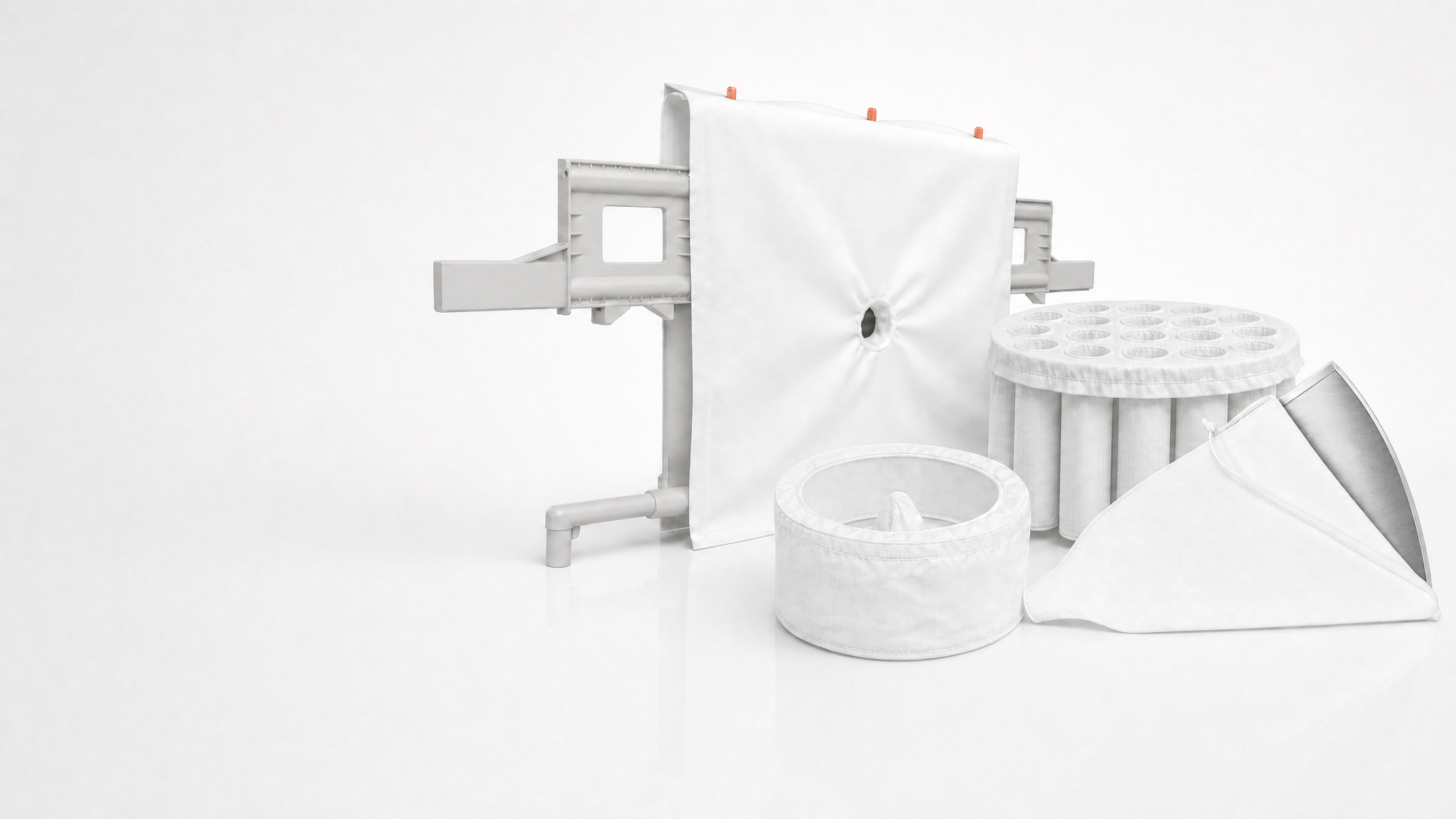
Pressure leaf filters are a workhorse in solid-liquid separation, but the fabric you choose has a direct impact on cycle time, filtrate clarity, cake release, and maintenance effort. If you operate a vertical or horizontal PLF, selecting the right media is less about “one universal cloth” and more about matching the fabric to your slurry, temperature, discharge method, and sealing concept.
🔑 Key Takeaways
- Match fabric material and weave to slurry chemistry, temperature, and required filtration fineness.
- On PLFs, sealing quality matters as much as permeability because edge leakage can bypass the media.
- Vertical and horizontal units often need different fabric handling, support, and cake-release strategies.
- Use a structured selection process — and when in doubt, find and configure the right filter fabric with our Solution Finder.
🏭 What a Pressure Leaf Filter Demands from the Fabric
A pressure leaf filter operates under pressure, so the fabric must do more than retain solids. It has to support cake formation, maintain throughput, resist blinding, and keep a tight seal around the leaf frame. If the media is too open, you lose clarity; if it is too tight, differential pressure rises too quickly and the cycle becomes unstable.
The first decision is usually whether you run a vertical or horizontal PLF. Vertical systems often place more emphasis on drainage and gravity-assisted cake release, while horizontal designs can make access, tensioning, and cleaning easier. For the machine-side details, it helps to review the pressure leaf filter machine overview before choosing the media.
🔬 How to Select the Right Filter Media
For operators, the most reliable approach is to start with the process, not the cloth. Ask what the slurry contains, how abrasive it is, whether the filtrate must be exceptionally clear, and how the cake is removed. Then choose the fabric construction that supports those conditions.
Material options that matter in day-to-day operation
- Polypropylene: Common choice for many chemical and wastewater duties; good general resistance and often cost-effective.
- Polyester: Useful where mechanical stability is important and operating temperatures stay within range.
- Specialty fibers: Consider when chemistry, temperature, or regulatory demands go beyond standard options.
In many plants, the best results come from pairing the right fiber with the right weave and finish. That is especially true when the cake is sticky or when you have had recurring issues with poor cake release or filter cloth clogging.
| Selection factor | What the operator should look for | Typical impact on performance |
|---|---|---|
| Chemical resistance | Compatibility with acid, alkali, solvents, or process additives | Longer life, fewer failures |
| Temperature resistance | Stable operation at actual process temperature, not just nominal conditions | Reduced shrinkage and distortion |
| Permeability | Balance between clarity and flow rate | Higher throughput or better filtrate quality |
| Surface finish | Calendered or optimized surface for release and cleaning | Less blinding, easier discharge |
💡 Tip: If your PLF is producing clear filtrate at the start of the cycle but pressure rises too fast, the fabric may be too tight or too prone to blinding for your solids loading.
🛠️ Sealing and Edge Design: Where Many PLF Problems Start
Even a well-chosen fabric can perform badly if the seal is weak. On pressure leaf filters, leakage often appears at seams, edges, or around the leaf frame rather than through the fabric itself. That is why sealing and fabrication details are central to selection.
⚠️ Caution: A poorly sealed PLF cloth can cause bypass, contaminate filtrate, and lead to premature replacement. In pressure service, small edge gaps quickly become major process losses.
What to check before installation
📋 PLF fabric installation checklist
- Verify the cloth dimensions against the leaf frame and fastening points.
- Inspect seams, hems, and reinforced areas for uniform construction.
- Check whether the edge design supports the required sealing method.
- Confirm that drainage paths are not blocked by excess stitching or folds.
- Make sure the fabric can be tensioned without wrinkling or distortion.
If you are dealing with chronic leakage, it is worth reviewing the broader drip leakage problem guide and confirming whether the issue is cloth design, frame condition, or installation practice.
Rule of thumb: If the seal is exposed to repeated opening, closing, or cleaning cycles, choose a fabric construction that protects the edge first — not just the filtration surface.
⚙️ Vertical vs. Horizontal PLF: Choosing for the Layout You Run
Vertical and horizontal pressure leaf filters behave differently in operation, so the “best” media is not always the same. In vertical units, cake drainage and gravity effects may favor a fabric that releases solids cleanly. In horizontal units, access and maintenance practicality can be more important.
If your plant also runs other separation equipment, comparing operating patterns can help. For example, the fabric logic used in a RF-FF Series filter press fabric or an RF-BF Series belt filter fabric may highlight whether your main challenge is retention, release, or washability. That perspective often makes PLF selection easier.
📊 A Practical Selection Workflow for Operators
Instead of trialing fabrics at random, follow a short structured process. This reduces downtime and helps procurement, maintenance, and production align on the same target specification.
Record slurry chemistry, temperature, solids concentration, cycle time, and discharge method.
Decide whether the main issue is blinding, leakage, short cloth life, or poor cake release.
Match fiber type, weave, and edge construction to the real operating conditions.
Compare filtrate clarity, cycle duration, washing behavior, and service life before full rollout.
For applications in chemical industry, mining, or wastewater, the same process works well — but the chemical load and solids behavior change the fabric choice substantially.
✅ Use the Right Product Family and Specify Confidently
When you are ready to standardize, the RF-PLF Series pressure leaf filter fabrics are designed specifically for PLF service. If you need to compare with other engineered media in the R+F portfolio, our product range also includes solutions for centrifuges, needle-felt applications, and fluid bed dryers, which can be helpful if your plant uses multiple filtration and drying steps.
💡 Tip: If your plant has more than one PLF duty, keep a record of successful fabric specs by slurry type. Reusing proven media specifications can cut commissioning time on the next line.
The fastest way to turn operating knowledge into a reliable specification is to find and configure the right filter fabric with our Solution Finder. You can select your filtration machine, define the process conditions, and receive a pre-filled, non-binding inquiry that speeds up technical review.
📩 Need Help Choosing the Right Fabric?
Our technical team at R+F FilterElements can help you find the perfect filter fabric for your specific application. Get in touch for a free consultation — we will recommend the right solution based on your machine, process, and operating conditions.