
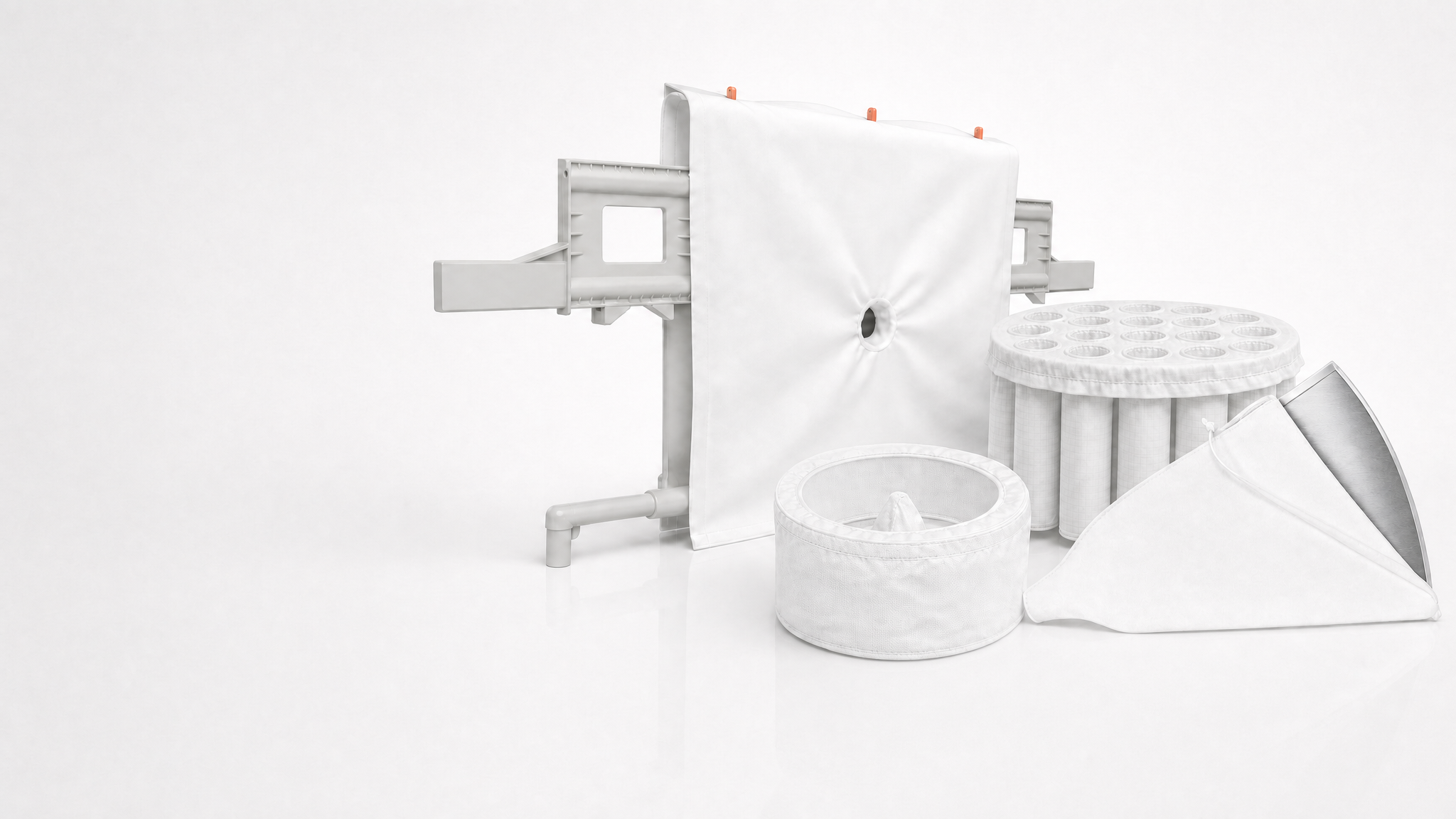
Clean filter fabrics are one of the easiest ways to protect throughput, cake release, and uptime on the plant floor. The right cleaning protocol can often extend usable fabric life by 2–3x, but the wrong chemical or cleaning force can damage fibers, stitching, or coatings in a single wash cycle.
🔑 Key Takeaways
- Match the cleaning method to the soil type, not just the machine type.
- Fabric material matters: polyester, polypropylene, PA, PTFE, and specialty pharma fabrics react differently to acids, caustics, and heat.
- Over-aggressive cleaning can shorten service life just as fast as process fouling.
- For regulated production, cleaning must be validated, documented, and repeatable.
If you run a filter press, a centrifuge, or a Nutsche filter, you already know that “clean enough” is not a maintenance strategy. The goal is to remove blinding, scaling, oils, crystals, or biological residues without attacking the fabric structure, seams, or surface finish.
🧪 Choosing the Right Cleaning Method
There is no universal cleaning protocol. In practice, operators choose based on contamination chemistry, fabric material, and how quickly the fabric must return to service. If you are seeing recurring clogging or poor discharge, start by reviewing the root cause on our filter-cloth clogging and cake release troubleshooting pages.
Chemical wash: acid, caustic, enzymatic
Acid cleaning is typically used for mineral scale, carbonate deposits, and certain inorganic precipitates. Caustic cleaning is more effective for fats, greases, oils, and some organic binders. Enzymatic cleaning is often the best fit when organic residues must be removed gently, especially in food and pharmaceutical environments.
- Acid: best for scale and mineral deposits
- Caustic: best for oils, fats, and organic soils
- Enzymatic: best for sensitive, residue-prone process streams
⚠️ Caution: Never assume a strong chemical is a better cleaner. Incorrect pH, temperature, or dwell time can weaken fibers, swell stitching, attack seams, or damage special finishes.
Ultrasonic cleaning
Ultrasonic cleaning works well when fine solids are trapped deep in the fabric structure. It is especially useful for precision cleaning of RF-NF Series needle felt fabrics and some specialty process fabrics where you want mechanical agitation without aggressive brushing.
Best use cases:
- fine particles and embedded dust
- lab-scale or controlled off-line cleaning
- delicate fabrics where scrubbing is risky
Rule of thumb: If a fabric still clogs after a proper rinse, move to a deeper cleaning method — but step up gradually, not all at once.
High-pressure water jet
High-pressure water can be effective for stubborn but non-adherent solids, especially on belt systems and larger filter surfaces. It is commonly used for RF-BF Series belt filter fabrics and for maintenance cleaning in wastewater and mineral processing.
Watch-outs:
- too much pressure can fuzz the surface or open the weave
- incorrect nozzle distance can create streak cleaning rather than full cleaning
- it may remove visible solids without fully restoring permeability
In-situ CIP (Clean-in-Place)
CIP is valuable when you cannot easily remove the fabric or when contamination must be managed with a repeatable, closed-loop procedure. This is especially relevant for enclosed systems and regulated environments, including pharmaceutical filtration and RF-ANF Series Nutsche pharma fabrics.
💡 Tip: For pharma or high-purity service, define the full CIP recipe in advance: chemical type, concentration, temperature, contact time, rinse quality, and acceptance criteria.
⚙️ How Fabric Material Changes the Cleaning Strategy
Cleaning chemistry must be selected around the fabric base material, surface treatment, and seam construction. The same wash that works on one fabric can permanently damage another.
| Fabric / Material | Good Cleaning Options | Use Caution With | Typical Notes |
|---|---|---|---|
| Polyester (PET) | Neutral wash, controlled alkaline cleaning | Strong caustic at high temperature | Common in general industry; check temperature limits |
| Polypropylene (PP) | Gentle alkaline or enzymatic cleaning | Hot oxidizing agents, harsh solvents | Often good chemical resistance, but heat can still matter |
| Polyamide (PA) | Mild detergents, controlled rinsing | Strong acids and prolonged heat | Mechanical strength is good, but chemical compatibility must be verified |
| PTFE / specialty pharma fabrics | Validated CIP, gentle chemistry | Abrasive brushing, unknown additives | Often used where low extractables and traceability are critical |
For fabric selection tied to your machine platform, compare the requirements of RF-FF Series filter press fabrics with the operating profile of your centrifuge, drum filter, or pressure leaf filter. If you are working in bulk solids transfer, the cleaning logic may differ again for an RF-AS Series air slide fabric or a RF-FBD Series fluid bed dryer fabric.
📋 Frequency Guidelines and Maintenance Triggers
Cleaning frequency depends on solids loading, slurry chemistry, temperature, cycle time, and discharge behavior. A good protocol is not just “every Friday”; it is tied to performance signals.
📋 Clean when you see these signs
- longer filtration cycles or lower throughput
- wet cake, poor release, or increased carryover
- visible blinding, discoloration, or scale build-up
- rising differential pressure or reduced permeability
- repeat contamination issues after normal rinsing
Remove loose solids with water before applying chemistry. This protects the fabric and improves chemical efficiency.
Use the mildest effective method first: enzymatic, then caustic or acid if the foulant requires it.
Rinse to neutral or validated residue limits, then inspect seams, edge wear, and permeability recovery.
🏭 Validation for Pharmaceutical and High-Purity Applications
In pharmaceutical service, cleaning is not complete until it is validated. That means your process must consistently meet predefined limits for residues, bioburden, and carryover. For these systems, repeatability matters more than convenience.
When you operate a Nutsche filter or other critical system, consider whether your cleaning protocol can be challenged, documented, and audited. R+F can support you in defining acceptance criteria and selecting fabric designs appropriate for your process. If you need a starting point, use our find and configure the right filter fabric with our Solution Finder to generate a pre-filled, non-binding specification and inquiry for your machine.
💡 Tip: For validated processes, keep records of detergent type, lot number, rinse conductivity, cycle time, and visual inspection results.
🛠️ Practical Operator Tips to Protect Fabric Life
The best cleaning program is preventive. A fabric that is cleaned correctly and on time usually lasts much longer than one that is periodically “rescued” after heavy blinding.
- Use the lowest effective temperature and chemical strength.
- Avoid metal brushes and rough scraping unless the fabric design explicitly allows it.
- Test new cleaning agents on a small, non-critical area first.
- Do not mix chemicals unless the procedure is validated.
- Document what works so the next shift repeats the same result.
💡 Tip: If you are unsure which cleaning method is safe for your fabric, R+F technical support can help build a cleaning protocol around your actual process chemistry and machine design.
📩 Need Help Choosing the Right Fabric?
Our technical team at R+F FilterElements can help you find the perfect filter fabric for your specific application. Get in touch for a free consultation — we will recommend the right solution based on your machine, process, and operating conditions.
If you want a faster starting point, use our find and configure the right filter fabric with our Solution Finder to select your filtration machine, configure the fabric online, and receive a pre-filled, non-binding specification and inquiry.