
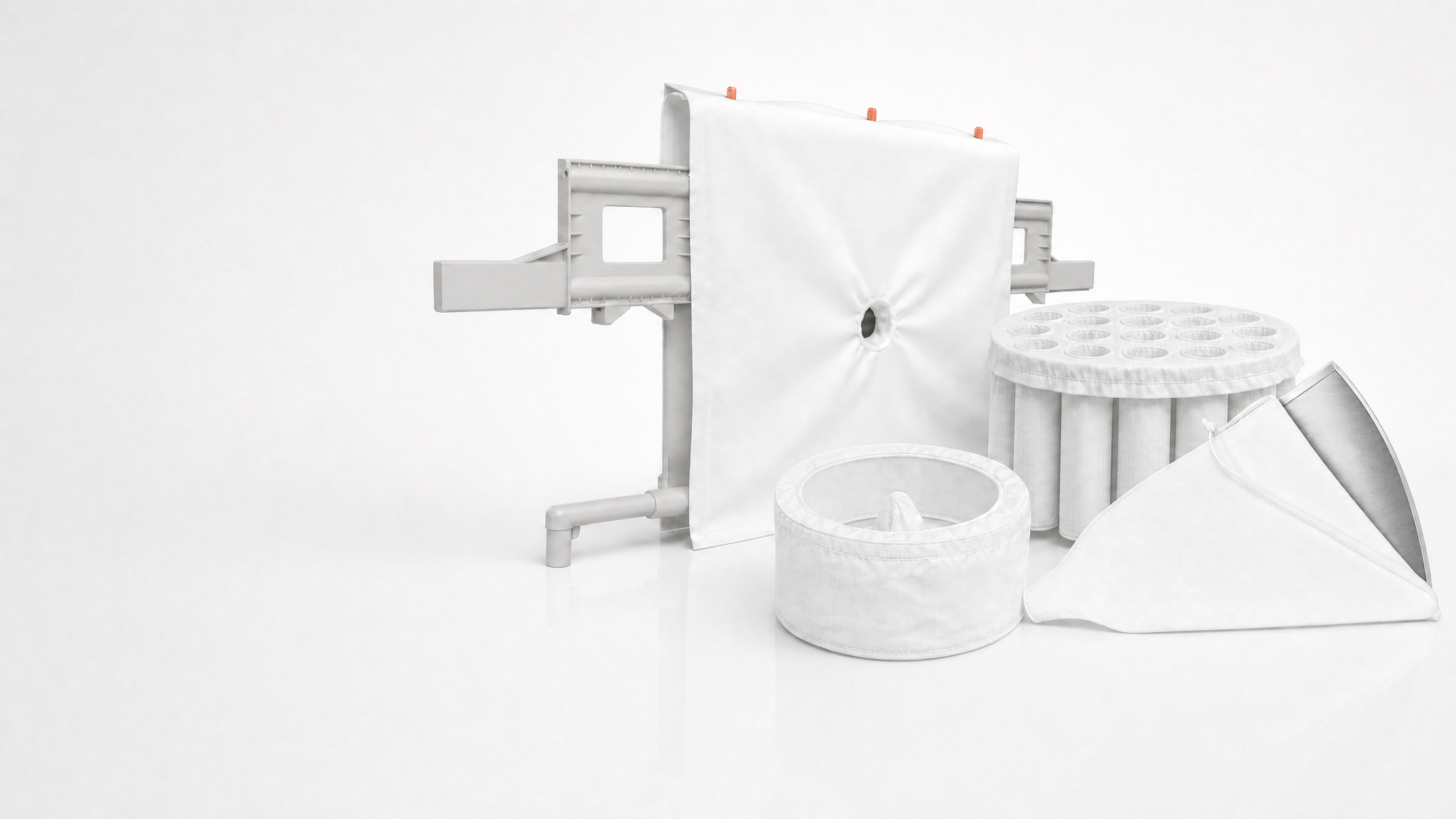
In an air slide, the fabric is not just a support layer — it is the active conveying medium. When permeability is matched correctly, powder fluidizes evenly, flows downhill under gravity, and moves with low energy demand and stable throughput. If permeability is too low or too high, operators quickly see uneven flow, rat-holing, dusting, and unstable discharge in cement and bulk solids handling.
🔑 Key Takeaways
- Permeability controls fluidization: the air film must be uniform across the full air slide width.
- Typical operating range: air slide fabrics are often specified around 3–10 m³/m²/min, depending on material and design.
- Too little air causes sluggish flow, build-up, and start-stop conveying.
- Too much air can create turbulence, dust emissions, and loss of conveying stability.
⚙️ How Air Slide Fabrics Work in Pneumatic Conveying
An air slide is a gravity conveyor with a porous fabric base. Low-pressure air passes through the fabric, fluidizes the powder, and reduces internal friction so the material flows downhill like a controlled “dry liquid.” This is widely used in cement and bulk solids applications, especially for meal, cement, fly ash, lime, and similar fine powders.
The fabric’s job is to distribute air consistently across the deck. On an operator level, that means you want stable airflow, even fluidization, and predictable discharge. If the textile is not engineered correctly, the conveyor may still run — but it will not run reliably.
📊 Why Permeability Matters: The 3–10 m³/m²/min Range
Permeability is the amount of air that passes through the fabric under defined test conditions. For air slide fabrics, a practical operating range is often 3–10 m³/m²/min. That range is not arbitrary: it reflects the balance between enough air to fluidize the powder and not so much that the material becomes unstable.
| Permeability Level | What the Operator Sees | Typical Risk |
|---|---|---|
| Too low | Poor fluidization, slow flow, bridges, uneven discharge | Build-up, downtime, higher air pressure demand |
| In range | Even flow, stable bed, predictable transport | Minimal process instability |
| Too high | Over-fluidization, dusting, pulsation, air escaping at outlets | Loss of control, emissions, segregation |
In practice, the “best” permeability depends on powder fineness, bulk density, moisture, and the slope and length of the air slide. A cement meal with good flow behavior may work well at one end of the range, while a denser or slightly cohesive material may need a different fabric structure within the same family.
🛠️ What Happens When Permeability Is Wrong?
Both extremes cost money. Low permeability often means higher compressed-air demand and more cleaning interruptions. Excessive permeability can reduce conveying stability and increase dust loading at the outlet. For operators, the goal is not maximum airflow — it is consistent fluidization with the least possible energy.
⚠️ Caution: Do not compensate for a poorly matched air slide fabric by simply increasing air pressure. That can mask the root cause and may worsen dusting, segregation, or emission issues.
🔬 Selection Factors That Affect Air Slide Performance
When choosing an air slide fabric, permeability is only one part of the picture. The fabric construction, surface behavior, and dimensional stability must also fit the machine. For operators running cement lines, the most important questions are:
- Does the powder have fine, cohesive, or abrasive characteristics?
- Is the conveying duty continuous or intermittent?
- Does the system need low start pressure and even air distribution?
- Are you operating in a dusty area with ATEX considerations?
📋 Operator Checklist for Air Slide Fabric Selection
- Confirm required permeability target and test method.
- Check powder properties: moisture, fines content, bulk density.
- Review air supply pressure and distribution design.
- Inspect slope angle, length, and outlet geometry.
- Verify whether antistatic performance is needed.
If you are comparing options across process equipment, it often helps to look at the broader fabric family. For example, RF-BF Series belt filter fabrics or RF-FBD Series fabrics for fluid bed dryers serve very different duty profiles, but the same principle applies: the fabric must match the process, not just the machine name.
💡 Practical Rules for Better Conveying Stability
Rule of thumb: If you must keep increasing air pressure to maintain flow, the fabric permeability is probably not matched to the powder or the air slide design.
For day-to-day operation, these habits help you keep the system stable:
- Watch discharge behavior after start-up and after short stoppages.
- Track compressed-air consumption as a process indicator.
- Inspect for uneven fluidization across the width of the slide.
- Check for deposits at the outlet, especially with moist raw meal.
- Replace fabric before the system becomes difficult to re-start.
💡 Tip: If flow becomes uneven in one section of the air slide, the issue may be fabric aging, localized contamination, or damage — not just “bad material.”
✅ Choosing the Right Fabric for Your Air Slide
The most reliable selection starts with your machine data and operating experience. That is why our Solution Finder lets you find and configure the right filter fabric online for your air slide, so you can generate a pre-filled, non-binding specification and inquiry in a few steps.
Choose the air slide in the configurator so the fabric options fit the duty from the start.
Provide powder type, operating temperature, and target permeability to narrow the selection.
Receive a structured, non-binding specification request for the most suitable fabric solution.
For cement plants and bulk solids terminals, the right air slide fabric can make the difference between a smooth gravity conveyor and a constant maintenance issue. If you are currently troubleshooting flow instability, it is also worth reviewing related issues such as filter cloth clogging and short filter lifespan in other process areas, because upstream dust handling and fabric condition often affect the whole plant.
📩 Need Help Choosing the Right Fabric?
Our technical team at R+F FilterElements can help you find the perfect filter fabric for your specific application. Get in touch for a free consultation — we will recommend the right solution based on your machine, process, and operating conditions.
Ready to simplify selection? Use our Solution Finder to configure the right filter fabric online and receive a pre-filled, non-binding inquiry tailored to your air slide application.