
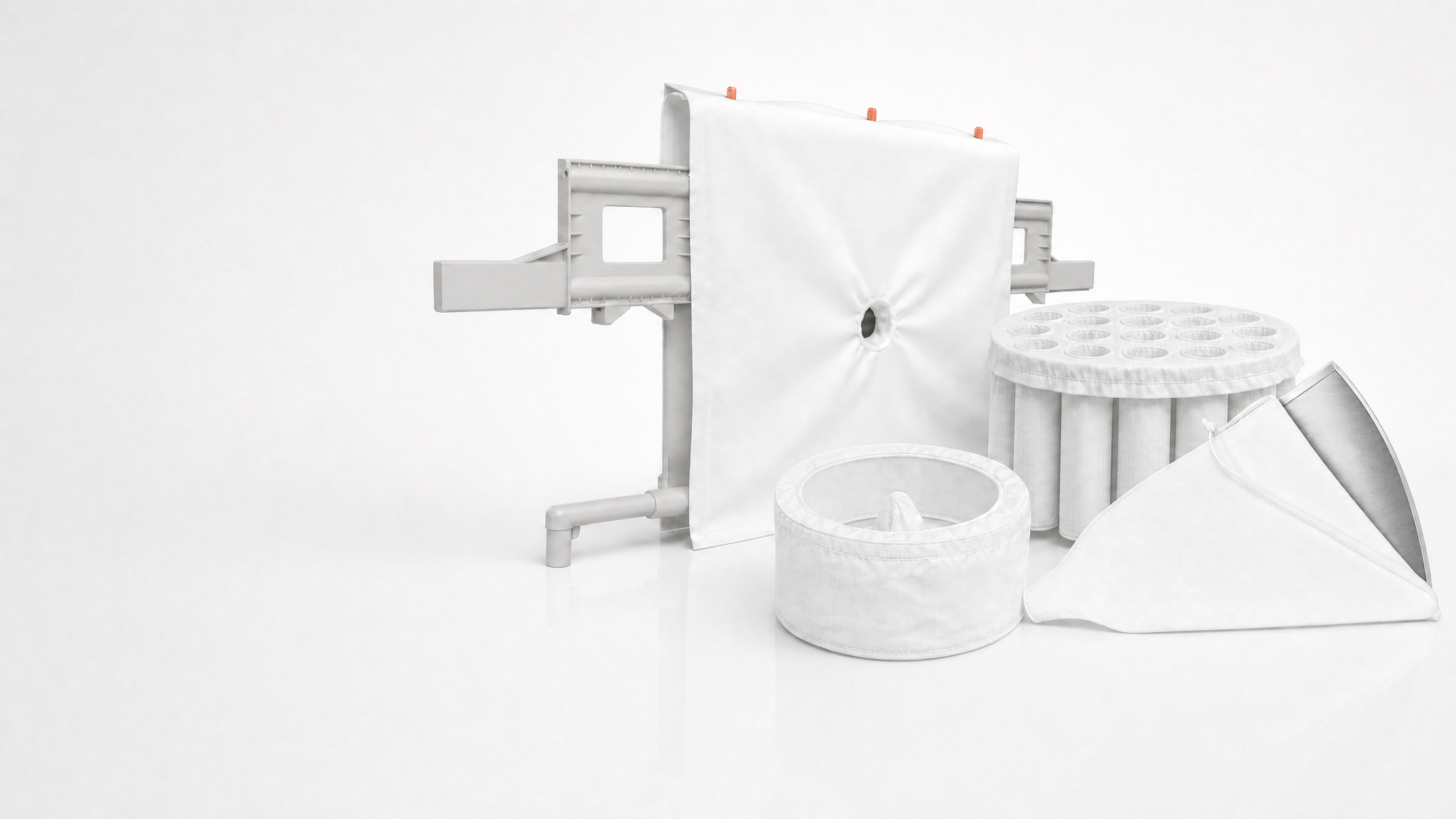
When your belt filter is running well, the drainage belt is doing two jobs at once: moving liquid away fast and supporting a stable cake. The choice between woven drainage belts and needle felt belts affects throughput, cake dryness, washability, and how often you stop for cleaning.
If you operate a belt filter or belt press, the right fabric depends less on the name of the material and more on what your slurry does on the belt in real life.
🔑 Key Takeaways
- Woven drainage belts are usually the best starting point when drainage speed and cake release matter most.
- Needle felt belts are better when fine particle retention or surface filtration is more important than open drainage.
- Sticky slurries, high solids loads, and frequent wash cycles often favor woven structures.
- Always match the fabric to the cake behavior, not just the machine type or the nameplate duty.
⚙️ What Actually Changes Between Woven and Needle Felt?
On the floor, the difference is simple: a woven drainage belt gives the process more open area, while a needle felt belt gives more surface retention. That means woven belts move filtrate away quickly, while needle felt belts hold back smaller particles better but can blind sooner.
| Aspect | Woven drainage belt | Needle felt belt | Best fit |
|---|---|---|---|
| Drainage speed | High | Moderate to low | High-throughput dewatering |
| Particle retention | Moderate | High | Fine solids, polish filtration |
| Cake release | Usually easier | Can be more tenacious | Sticky or compressible cakes |
| Cleaning behavior | Easier to wash | More prone to blinding | Frequent wash-down environments |
💡 Tip: If your belt filter already struggles with carryover or uneven cake formation, start by improving drainage structure before moving to a tighter fabric. In many plants, that means choosing RF-BF Series belt filter fabrics first, then only moving to a needle felt solution if filtrate quality still is not good enough.
🏭 Where Woven Drainage Belts Win
In most industrial belt filter applications, woven belts are the safer and more efficient default. They are especially useful when you need the cake to form quickly and release cleanly on the discharge end.
Typical operator advantages
- Faster free drainage under load
- Better tolerance to thick, gritty, or fibrous slurries
- Less risk of rapid blinding during continuous operation
- Easier washing between shifts or batches
That is why woven fabrics are often preferred in wastewater dewatering, mining, and many bulk processing lines where the belt must stay open and stable for long run times. If your process runs on a belt filter with high throughput and a strong dewatering zone, a woven structure is usually the first fabric to test.
Rule of thumb: If your biggest pain point is slow drainage or poor cake release, choose woven first. If your biggest pain point is fines passing through the belt, then evaluate needle felt.
🔬 When Needle Felt Belts Make Sense
Needle felt belts are not the first choice for every belt filter, but they can be the right answer when you need more retention and a smoother cake surface. Think of them as a filtration-oriented option, not a pure drainage-first option.
In chemical industry duties or selected pharmaceutical batch processes, a needle felt belt can help when the target is cleaner filtrate or tighter particle capture. That said, on a belt filter the fabric must still drain effectively, so the operating window is narrower than with woven belts.
⚠️ Caution: Do not switch to needle felt just because the cake looks “too wet.” If the root cause is poor drainage, overfilling, or misaligned belt washing, a tighter fabric can make the problem worse and shorten service life.
📊 Application-Specific Guidance for Operators
The right belt depends on what comes off the feed pump and how the cake behaves across the zones of your machine. Use the process, not the catalog, as the final judge.
Wastewater and sludge dewatering
For wastewater, woven drainage belts usually outperform because sludge tends to be variable, fibrous, and sometimes sticky. On a belt filter or belt press, stable drainage and washability are usually more valuable than fine retention.
Mining and mineral slurries
In mining, where solids loading is high and particles can be abrasive, the belt must stay open under stress. Woven structures typically handle that better and reduce the risk of rapid blinding or uneven dewatering.
Chemical and specialty process slurries
For chemical industry service, the choice is often process-specific. If your filtrate spec is strict, test needle felt. If your process is batchy, dirty, or temperature-sensitive, woven often gives more stable operation.
Best practice for repeatable results
- Test the same slurry at the same feed rate on both fabrics
- Measure cake dryness, filtrate clarity, and wash water demand
- Check whether the belt releases cake cleanly after the discharge zone
- Watch for blind spots, edge wear, and stitch contamination
Decide whether you care most about drainage speed, cake dryness, filtrate clarity, or belt lifetime.
Use woven for open drainage and easier release; use needle felt only when retention needs justify the tighter structure.
Run the fabric on your actual machine, with your actual feed, wash, and discharge settings before you standardize.
🛠️ What to Check Before You Order a New Belt
A good fabric choice starts with a simple operator checklist. If you answer these points before procurement, you reduce trial-and-error and avoid short service life problems such as filter cloth clogging or short filter lifespan.
📋 Pre-order checklist
- What machine are you running: belt filter or belt press?
- Is your slurry coarse, fibrous, sticky, or fine?
- Do you need fast drainage or tighter solids retention?
- How often can the belt be washed during operation?
- Is cake release a current problem?
- Are there temperature, chemical, or ATEX constraints?
💡 Tip: If you are unsure which direction to take, compare your current belt to a target process metric, not just visual appearance. A belt can “look fine” and still be the cause of poor cake release, carryover, or excessive wash water use.
For a deeper look at fabric selection across machine types, it also helps to review the matching machine pages for your setup, such as belt filter and belt press. If your issue is really discharge behavior, you may also want to check the guidance on cake release and drip leakage.
📩 Need Help Choosing the Right Fabric?
Our technical team at R+F FilterElements can help you find the perfect filter fabric for your specific application. Get in touch for a free consultation — we will recommend the right solution based on your machine, process, and operating conditions.