
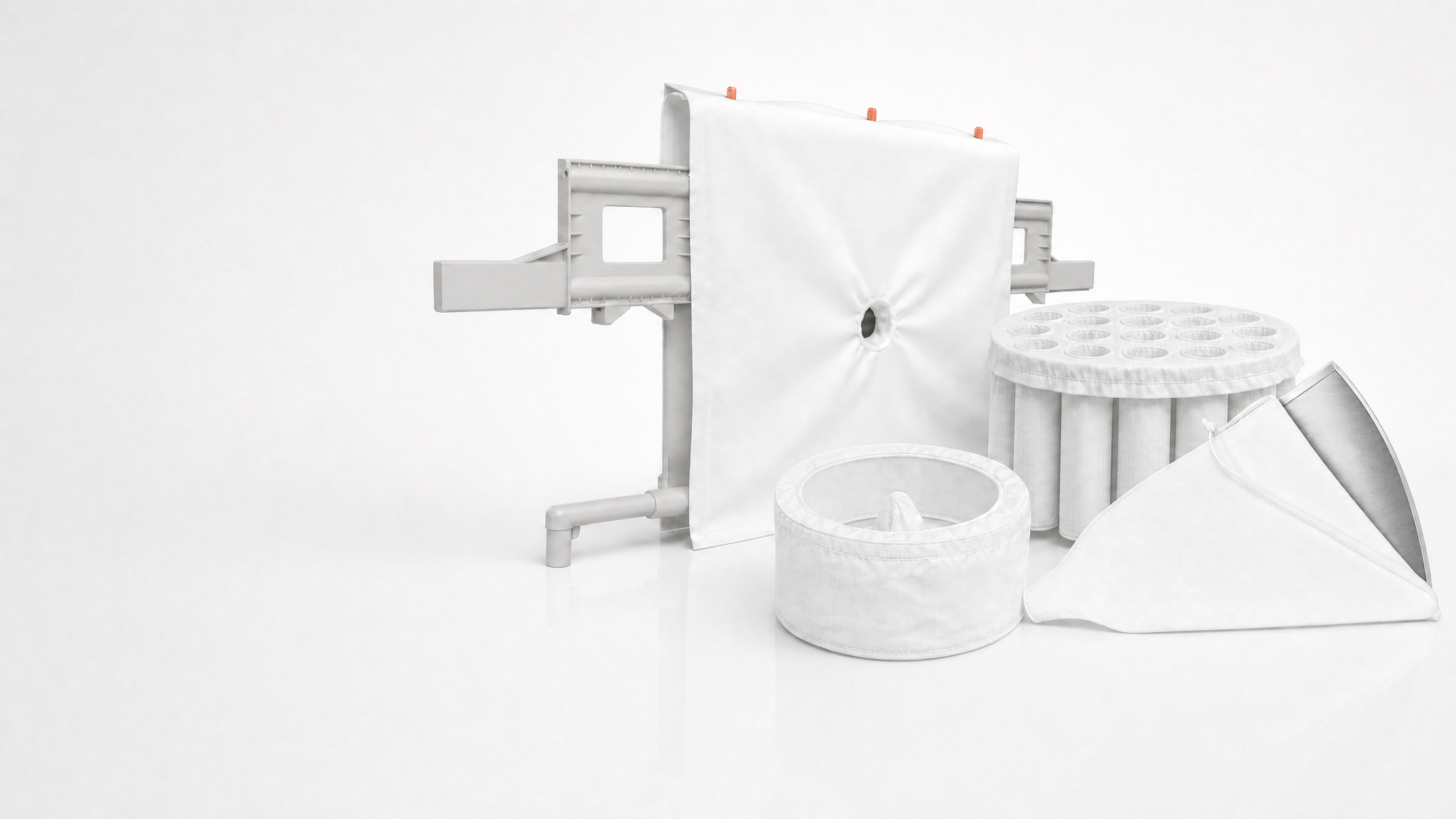
Your filter cloth is doing more than simply holding back solids — it is also managing flow, cake formation, and release. When it starts clogging, throughput drops, cycle times rise, and the whole press, centrifuge, or belt filter becomes harder to run efficiently. The good news: clogging usually follows recognizable patterns, and once you know the mechanism, you can choose the right fabric and operating strategy.
🔑 Key Takeaways
- Clogging is not one problem — it can be caused by depth filtration, surface plugging, or oily deposits.
- Fabric structure matters — yarn type, weave, permeability, and finish all affect blinding risk.
- Operating conditions matter too — pressure, solids loading, temperature, and cleaning frequency all influence performance.
- The right fabric can prevent repeat downtime — especially when matched to your machine and slurry behavior.
⚙️ What “Clogging” Really Means in Daily Operation
In the plant, clogging often shows up as longer filtration times, wetter cakes, poorer filtrate clarity, or a cloth that needs cleaning far too often. If you run a filter press, centrifuge, belt filter, or Nutsche filter, the symptoms may look similar — but the mechanism behind them can be very different.
Depth filtration: the cloth becomes part of the filter cake
Depth filtration happens when fine particles penetrate into the fabric structure instead of staying on the surface. This is common with very fine, compressible, or sticky solids. The cloth may initially perform well, but over time the pores load up and permeability falls. In practice, this often appears as a gradual slowdown rather than a sudden failure.
Surface plugging: a sealed top layer forms too quickly
Surface plugging occurs when particles bridge over the openings and build a dense layer at the top of the cloth. This can be useful up to a point — a cake is supposed to form — but if the cake starts sealing the cloth too early, filtrate flow drops and cleaning becomes difficult. This is especially relevant in mining and wastewater slurries with mixed particle sizes.
Oily deposits: the hidden cause operators often miss
Oil, fats, resins, and binders can coat the fiber surface and create a sticky film. Once that film is present, solids cling more easily and the cloth becomes harder to clean. This is a frequent issue in chemical production and some food-related or process-derived streams. For these duties, fabrics used on a RF-NF Series needle felt or a RF-FF Series filter press fabric often need a careful balance between retention and release.
⚠️ Caution: If the cloth is clogging because of oily or sticky deposits, increasing pressure is often the wrong fix. Higher pressure can drive fine material deeper into the fabric and make blinding worse.
🔬 How to Identify the Clogging Mechanism
Before you change the cloth, watch how the process fails. That tells you whether the solution is a different weave, a different fiber, or a different operating setpoint.
| Symptom | Likely Mechanism | Typical Operator Response |
|---|---|---|
| Slow loss of capacity over multiple cycles | Depth filtration | Review porosity, yarn selection, and cleaning method |
| Fast surface sealing and early pressure rise | Surface plugging | Adjust particle distribution, precoat, or cloth openness |
| Sticky residue, dark film, poor release | Oily deposits | Check process contaminants and cleaning chemistry |
| Cake releases poorly after discharge | Combined blinding + adhesion | See cake release troubleshooting |
📋 Quick diagnostic checklist
- Does flow drop after a few cycles or after just one cycle?
- Is the cloth visibly coated, polished, or sticky?
- Do fines appear in the filtrate or stay trapped in the cloth surface?
- Has slurry composition changed recently?
- Has cleaning frequency increased without improving throughput?
🛠️ What You Can Do About It on the Plant Floor
The best prevention strategy is usually a combination of fabric selection and operating discipline. If you are trying to reduce blinding on a press, the fabric should be matched not just to the machine, but to solids behavior, temperature, chemistry, and cleaning routine. For polymer-rich or sticky slurries, a RF-BF Series belt filter fabric may need a different surface behavior than a cloth used on a pressure leaf or disc filter.
Determine whether the issue is fine solids, oily film, or compacted cake residue. This drives the fabric choice.
Check weave density, filament type, permeability, and surface finish. Closed fabrics retain more fines but are more prone to blinding.
Lower unnecessary pressure spikes, optimize cake thickness, and verify wash/cleaning intervals before the cloth is fully loaded.
Rule of thumb: If the cloth needs aggressive cleaning every shift, the process is telling you the fabric is either too fine, too open, or too chemically mismatched for the slurry.
📊 Fabric Recommendations by Common Clogging Scenario
There is no universal anti-clogging fabric. The right answer depends on whether you need more release, more retention, or better chemical resistance. In many cases, the best results come from matching the cloth type to the machine and process instead of trying to “force” one fabric to do everything.
For filter presses, the RF-FF Series filter press fabrics are a strong starting point when you want predictable cake formation and controlled release. For continuous duty systems, RF-BF Series belt filter fabrics are designed with drainage and release in mind. If your issue is a fine, fiber-like fouling layer, the structure of RF-NF Series needle felt can be better suited to capture solids while still allowing regeneration through proper cleaning.
💡 Tip: If your slurry changed recently — for example due to raw material variability, seasonal feed changes, or upstream dosing — re-check the fabric recommendation. Clogging often starts when the process changes but the cloth does not.
✅ Preventing Repeat Clogging Before It Starts
Once a cloth is blinded, recovery is often partial at best. That is why prevention is more valuable than emergency cleaning. In operator terms, that means watching the feed, validating wash performance, and making sure the fabric matches the real process rather than the design basis from years ago.
Record throughput, pressure rise, and discharge quality. A slow trend is easier to fix than a full shutdown.
If washing or backflushing is standard, confirm it removes the actual foulant — not just loose solids.
For special duties, such as pharma or fine chemical filtration, consider the requirements of pharmaceutical applications and chemical industry applications.
If you are unsure whether the problem belongs to the cloth, the cake, or the machine settings, the fastest next step is to review our filter cloth clogging troubleshooting guide. It will help you separate symptom from root cause.
You can also use our online tool to find and configure the right filter fabric with our Solution Finder. Pick your filtration machine, answer a few process questions, and receive a pre-filled, non-binding specification and inquiry for the most suitable fabric.
📩 Need Help Choosing the Right Fabric?
Our technical team at R+F FilterElements can help you find the perfect filter fabric for your specific application. Get in touch for a free consultation — we will recommend the right solution based on your machine, process, and operating conditions.
Prefer a faster start? Use our Solution Finder to find and configure the right filter fabric online and send us a pre-filled request in just a few steps.