
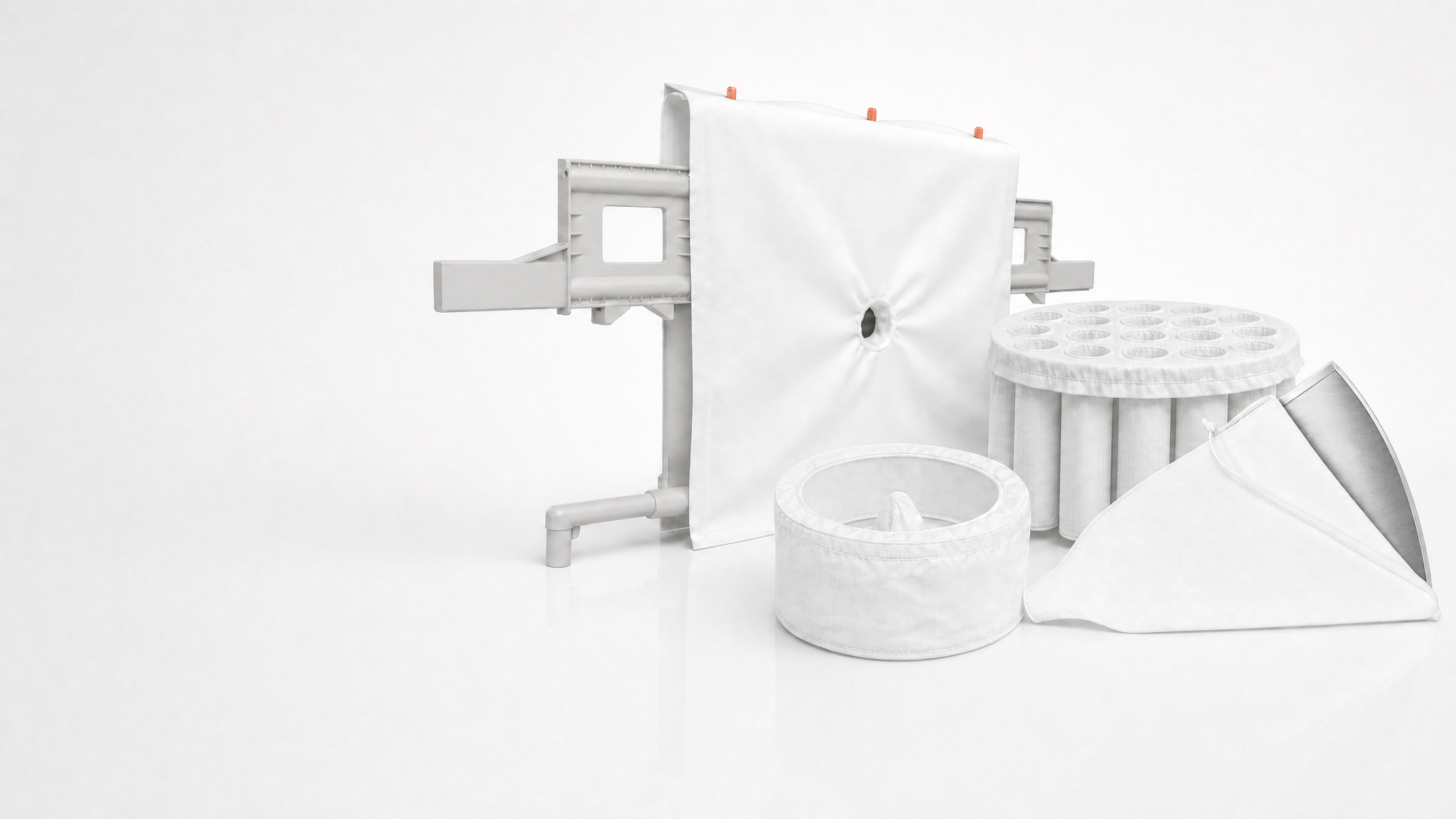
Metal hydroxide precipitation looks simple on paper: dose the reagent, form the solids, and separate the cake. In practice, these precipitates are often gelatinous, fine, and highly blinding, which makes fabric selection just as important as the chemistry itself. If you run a filter press, centrifuge, belt filter, or Nutsche filter in a chemical plant, the right fabric can make the difference between stable throughput and constant shutdowns.
🔑 Key Takeaways
- Metal hydroxide sludges are usually fine, sticky, and prone to rapid cloth blinding.
- The best fabric balances permeability, cake release, and chemical resistance.
- Machine type matters: filter press, centrifuge, belt filter, and Nutsche each need a different fabric strategy.
- Use a structured selection process and digital tools like our Solution Finder to shorten trial-and-error.
For operators in the chemical industry, these challenges show up in everyday signals: longer cycle times, wetter cakes, rising differential pressure, or cloths that never seem to clean fully. The good news is that you can usually improve performance without changing the whole process — by matching the fabric to the solids, the machine, and the washing strategy.
⚗️ Why Metal Hydroxide Cakes Are Difficult to Filter
Metal hydroxides such as iron, aluminum, nickel, zinc, copper, and manganese compounds often form fluffy, amorphous, and compressible cakes. That means the first layer on the fabric can act like a gel and quickly block the pores underneath. Once that happens, the process starts fighting itself: the fabric retains more solids, but flow drops and washing becomes less effective.
In the field, this often leads to:
- Rapid cloth blinding after only a few cycles
- Poor cake release, especially with sticky hydroxides
- Longer filtration times and higher energy demand
- Wet cakes that are hard to discharge or dry later
⚠️ Caution: A fabric that is too tight can trap fines and accelerate blinding, while a fabric that is too open may reduce solids capture and worsen filtrate clarity. Always balance retention and release.
If your cake release is the main issue, also review our guidance on cake release problems and filter cloth clogging.
🧵 The Right Fabric Approach for Hydroxide Precipitates
For these applications, the fabric should not just “filter”; it should support stable dewatering and easy cleaning. In most cases, you want a fabric structure that resists deep blinding, supports backwashing or wash cycles, and offers enough mechanical strength for repeated use.
What typically works best
- Monofilament fabrics for cleaner cake release and easier washing
- Fine but open weave structures to reduce deep particle embedding
- Surface-friendly finishes when sticky precipitates are present
- Chemically resistant polymers suited to pH shifts and reagent residues
Rule of thumb: If the precipitate is gelatinous, start with a fabric that favors release and cleanability over maximum capture. You can often improve clarity later by optimizing the process, but a blinded cloth is hard to rescue.
On filter presses, operators often get the best results with the RF-FF Series filter press fabrics, especially when the cake must discharge cleanly after short cycles. On continuously running systems, the RF-BF Series belt filter fabrics are often a strong option when drainage and washability matter more than absolute fine retention.
📊 Choosing the Fabric by Machine Type
The machine determines how the fabric loads, cleans, and releases the cake. A filter press needs different behavior than a centrifuge or vacuum belt filter. Here is a practical comparison from the operator’s point of view.
| Machine | Typical Hydroxide Challenge | Fabric Priority | Suggested R+F Direction |
|---|---|---|---|
| Filter press | Fast blinding, difficult cake release | Release + washability | RF-FF Series filter press fabrics |
| Belt filter | Drainage loss and carryover fines | Open drainage + stable tracking | RF-BF Series belt filter fabrics |
| Centrifuge | Fines embedding under high g-force | Strength + controlled permeability | RF-CF Series centrifuge fabrics |
| Nutsche filter | Slow percolation, sticky cake washing | Chemical resistance + clean discharge | RF-NF Series needle felt or RF-ANF Series Nutsche pharma fabrics |
If your setup is a vacuum unit or rotary system, you can also review compatible machine pages like vacuum filter systems, centrifuges, and Nutsche filters to align the fabric with the process mechanics.
🛠️ Practical Selection Checklist for Operators
Before you order a replacement cloth or test a new fabric, check the process conditions that matter most. Small changes in pH, temperature, or washing chemistry can completely change how a hydroxide cake behaves.
📋 Fabric Selection Checklist
- What metal hydroxide is forming, and how gelatinous is the cake?
- What is the particle size distribution after precipitation and aging?
- Is the process batch or continuous?
- Do you need fast cake release or maximum solids retention?
- What are the operating pH, temperature, and chemical exposure limits?
- Is cloth washing done with water, acid, alkali, or air?
Determine whether the problem is blinding, leakage, poor clarity, or cake sticking.
Choose a fabric suited to the pressure, speed, and discharge method of your equipment.
Check whether the fabric can be restored after wash cycles without losing permeability.
Track filtrate clarity, cycle time, cake dryness, and cloth life over several runs.
💡 Troubleshooting: When a “Good” Fabric Still Fails
Sometimes the cloth is not the real root cause. If the hydroxide precipitate is formed too fast, too cold, or under poor mixing, it can create ultra-fine gels that blind almost any fabric. In that case, process control and fabric choice must work together.
For operators who need to reduce downtime, our short filter lifespan and drip leakage resources can help pinpoint whether the issue is fabric wear, edge sealing, or cake behavior.
💡 Tip: If you are changing reagents or pH setpoints, re-check the fabric selection. A cloth that performs well on one hydroxide can underperform when the particle morphology changes.
For many plants, the fastest route to the right selection is to use our online tool to find and configure the right filter fabric with our Solution Finder. You choose the filtration machine, enter the process details, and receive a pre-filled, non-binding specification and inquiry that speeds up internal approval.
📩 Need Help Choosing the Right Fabric?
Our technical team at R+F FilterElements can help you find the perfect filter fabric for your specific application. Get in touch for a free consultation — we will recommend the right solution based on your machine, process, and operating conditions.
Try the Solution Finder today to configure your machine online and generate a tailored, non-binding inquiry for the fabric that fits your metal hydroxide process.