
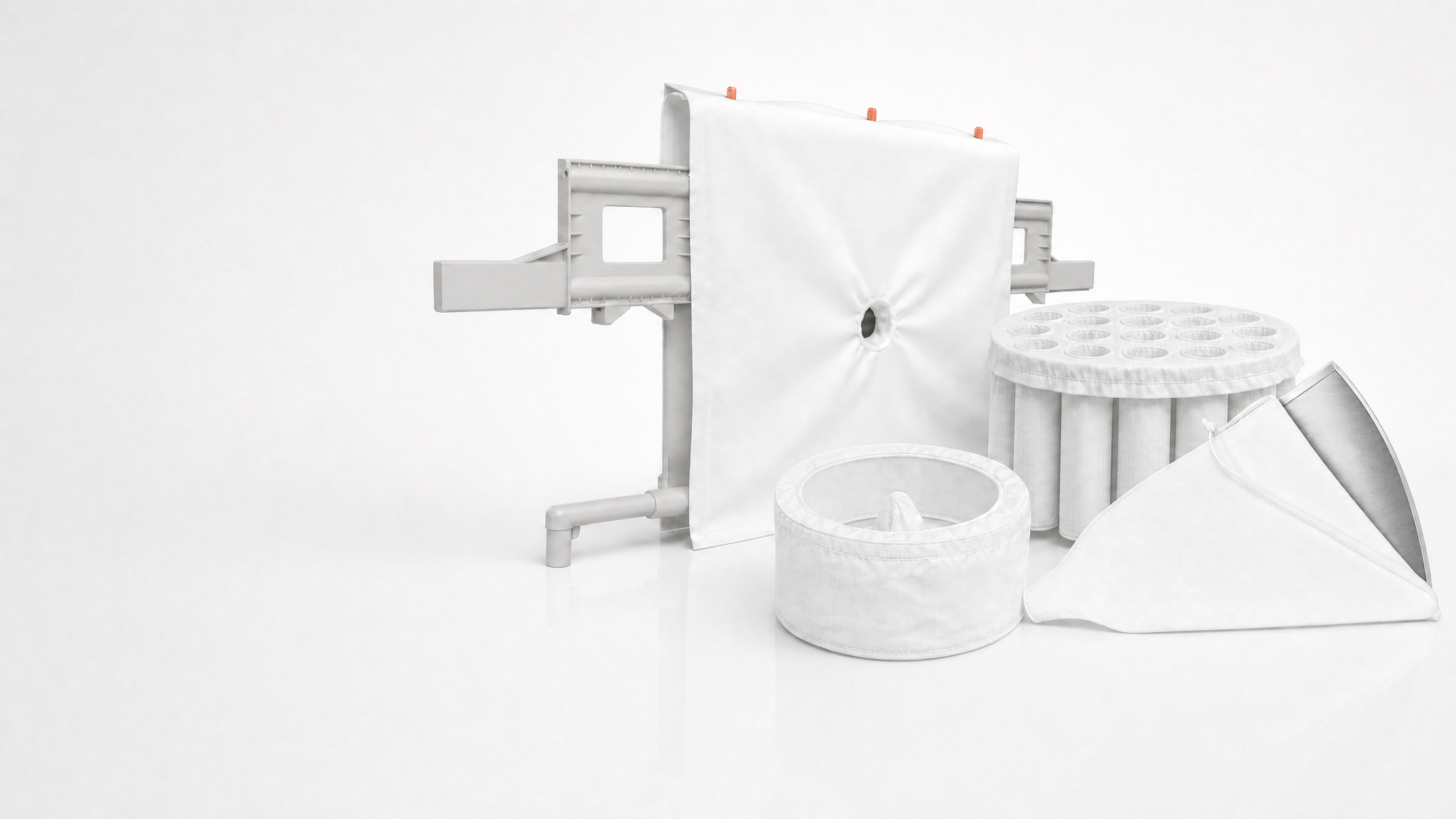
On a vacuum filter or drum filter, the fabric surface finish has a direct impact on filtrate clarity, cake release, and overall cycle stability. Small changes such as calendering, singeing, and heat-setting can make the difference between a clean-running filter and one that struggles with blinding, carryover, or short cloth life.
For operators, the goal is simple: keep the fabric open enough for good throughput, but smooth and stable enough to release cake consistently. That is why the right finish matters as much as the base yarn construction of the fabric itself.
🔑 Key Takeaways
- Fabric surface finish influences filtration rate, cake release, and cleaning behavior.
- Calendering can smooth and stabilize the surface, but over-finishing may reduce permeability.
- Singeing helps remove protruding fibers that can trap fines and increase clogging.
- Heat-setting improves dimensional stability, especially on rotating vacuum filter systems.
⚙️ Why Surface Finish Matters on Vacuum Filters
In vacuum filtration, the cloth is exposed to constant suction, cake build-up, discharge, and washing cycles. A rough or fuzzy surface can hold fine particles, slow drainage, and increase the risk of filter cloth clogging. A well-finished fabric, by contrast, supports more stable operation and more predictable cake discharge.
If you run a vacuum filter or drum filter, you already know that the fabric is not just a support medium — it is part of the separation process itself. Surface topography affects how quickly liquid passes through, how the cake forms, and whether the cake releases cleanly at the discharge point.
⚠️ Caution: A smoother surface does not automatically mean better performance. If the finish is too closed, permeability drops and vacuum load can rise, which may reduce throughput.
🔬 Calendering, Singeing, and Heat-Setting Explained
These three surface treatments are often used to tailor fabric behavior for vacuum and drum applications. Each one affects the cloth differently, so the best choice depends on the slurry, particle size, and operating temperature.
Calendering
Calendering passes the fabric through rollers to compress and smooth the surface. For operators, the benefit is usually better cake release and a more uniform surface for filtration. It can also reduce loose fiber ends that contribute to premature blinding.
Singeing
Singeing burns off surface fuzz and protruding fibers. This is especially useful when fine solids tend to lodge in the cloth surface. A singed fabric often gives a cleaner start-up and is easier to wash between cycles.
Heat-setting
Heat-setting stabilizes the fabric structure and helps maintain dimensions under load and temperature variation. On rotating vacuum equipment, that stability supports better tracking, consistent tension, and fewer wrinkles at the seam or edge.
Rule of thumb: Use the smoothest finish that still preserves enough open structure for your target flow rate. If throughput drops after finishing, the fabric may be too tightly compacted.
📊 Finish Types Compared: What Operators Usually Notice
| Surface treatment | Operator benefit | Possible drawback | Typical best use |
|---|---|---|---|
| Calendered | Smoother cake release, more uniform surface | Can reduce permeability if overdone | Fine solids, improved discharge behavior |
| Singed | Less fiber fuzz, improved anti-blinding behavior | May slightly change initial wetting behavior | Fines-heavy slurries, easier cloth cleaning |
| Heat-set | Dimensional stability, better tension control | Limited effect if process issues are elsewhere | Rotating vacuum systems, warmer process zones |
For many plants, the right answer is not one treatment alone but a combination. A smooth, stable fabric can also reduce the risk of cake release problems, especially when the cake is sticky or the discharge angle is short.
🛠️ Practical Selection Tips for Plant Operators
If you are evaluating a replacement cloth, start with the process symptoms rather than the fabric name. Are you seeing slow drainage, carryover, poor discharge, or frequent wash-up? Those symptoms point to different finish requirements.
📋 Pre-selection checklist
- Particle size distribution and solids shape
- Vacuum level and cycle time
- Required cake moisture and release behavior
- Operating temperature and chemical exposure
- Whether the cloth must resist blinding or abrasion
When surface finish is matched correctly, it can also support longer service life and less downtime. For demanding duty cycles, compare the finish options in the R+F range against the machine type and slurry chemistry — for example, the RF-BF Series belt filter fabrics and RF-FF Series filter press fabrics use different design priorities than vacuum cloths, but the same principle applies: the surface must suit the separation task.
For vacuum and drum systems specifically, the fabric construction should be reviewed alongside the machine geometry. That is why it helps to start from the machine page for your equipment, such as vacuum filter or drum filter, and then align the surface finish to the process requirements.
💡 Tip: If cake release is inconsistent, test a more highly finished surface before changing vacuum level or cycle time. A fabric change is often the fastest path to a stable process.
🏭 Where Surface Finish Makes the Biggest Difference
Surface finish is especially important in fine solids separation, sticky products, and applications with frequent discharge cycles. In mining and wastewater, for example, a cloth that resists blinding can reduce unscheduled washing. In chemical industry service, consistent release and chemical compatibility matter just as much as permeability.
If your plant has struggled with drip leakage or contamination from damaged stitching, the surface finish review should happen together with seam design and fabric edge quality. Otherwise, you may fix one issue while leaving another unresolved.
Look for fuzz, glazing, plugging, and uneven wear patterns after a full operating cycle.
Use singeing for blinding, calendering for release, and heat-setting for stability.
Check vacuum draw, cake dryness, discharge quality, and cloth cleaning behavior over several cycles.
For faster specification work, you can also configure your vacuum / drum filter filter fabric online and receive a pre-filled, non-binding specification and inquiry. That gives your maintenance or procurement team a practical starting point before the next shutdown window.
📩 Need Help Choosing the Right Fabric?
Our technical team at R+F FilterElements can help you find the perfect filter fabric for your specific application. Get in touch for a free consultation — we will recommend the right solution based on your machine, process, and operating conditions.
If you want to move faster, configure your vacuum / drum filter filter fabric online and get a non-binding specification request prepared for your application.