
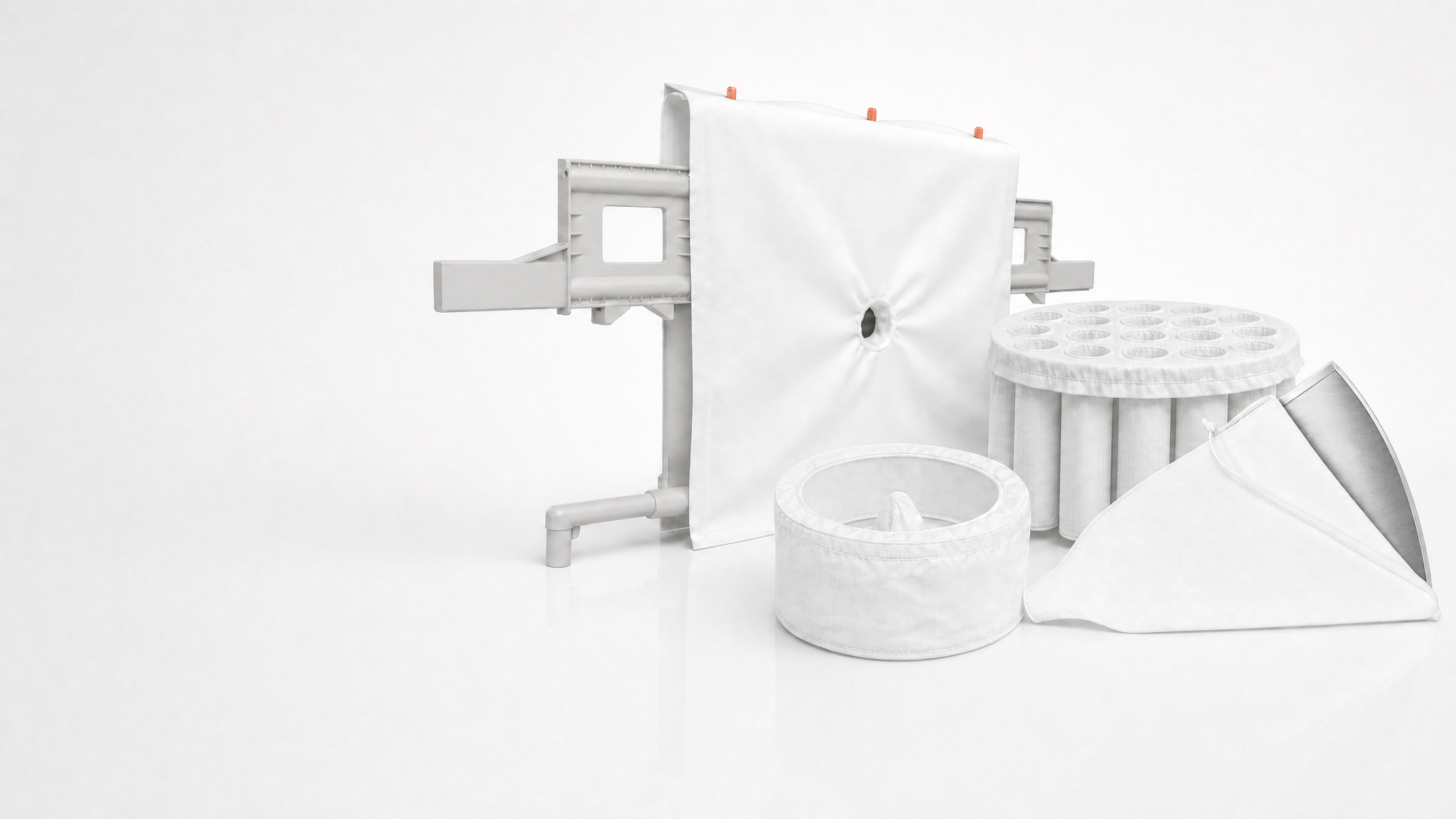
Cement plants run hot, dusty, and nonstop — which means filter fabrics have to perform reliably from the raw mill all the way to final dispatch. Whether you are dealing with air slides, bag filters, or dust collection points, the right media can improve conveying stability, reduce emissions, and keep maintenance predictable.
For operators, the challenge is rarely one single machine. It is the full material flow: hot meal, abrasive dust, moisture swings, and long operating hours. That is why cement and bulk solids applications demand fabrics that are built for temperature, abrasion, and clean release.
🔑 Key Takeaways
- Cement filtration is not just about dust capture — it is about keeping material flow stable across the plant.
- Air slide fabrics must support smooth aeration while surviving heat and abrasion.
- Bag filters and dust collectors need durable media with strong surface stability and consistent permeability.
- Choosing the right fabric early helps reduce clogging, pressure loss, and unexpected shutdowns.
🏭 Where Filter Fabrics Matter in a Cement Plant
In cement production, filter fabrics show up in more places than many operators expect. They are part of conveying, dedusting, product handling, and process protection. The most visible role is usually dust collection, but air slide systems are just as critical because they keep powder moving between process steps without mechanical conveying.
At the dust collection end, bag filters and dedusting units protect both product quality and the plant environment. In these systems, fabrics must hold fine particles efficiently while maintaining airflow. For material handling, the focus shifts to permeability, uniform aeration, and resistance to heat build-up.
💡 Tip: If your air slide starts to move unevenly, do not only inspect the blower. Check the fabric for blinding, uneven aeration, and heat-related shrinkage.
⚙️ Air Slides: The Hidden Workhorse of Cement Handling
Air slides are one of the most elegant solutions in bulk solids handling. They use a fabric membrane to fluidize powder and move it with low energy, often between silos, elevators, separators, and packing lines. In practice, the fabric has to do more than “let air through” — it must distribute air evenly across the full width of the chute.
That is where the RF-AS Series air slide fabrics are especially relevant. The fabric must withstand hot, abrasive cement dust while preserving a stable air cushion. If permeability drifts too far, the result is poor flow, slugging, or dead zones in the conveyor.
Operator signs the fabric is no longer performing well
- Material flow becomes uneven or starts surging.
- Air demand rises for the same conveying performance.
- Dust leaks or accumulation appear along the chute.
- The air slide needs more frequent cleaning or shutdowns.
Rule of thumb: If the air slide needs more and more blower pressure to maintain the same output, the fabric is often the first place to inspect.
🔬 Dust Collection and Bag Filters: Keeping the Plant Clean
In a cement plant, bag filters protect the process at transfer points, mills, silos, elevators, and packing stations. Fine dust loadings can be extreme, and filtration must remain stable even when process conditions change. This is where surface quality, fiber choice, and resistance to heat and abrasion become essential.
For operators working with high dust loads, the RF-NF Series needle felt fabrics are a strong starting point for dust filtration. They are designed to support efficient particle capture while keeping differential pressure under control. In the right setup, they can improve cleaning intervals and reduce stress on the fan or pulse-jet system.
⚠️ Caution: Cement dust can be hot, abrasive, and alkaline. Always verify temperature limits, seam integrity, and compatibility with your cleaning method before installation.
| Application | Main Challenge | Fabric Priority | Typical Operator Benefit |
|---|---|---|---|
| Air slides | Uniform aeration | Stable permeability | Consistent flow |
| Bag filters | Fine dust loading | Dust retention and cleanability | Lower emissions |
| Transfer points | Abrasive wear | Mechanical durability | Longer service life |
| High-temp zones | Heat exposure | Thermal stability | Fewer changeouts |
📊 How to Choose the Right Fabric for Cement Service
When selecting filter fabrics for cement production, the machine type matters — but so do the process details. A fabric that works well in a lower-temperature dust collector may fail quickly in a hot air slide. That is why it helps to compare the operating environment first and the fabric second.
📋 Pre-selection checklist for cement filtration
- Maximum process temperature and temperature peaks
- Particle size, dust load, and abrasion level
- Whether the system is an air slide, bag filter, or transfer deduster
- Cleaning method: pulse-jet, mechanical, or gravity-assisted
- Need for antistatic or special sealing requirements
If you are comparing machine-specific solutions, it is worth reviewing the air slide machine page alongside the filtration requirements for your dedusting setup. In some plants, the best choice is also to use the online find and configure the right filter fabric with our Solution Finder, where you can select your machine and generate a pre-filled, non-binding inquiry in a few steps.
🛠️ Practical Installation and Maintenance Tips
Even the best fabric will underperform if installation is rushed. Cement plants often run on tight maintenance windows, so the goal is simple: install cleanly, seal properly, and verify performance early.
Check seams, edges, and dimensional accuracy before the fabric goes into service.
Make sure the fabric is seated correctly so air distribution stays uniform from the first start-up.
Monitor differential pressure, discharge behavior, and flow stability during the first operating cycles.
For process areas with elevated temperatures or particularly harsh dust, compare the fabric requirement with other high-demand applications on our site, such as mining applications or chemical industry applications, to understand how abrasion and thermal stress influence fabric selection.
✅ Final Takeaway for Cement Operators
In cement production, filter fabrics are not a background component — they directly affect throughput, emissions, cleaning effort, and material flow stability. Air slides need predictable permeability, while dust collectors need durable media that can hold fine dust without choking the system.
If your plant is fighting buildup, rising pressure drop, or short fabric life, start by matching the fabric to the exact machine and process zone. The best results usually come from a fabric that is engineered for temperature, abrasion, and release behavior, not just basic particle capture.
📩 Need Help Choosing the Right Fabric?
Our technical team at R+F FilterElements can help you find the perfect filter fabric for your specific application. Get in touch for a free consultation — we will recommend the right solution based on your machine, process, and operating conditions.
Prefer a faster starting point? Use our Solution Finder to find and configure the right filter fabric for your machine online and receive a pre-filled, non-binding specification request.