
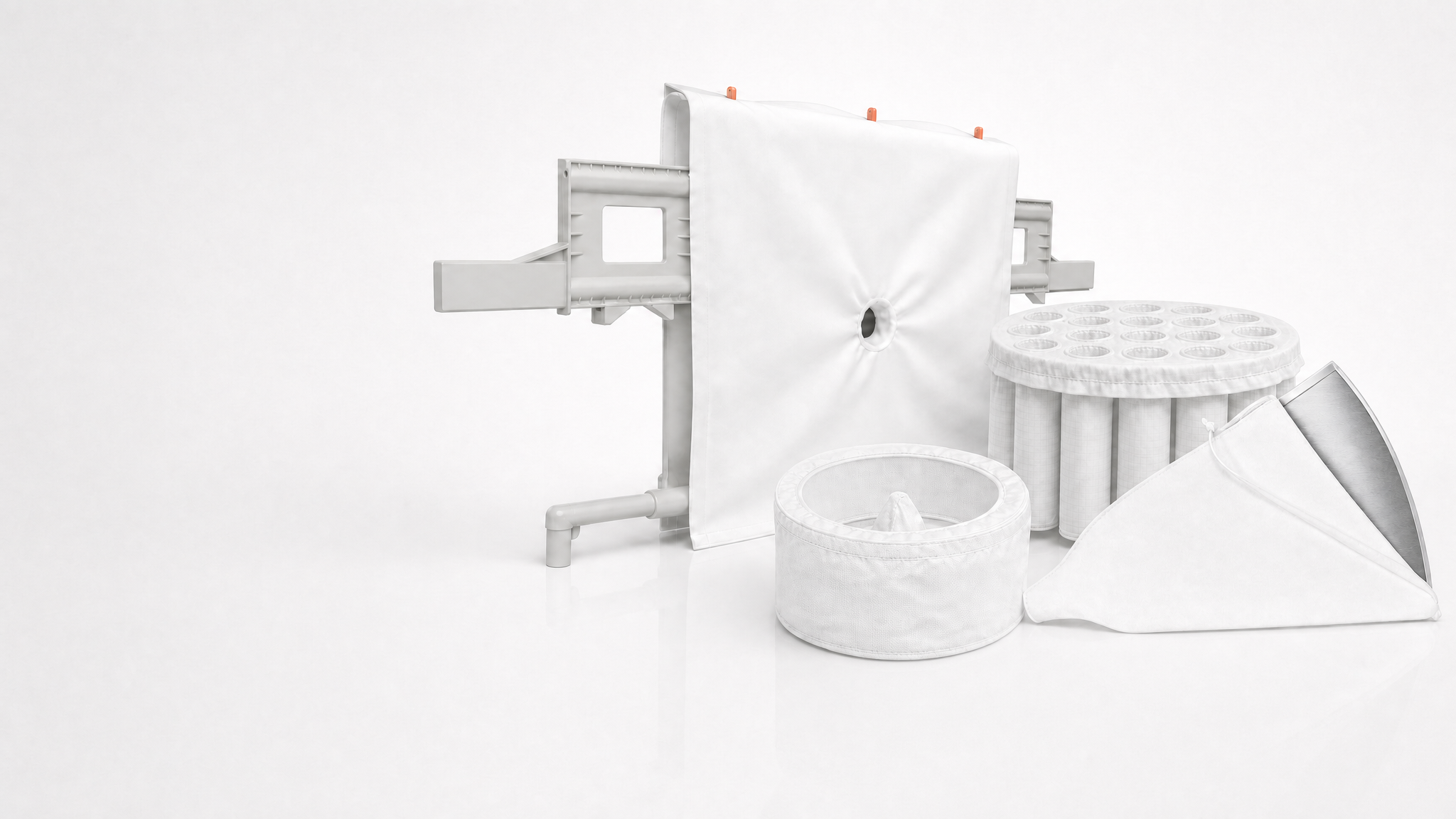
Battery recycling is moving from pilot projects to industrial-scale hydrometallurgy, and filtration sits at the center of the process. If you operate a filter press on black mass or downstream metal recovery streams, you already know that the chemistry is aggressive, the particles are ultra-fine, and the cake has to dewater cleanly to keep the plant moving.
For operators, the challenge is not just separating solids from liquids once—it is doing it reliably across multiple leach, precipitation, and polishing stages. That is where the right filter cloth design makes a measurable difference in throughput, cake release, and fabric service life.
🔑 Key Takeaways
- Black mass hydrometallurgy needs acid-resistant filter fabrics that can handle H2SO4 and HCl-based process conditions.
- Fine Ni/Co/Mn/Li precipitates demand tight weaves for retention without choking the filter too quickly.
- The filter press is usually the main workhorse, but multiple filtration stages can also benefit from matching fabric grades to each duty.
- R+F RF-FF series fabrics are designed for demanding solid-liquid separation tasks where chemical resistance and fine particle capture matter.
⚙️ Why Black Mass Filtration Is So Demanding
Black mass is a complex mix of cathode and anode residues recovered from spent lithium-ion batteries. In a hydrometallurgical route, operators typically leach the material in acid, separate the residue, and then recover valuable metals through precipitation and filtration. The process often involves strong acidity, abrasive slurries, and very fine solids that behave differently from conventional mineral slurries.
At the front end, acidic leaching with H2SO4 or HCl can attack weak fabric structures and accelerate wear. At the back end, Ni/Co/Mn hydroxides, sulfates, and carbonate precipitates can form a slimy, compressible cake that blinds cloth quickly if the weave is not chosen correctly.
Typical operator pain points
- Rapid cloth blinding from sub-micron and colloidal fines
- Short cycle times caused by poor cake release
- High moisture in discharged cake after precipitation steps
- Premature seam or stitching wear in aggressive chemistry
For related process environments with similar chemical exposure, see our chemical industry filtration applications and filter cloth clogging guidance.
🔬 Hydrometallurgical Route: Where Filtration Fits
In a typical battery recycling line, filtration appears several times. Each stage has a different target, and each target can need a different fabric specification. The main operator goal is to keep solids where they belong while maintaining enough permeability for practical cycle times.
The first filtration step removes undissolved residues after dissolution, often under harsh pH and elevated temperature.
Iron, aluminum, copper, and other contaminants may be removed before selective recovery begins.
Fine precipitates are filtered out and washed, often requiring tight retention and low cake moisture.
Final solids-liquid separation may be needed for lithium carbonate or lithium phosphate product streams.
Because these duties vary, the fabric that works well in one stage may fail in the next. That is why operators should consider the full flowsheet, not just the first filter duty.
💡 Tip: When the slurry changes from leach residue to fine precipitate, review mesh size, yarn structure, and seam design together—not in isolation.
🛠️ Material Selection for Acidic Battery Recycling Streams
For black mass and downstream metal recovery, polypropylene (PP) is usually the first material choice because it offers strong resistance to many acid systems and good mechanical stability in wet filtration. In practice, this matters because the fabric must survive repeated exposure to acidic liquor, washing cycles, and temperature swings without losing dimensional stability too quickly.
Operators should also pay attention to yarn construction and weave tightness. A tighter weave can improve fine particle retention, but it can also increase pressure drop and make cleaning more difficult. The right balance depends on cake structure, slurry viscosity, and how often the cloth is cleaned or replaced.
| Filter cloth choice | Main benefit | Trade-off | Best fit |
|---|---|---|---|
| Open weave PP | Better permeability and faster drainage | Lower fine retention | Rougher residues, pre-filtration |
| Tight weave PP | Fine particle capture and cleaner filtrate | Higher blinding risk | Ni/Co/Mn precipitates, polishing duties |
| Reinforced PP construction | Improved service life in harsh chemistry | May reduce flexibility | Long-running acid duties |
Rule of thumb: If filtrate clarity is excellent but cycle times keep rising, the cloth may be too tight for the current precipitate structure.
📊 Choosing the Right Machine and Fabric Combination
The filter press remains the primary machine in many battery recycling plants because it handles batch separation well, produces a dry cake, and integrates easily into precipitation circuits. For some plants, other technologies such as a centrifuge or vacuum filter may appear in upstream or auxiliary duties, but the filter press is usually the core solid-liquid separator.
For operators running multiple solid-liquid separation steps, it can help to standardize fabric selection by process stage. The R+F RF-FF Series filter press fabrics are a strong starting point for acid-resistant, fine-retention duties in hydrometallurgical recovery lines. If you also operate auxiliary units, our RF-BF Series belt filter fabrics may be relevant for dewatering duties where continuous operation is preferred.
🔧 Common Operating Problems and How to Avoid Them
In battery recycling, many cloth problems show up as process symptoms before they become visible damage. Reduced filtrate clarity, longer press fill times, higher residual moisture, or inconsistent cake drop can all point to a mismatch between the slurry and the fabric.
⚠️ Caution: Acidic leachates and fine precipitates can shorten cloth life quickly. Never assume a fabric that works in neutral wastewater will survive a black mass process without redesign.
📋 Pre-start checklist for black mass filtration
- Confirm liquor chemistry: H2SO4, HCl, or mixed acid exposure
- Check solids profile: residue, precipitate, or polishing duty
- Verify cloth pore structure and weave density
- Review seam and edge construction for chemical resistance
- Inspect cake release behavior after the first production cycles
If you are seeing repeat blinding or poor discharge, our problem guides on short filter lifespan and cake release issues may help you narrow down the cause.
To configure the correct fabric for your machine and duty, you can also find and configure the right filter fabric with our Solution Finder. It helps you select the filtration machine and generate a pre-filled, non-binding inquiry for the technical team.
✅ Where R+F RF-FF Series Fits In
For battery recycling plants, the RF-FF series is positioned for demanding filter press duties where chemical resistance, tight particle retention, and dependable release matter. It is especially relevant in hydrometallurgical circuits with fine precipitates and frequent wash cycles. In operator terms, the goal is simple: maintain stable throughput without sacrificing cake dryness or filtrate clarity.
Because each black mass line is different, the best fabric is rarely a one-size-fits-all answer. One stage may need maximum retention; another may need quicker discharge or better washing efficiency. That is why a project-level fabric review is more useful than selecting by particle size alone.
- Use tighter weaves for fine Ni/Co/Mn precipitate capture
- Use PP construction for acid resistance in aggressive leach circuits
- Match seam design to your cleaning method and chemical load
- Review each stage separately when your process has multiple filtration points
For a broader view of similar industrial duties, see our mining applications and wastewater filtration applications.
📩 Need Help Choosing the Right Fabric?
Our technical team at R+F FilterElements can help you find the perfect filter fabric for your specific application. Get in touch for a free consultation — we will recommend the right solution based on your machine, process, and operating conditions.
Prefer to start online? Use our Solution Finder to pick your filtration machine, configure the right filter fabric, and receive a pre-filled, non-binding specification and inquiry.