
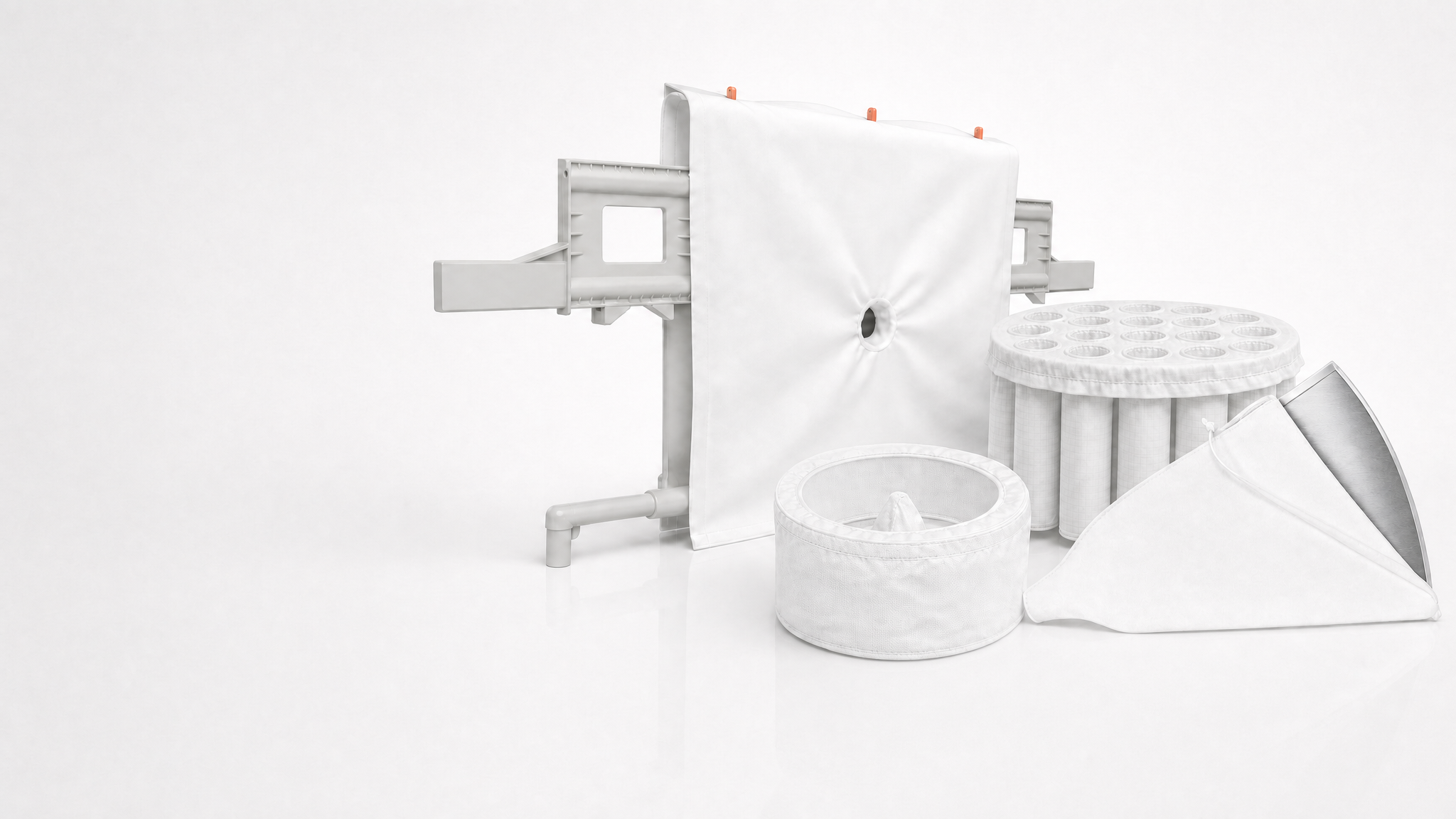
In biotechnology and fermentation, the real process challenge starts after growth: separating fine microbial biomass from the broth, recovering valuable enzymes, and isolating antibiotics without damaging the product. For plant operators, the right filter fabric can make the difference between stable throughput, clean filtrate, and costly downtime.
Whether you run a filter press, centrifuge, or vacuum-based separator, the fabric has to cope with very fine particles, repeated CIP cycles, and often strict hygiene expectations.
🔑 Key Takeaways
- Biotech separations often involve 1–10 µm particles that demand fine, uniform filtration media.
- Gentle drainage and low solids disturbance help reduce cell lysis and product loss.
- Steam-sterilisable, autoclavable, and CIP-resistant fabrics are essential in fermentation plants.
- R+F RF-FF Series filter press fabrics and RF-CF Series centrifuge fabrics are well suited for biomass separation and product recovery.
🧫 Biomass Separation in Fermentation Plants
After fermentation, the broth usually contains microbial cells, cell fragments, residual nutrients, and the target product dissolved or suspended in liquid. Your job is to separate that mix efficiently while protecting product quality. In yeast, bacterial, and fungal processes, the solids are often extremely fine, so cloth selection matters more than in many mineral applications.
For operators, the first question is usually: do I need a filter press for batch dewatering, or a centrifuge for continuous or semi-continuous separation? Both can work well, but they place different demands on the fabric.
What makes biotech filtration different?
- Fine particles: Microbial biomass can be extremely small and compressible.
- Shear sensitivity: Excessive turbulence can break cells and reduce downstream recovery.
- Hygiene: Fabrics must tolerate steam, cleaning chemicals, and frequent sanitising.
- Consistency: Small changes in cloth permeability can affect yield and cycle time.
⚠️ Caution: If cell lysis is a concern, avoid overly aggressive pressure ramps or fabric choices that force high differential pressure too early. Damaged cells can increase viscosity and complicate downstream purification.
⚙️ Machine Choice: Filter Press, Centrifuge, or Rotary Vacuum Filter?
The right machine depends on broth properties, solids loading, and how sensitive the product is to heat and shear. In many fermentation lines, a filter press is preferred for batch recovery and cake dewatering, while a centrifuge is often chosen for faster throughput and gentler continuous handling. Rotary vacuum filters remain useful where large volumes and stable suspensions are involved.
For centrifuge applications, the RF-CF Series centrifuge fabrics are designed for stable solids retention and reliable discharge behavior. For batch biomass dewatering, the RF-FF Series filter press fabrics are a strong fit when you need consistent cake formation and repeatable cycles.
| Machine | Best use in biotech | Fabric priority |
|---|---|---|
| Filter press | Biomass dewatering, product clarification, batch washing | Fine retention, cake release, steam sterilisability |
| Centrifuge | Continuous biomass separation, enzyme and yeast recovery | Mechanical stability, balanced drainage, low fiber shedding |
| Rotary vacuum filter | Large-volume slurries, stable suspensions, pre-dewatering | Uniform permeability, chemical resistance, clean discharge |
🔬 Enzyme Recovery and Antibiotic Isolation
Industrial enzymes and antibiotics are high-value products, so even small losses in the separation stage can hurt profitability. In enzyme production, the broth may contain delicate proteins that should not be exposed to unnecessary stress. In antibiotic isolation, the challenge is often to remove biomass while preserving downstream purity and consistent recovery.
That is where controlled filtration helps. A fabric with the right pore structure supports fine solids capture without choking too quickly. In many operations, operators use a staged approach: pre-separation in a centrifuge, followed by polishing or cake handling on a filter press or vacuum filter.
Remove the bulk biomass first to reduce load on the final separation stage.
Keep shear low and avoid excessive pressure spikes that can damage cells or proteins.
Use fabrics that tolerate steam sterilisation and repeated CIP with alkaline or acidic media.
💡 Tip: If your plant runs repeated steam cycles, specify autoclavable fabrics from the start. Retrofitting after premature shrinkage or deformation is usually more expensive than selecting the right media upfront.
🛠️ Fabric Requirements: Hygiene, Chemical Resistance, and Gentle Handling
Biotech fabrics need more than filtration efficiency. They must survive cleaning-in-place agents, resist common process chemicals, and maintain dimensional stability after steam exposure. In some plants, fabrics are cleaned daily; in others, they are sterilised between campaigns. Either way, the material must stay predictable.
- Autoclavable construction: For sterilisation and hygienic campaigns.
- CIP resistance: Compatible with alkalis, acids, and sanitising agents.
- Low extractables: Important for product purity and food-grade or pharma-adjacent processes.
- Stable permeability: Helps maintain cycle times and filtrate clarity.
📋 Pre-start Checklist for Fermentation Filtration
- Confirm particle size and solids load in the broth
- Check whether the process is batch, semi-batch, or continuous
- Verify steam and CIP temperatures and chemistry
- Review cake release and washing requirements
- Confirm whether product recovery or biomass disposal is the main goal
Rule of thumb: If the broth looks “easy” in the lab but slows down in production, the fabric is often too open, too rigid, or not chemically stable enough for real CIP conditions.
🏭 R+F Solutions for Fermentation and Bioprocessing
For operators looking for a reliable process fit, R+F offers engineered fabrics for both batch and continuous biotech separations. The RF-FF Series is a practical option for filter presses handling biomass, enzyme slurries, and broth clarification. For rotating equipment, the RF-CF Series supports centrifuge-based solids removal with a focus on stable performance and clean operation.
If you are still deciding between machines or fabric constructions, our online find and configure the right filter fabric with our Solution Finder tool helps you select your filtration machine and generate a pre-filled, non-binding specification and inquiry.
Need a fabric for a filter press in fermentation, a centrifuge in enzyme production, or a hygienic batch process in pharma-adjacent manufacturing? Compare your setup against our filter press and centrifuge machine pages, then match the operating conditions to the right media.
📩 Need Help Choosing the Right Fabric?
Our technical team at R+F FilterElements can help you find the perfect filter fabric for your specific application. Get in touch for a free consultation — we will recommend the right solution based on your machine, process, and operating conditions.
If you want a fast starting point, use our Solution Finder to configure your machine and receive a non-binding specification request tailored to your biotech process.