
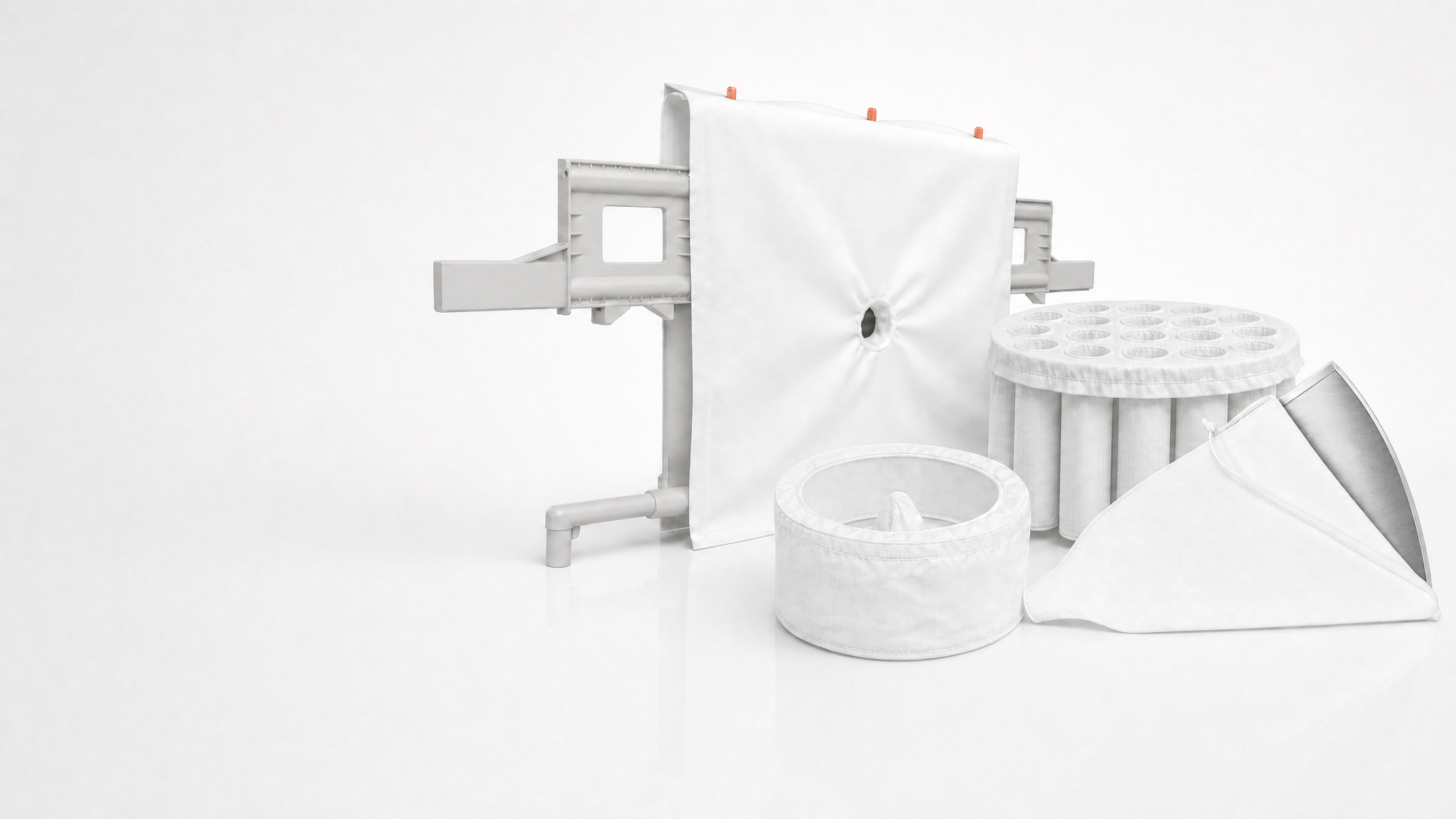
Fish oil and marine oil processing puts real pressure on your filter cloth: high viscosity at low temperatures, sensitive omega-3 fatty acids, and several demanding purification steps all in one line. If you run crude clarification, winterisation, bleaching earth removal, or final polishing, the right fabric directly affects throughput, clarity, and product quality.
🔑 Key Takeaways
- Fish oil filtration needs food-grade, chemically resistant, temperature-stable fabrics.
- Winterisation requires fine retention without blinding the cloth too quickly.
- Pressure leaf and sparkler filters are common for polishing and clarification.
- R+F’s RF-PLF Series pressure leaf filter fabrics and RF-SP Series sparkler filter fabrics are well suited for marine oil workflows.
💡 Tip: If your oil cools too far before filtration, viscosity rises fast and filtration time can increase sharply. Keep the process window stable and choose a cloth that maintains permeability under load.
⚙️ Why Fish Oil Filtration Is So Demanding
In omega-3 production, the filtrate is not just “oil”; it is a value-sensitive product where oxidation, heat exposure, and contamination all matter. From a plant operator’s point of view, the challenge is to remove solids efficiently while keeping the oil as stable and clean as possible.
Typical process stages include crude oil clarification, winterisation to remove waxes and stearins, bleaching earth removal after refining, and final polishing before storage or downstream encapsulation. Each stage places different demands on the filter fabric. For example, a cloth that performs well in a coarse clarification step may still fail in polishing because it cannot retain fine particles or releases too slowly.
🔬 What the Filter Cloth Must Handle
For marine oil and fish oil, the fabric must combine mechanical performance with chemical and thermal stability. Many plants also use caustic or acid refining steps upstream, so the cloth should tolerate cleaning chemicals and remain dimensionally stable after repeated cycles.
Key fabric requirements
- Chemical resistance to caustic and acid refining media
- Temperature stability during warm filtration and cleaning cycles
- Fine particle retention for polishing and bleaching earth removal
- Food-grade suitability for edible oil applications
- Low extractables and clean surface behavior to protect product quality
⚠️ Caution: Omega-3 fatty acids are oxidation-sensitive. Excessive residence time, heat, or air ingress can reduce quality. Avoid unnecessary delays between clarification, winterisation, and polishing.
Rule of thumb: The finer the polishing stage, the more important a stable surface finish and predictable cake release become. A fabric that traps too much oil in the cake can cost yield.
🏭 Typical Equipment in Marine Oil Processing
In practice, fish oil processors often use pressure leaf filters for clarification and bleaching earth removal, sparkler filters for polishing, and filter presses where batch separation and cake handling are preferred. The equipment choice depends on throughput, solids load, temperature control, and whether the process is batch or semi-continuous.
| Process step | Typical equipment | Fabric priority |
|---|---|---|
| Crude oil clarification | Pressure leaf filter / filter press | High flow, good solids loading, easy cake release |
| Winterisation | Filter press / sparkler filter | Fine retention, low blinding, stable permeability |
| Bleaching earth removal | Pressure leaf filter | Robust cake support, chemical resistance |
| Final polishing | Sparkler filter | Very fine retention, clean filtrate, low fiber release |
🛠️ How to Match Fabric to the Process Step
Not every stage needs the same cloth. In crude clarification, you usually want a fabric that can take suspended solids and still release cake well enough for economical cycle times. In winterisation, the filtration load changes because waxes and stearins behave differently at low temperature, so the cloth must retain fine crystals without immediately choking.
For polishing, the goal shifts to clarity and consistency. That is where the RF-SP Series sparkler filter fabrics are especially useful, because sparkler systems are often chosen for the final clean-up stage before filling or storage. For earlier stages with heavier solids or bleaching earth, the RF-PLF Series pressure leaf filter fabrics are a strong fit for operators looking for stable performance under load.
📋 Operator Checklist for Better Omega-3 Filtration
📋 Before you start the batch
- Confirm the oil temperature is within the agreed process window
- Check whether the fabric is rated for the cleaning chemistry in use
- Verify that the cloth construction matches your particle size target
- Inspect for stitching, seals, or edge details that could risk contamination
- Make sure the filter medium is suitable for food-grade service
If you are still comparing machine types, it helps to review the process together with the equipment. You can also use our find and configure the right filter fabric with our Solution Finder to select your machine, define the operating conditions, and receive a pre-filled, non-binding inquiry.
✅ Practical Takeaway for the Plant Floor
Fish oil and marine oil filtration is not just about removing solids. It is about protecting product value through every step, from crude clarification to final polishing. The right filter cloth reduces downtime, supports stable throughput, and helps preserve the quality of sensitive omega-3 oils.
For demanding clarification and bleaching stages, start with RF-PLF Series pressure leaf filter fabrics. For final polishing, consider RF-SP Series sparkler filter fabrics. If you want to match the fabric more precisely to your machine and process window, explore our related equipment pages such as pressure leaf filter systems and sparkler filter systems.
📩 Need Help Choosing the Right Fabric?
Our technical team at R+F FilterElements can help you find the perfect filter fabric for your specific application. Get in touch for a free consultation — we will recommend the right solution based on your machine, process, and operating conditions.
Prefer a faster start? Use our Solution Finder to configure the right filter fabric online and receive a non-binding specification tailored to your filtration setup.