
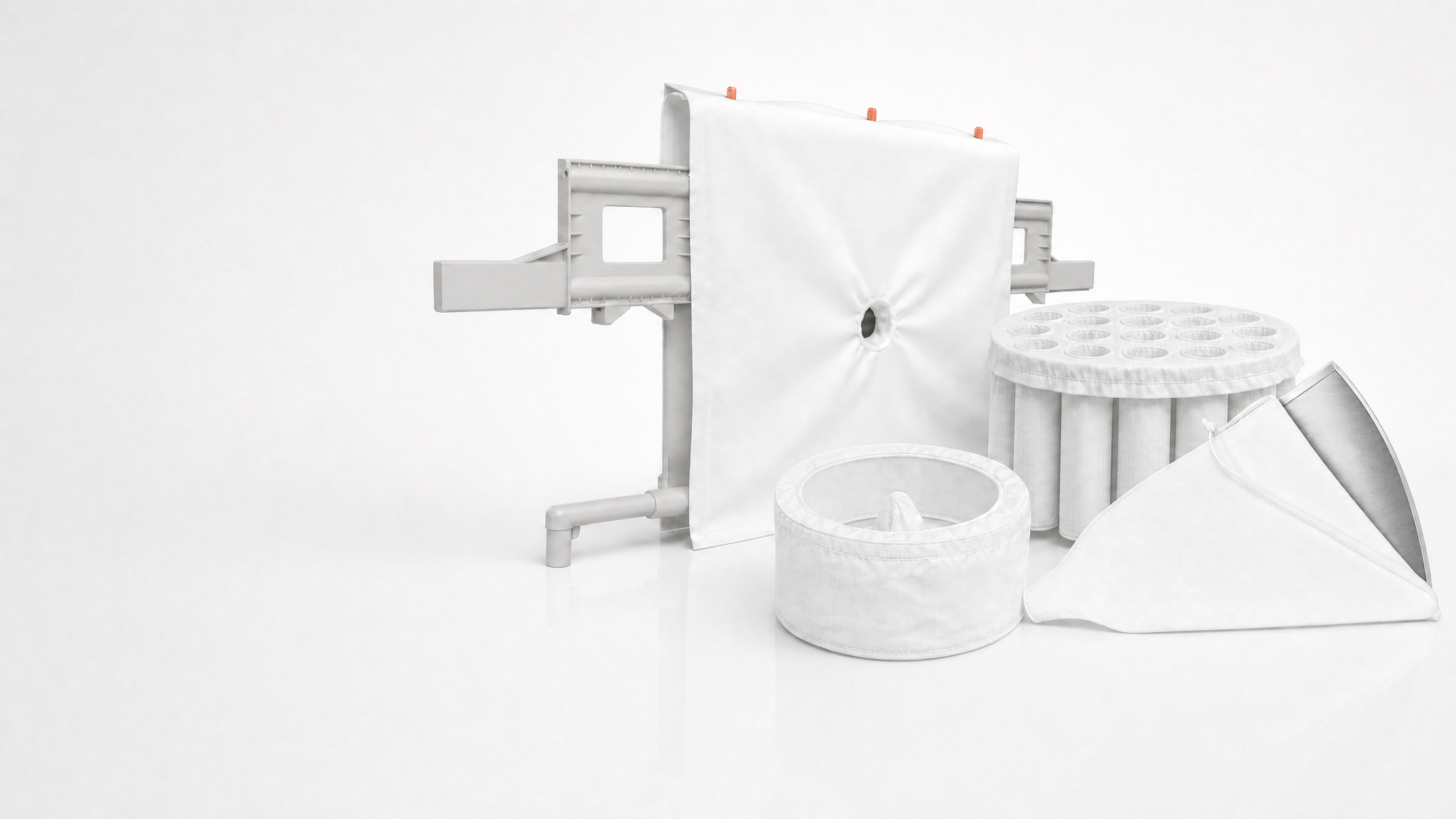
If your chamber filter press is spending too long filling, blinding early, or struggling to release the cake, the cloth is often the first place to look. In daily operation, fabric permeability, weave structure, and surface finish can make the difference between a press that runs smoothly and one that steals minutes from every cycle.
The good news: you do not always need to change the whole machine to improve throughput. A better-matched cloth can shorten fill time, improve cake release, and reduce unplanned cleaning stops.
🔑 Key Takeaways
- Permeability controls how quickly filtrate passes through the cloth.
- Weave choice affects both solids capture and resistance to blinding.
- Surface finish can improve cake release and reduce discharge delays.
- The best cloth is the one that balances speed, clarity, and clean release for your process.
⚙️ Why the Cloth Has Such a Big Impact on Cycle Time
On a chamber filter press, the cycle is only as fast as its slowest stage: filling, filtration, cake formation, and discharge. If the cloth is too tight, filtrate flow slows down and the press reaches target cake consistency later. If it is too open, you may gain speed at first but lose clarity, build a weaker cake, or spend extra time cleaning up solids migration.
When operators talk about cycle time, they usually mean more than just fast filling. In practice, you want a cloth that helps the press fill evenly, lets liquid pass quickly, and releases the cake without scraping or extra air blasting. If you are also fighting blinding or drip leakage, it is worth reviewing related issues like filter-cloth clogging and poor cake release.
🔬 Permeability, Weave, and Finish: What Each One Does
Think of the cloth as a controlled barrier. The fabric must hold back solids while allowing liquid to escape at the rate your press and slurry can support. That balance is created by the fabric construction, not just the polymer type.
| Cloth property | Effect on filtration speed | Typical operator sign | Best fit |
|---|---|---|---|
| Higher permeability | Faster filtrate flow, shorter fill stage | Faster pressure build, lower initial resistance | Coarser solids, well-behaved slurries |
| Tighter weave | Slower flow, better fines retention | Cleaner filtrate, longer cycle | Fine particles, clarity-critical processes |
| Smoother surface finish | Improves cake release and reduces discharge delay | Less sticking after opening the press | Sticky cakes, frequent stoppages |
| More open surface | Can speed initial drainage but may blind sooner | Early flow is good, later flow drops off | Short runs, less aggressive solids |
💡 Tip: If your press fills quickly at the start but slows dramatically later, the problem may not be the pump. It often points to cloth blinding, the wrong weave, or a surface that traps fine particles.
For broader process context, it helps to think in terms of the whole separation system. A cloth that works well in one filter press may behave differently on another frame size, feed strategy, or slurry chemistry. The same logic applies across solid-liquid separation applications: the cloth must match the operating window, not just the machine nameplate.
🛠️ Practical Operator Checks Before You Change the Cloth
Before ordering a new fabric, make sure the current cycle problem is really cloth-related. A worn pump, air leaks, uneven cake formation, or incorrect feed pressure can mimic a bad cloth. Start with a quick, structured check.
Look for blinded areas, seam wear, cake sticking, and uneven discharge across plates.
Compare fill time, pressure rise, and discharge time from recent shifts. A change in one stage often reveals the root cause.
Particle size, solids load, temperature, and chemistry can all change the ideal permeability and weave.
Change permeability or finish first, then compare results using the same feed conditions.
📋 Pre-change checklist
- Is filtrate clarity acceptable, or are you already losing solids?
- Is the cake release slow, sticky, or incomplete?
- Are wash cycles or cloth cleaning getting longer?
- Has the process chemistry or solids composition changed?
⚠️ Caution: Do not chase speed alone. A cloth that reduces fill time but increases solids carryover can create more downtime later through rework, cleaning, and poor cake quality.
📊 Choosing the Right Balance for Speed and Separation
In many plants, the best results come from a balanced cloth rather than the most open one available. If your feed is fine, compressible, or prone to blinding, a slightly tighter structure may actually reduce total cycle time by keeping the press stable and the cake uniform. If your solids are coarse and release is the bottleneck, a smoother finish can save more time than increasing permeability alone.
Rule of thumb: If the press is losing time during discharge, focus on surface finish. If it is losing time during filling, focus on permeability and weave.
For operators handling recurring blinding or short cloth life, it is also worth checking the wear pattern and seam areas. A cloth that looks fine at first glance can still be part of the problem if it loses permeability too quickly. That is where a purpose-built filter press fabric makes the biggest difference.
🏭 A Better Fit for Chamber Filter Press Operation
At R+F FilterElements, the RF-FF Series is designed for chamber filter press applications where stable filtration, reliable release, and efficient cycle times matter. The goal is not just to separate solids and liquids, but to do it consistently shift after shift.
If you are looking for a practical next step, start by documenting your current fill time, pressure profile, cake release behavior, and cloth cleaning frequency. Then compare those results against the cloth structure you are using today. That gives you a clear basis for selecting a faster, more stable replacement rather than relying on guesswork.
Need help narrowing the options? Our technical team can match cloth permeability, weave, and finish to your slurry and press conditions, so you can reduce cycle time without sacrificing clarity or cake quality.
📩 Need Help Choosing the Right Fabric?
Our technical team at R+F FilterElements can help you find the perfect filter fabric for your specific application. Get in touch for a free consultation — we will recommend the right solution based on your machine, process, and operating conditions.