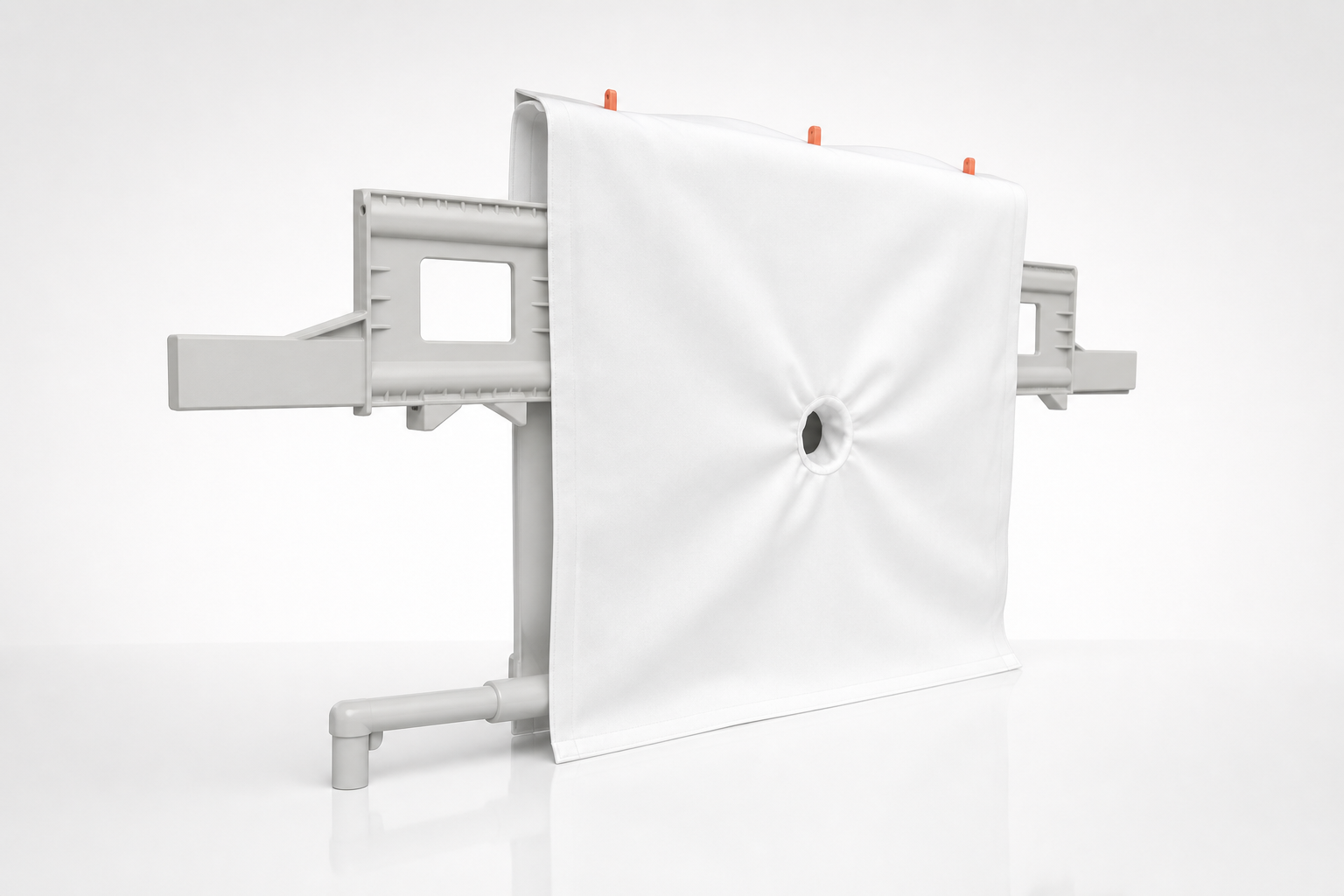
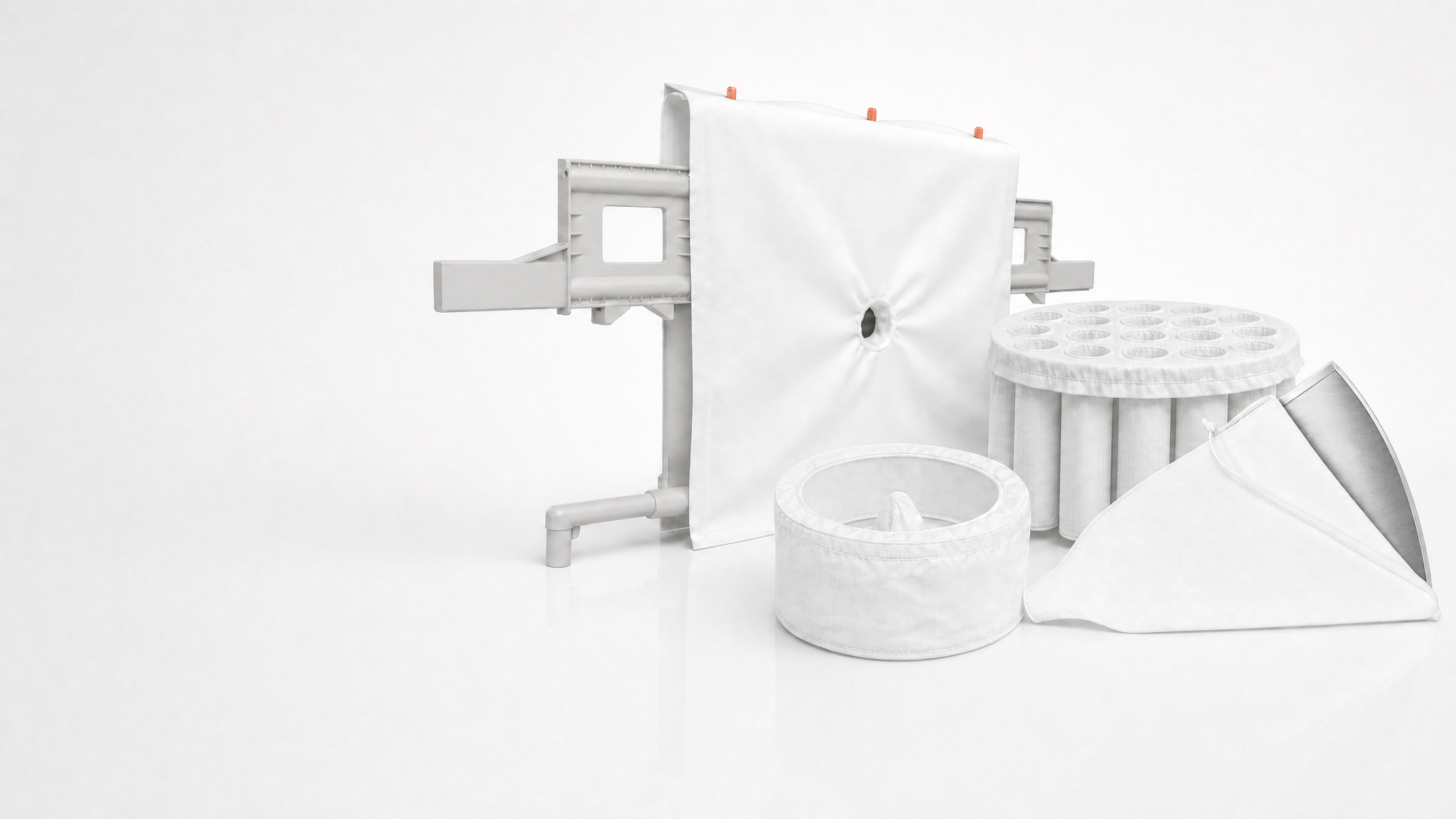
When a filter press cloth reaches the end of its service life, operators usually see the impact first in cycle time, cake dryness, and filtrate clarity. If you run an Andritz filter press, the replacement cloth must do more than "fit" — it has to seal reliably, release cake cleanly, and withstand your process conditions without adding maintenance headaches.
The RF-FF Series is engineered as a compatible alternative for filter press applications, giving operators a practical path to restore performance and, in many cases, improve it with the right fabric construction and finishing.
🔑 Key Takeaways
- RF-FF Series filter cloths are designed as compatible replacements for Andritz filter presses.
- Correct cloth selection depends on plate size, feed style, chamber depth, process chemistry, and cake discharge behavior.
- Many filtration issues blamed on the press are actually caused by worn, blinded, or poorly specified cloths.
- R+F can help match or improve key performance factors such as filtrate clarity, cake release, and service life.
⚙️ Why Andritz Filter Press Operators Replace Filter Cloths
Filter cloths are wear parts, and on a filter press they work hard: every cycle exposes them to pressure, abrasion, solids loading, cleaning chemistry, and repeated cake release. Even a well-run press will eventually show the effects of fabric aging, especially if the slurry is abrasive, sticky, fine, or chemically aggressive.
For operators, the decision to replace a cloth is rarely just about age. It is usually a response to measurable process losses, such as longer cycle times, wetter cake, or rising differential pressure. If you are troubleshooting recurring issues, it is worth reviewing both the machine setup and the cloth condition on your filter press equipment.
⚠️ Don't ignore the early signs: A cloth that still looks intact can already be 40–60% blinded. By the time operators notice wet cake or slow filling, performance has often degraded significantly. Proactive replacement saves more than reactive replacement.
Common signs the cloth is no longer performing
🔍 Cloth Replacement Indicators
- Slow filling and longer cycles — blinding or pore blockage reduces permeability
- Higher cake moisture — poor drainage means solids do not dewater efficiently
- Filtrate carryover or turbidity — damaged fibres or poor sealing let fines escape
- Cake sticking to plates — poor surface release increases cleanup time
- Frequent washing or manual intervention — the cloth is no longer self-releasing
In many plants, these symptoms are linked to issues that are easier to fix than a full press overhaul. For example, if your crew is dealing with cake hanging, cloth blinding, or slow dewatering, the replacement cloth specification should be part of the root-cause review.
🔬 How the RF-FF Series Matches Your Press Requirements
The RF-FF Series is built for filter press service where dimensional accuracy, sealing performance, and fabric behaviour all matter. In practice, "compatible" means the cloth can be specified to match the press configuration and process needs of an Andritz unit, while giving you the option to fine-tune performance through material selection, weave structure, and finishing.
Explore the main product here:
What "compatible" means in real plant conditions
A replacement cloth is only useful if it installs without forcing plate modifications or production delays. RF-FF cloths are specified around the practical details that determine whether a press runs smoothly:
- Plate geometry: chamber size, recess depth, corner cutouts, and sealing surfaces.
- Feed configuration: centre feed, corner feed, eyelets, grommets, or special inlet openings.
- Discharge behaviour: whether the cake should drop freely or release with minimal shaking.
- Process chemistry: pH, temperature, oxidizers, solvents, and cleaning agents.
- Solids profile: particle size distribution, fines content, abrasiveness, and compressibility.
Rule of thumb: For the fastest and most accurate match, send R+F a used cloth sample, plate drawing, or press model details. Even small differences in cutout position, seam style, or shrinkage can affect fit and sealing.
| Evaluation Factor | Typical OEM Goal | RF-FF Compatible Alternative | Operator Impact |
|---|---|---|---|
| Dimensional fit | Match plate and inlet geometry | Specified to align with press configuration | Faster installation, fewer leaks |
| Filtration performance | Maintain clarity and cycle time | Fabric selected for process target | Stable filtrate quality |
| Cake release | Clean discharge, minimal sticking | Finishes and weaves that support release | Less cleaning, shorter downtime |
| Durability | Resist wear, heat, chemistry | Material matched to operating conditions | Longer service intervals |
| Availability | Reduce replacement lead time | Independent manufacturing, flexible specs | Quicker recovery after failure |
📊 What You Should Specify Before Ordering Replacement Cloths
The best replacement is not chosen by brand name alone. It is chosen by how the press runs in your plant.
Press make/model, plate dimensions, chamber size, recess geometry, feed and outlet design.
Solids content, particle size, temperature, pH, chemical exposure, and any polymer conditioning.
Faster cycle time? Drier cake? Better clarity? Improved cake release? Longer cloth life?
Measure the old cloth when removed — real-world shrinkage and wear reveal why the current setup underperforms.
After installation, monitor filtrate quality, cake release, and cycle stability over multiple runs.
💡 Tip: If the old cloth is still available, measure it when removed from service, not only from the drawing. Real-world shrinkage, stretching, and seam wear often reveal why the current setup is underperforming.
For operators in sludge dewatering, mining and minerals, and chemical processing, those details matter even more. Fine mineral solids, sticky polymer-treated sludge, and chemically aggressive streams each demand a different cloth behaviour.
🛠️ Common Problems a New Cloth Can Solve
1) Slow dewatering
If the press is taking longer to reach target pressure or produce a dry cake, the cloth may be restricting flow. You can read more about related issues on our slow dewatering page. In some plants, a better-specified cloth restores the original cycle time without other mechanical changes.
2) Poor cake release
When cake hangs in the chamber, operators lose time to manual cleanout and the press becomes a bottleneck. A compatible cloth with the right finish can help the cake drop more consistently and reduce cleanup labour.
3) Filtrate clarity problems
If fines are escaping or the filtrate is becoming cloudy, the cloth may be damaged, worn, or too open for the process. A tighter or better-matched fabric construction can improve solids retention while keeping flow acceptable.
4) Frequent cloth washing or unplanned downtime
When the cloth needs constant washing, it is consuming labour and often masking a specification mismatch. Review related symptoms on cloth blinding.
Rule of thumb: If you are replacing cloths more than twice a year on the same press, the issue is likely a specification mismatch — not just normal wear. Review material, weave, and finishing before reordering the same part.
✅ Selecting the Right Cloth for Your Application
📋 Cloth Selection Checklist
- Choose permeability for the slurry, not just the press
- Match the seam and sealing style to your plate type
- Account for temperature and chemistry in material selection
- Think beyond initial price — service life and downtime matter more
- Validate with operating feedback after startup
If your plant is comparing replacement paths for multiple filtration assets, it may also help to review adjacent product families:
In practice, the most successful installations are the ones where the operator, maintenance team, and fabric supplier work from the same process targets. That is the fastest way to move from "part replacement" to real performance recovery.
📩 Need Help Choosing the Right Fabric?
Our technical team at R+F FilterElements can help you find the perfect filter fabric for your specific application. Get in touch for a free consultation — we will recommend the right solution based on your machine, process, and operating conditions.