
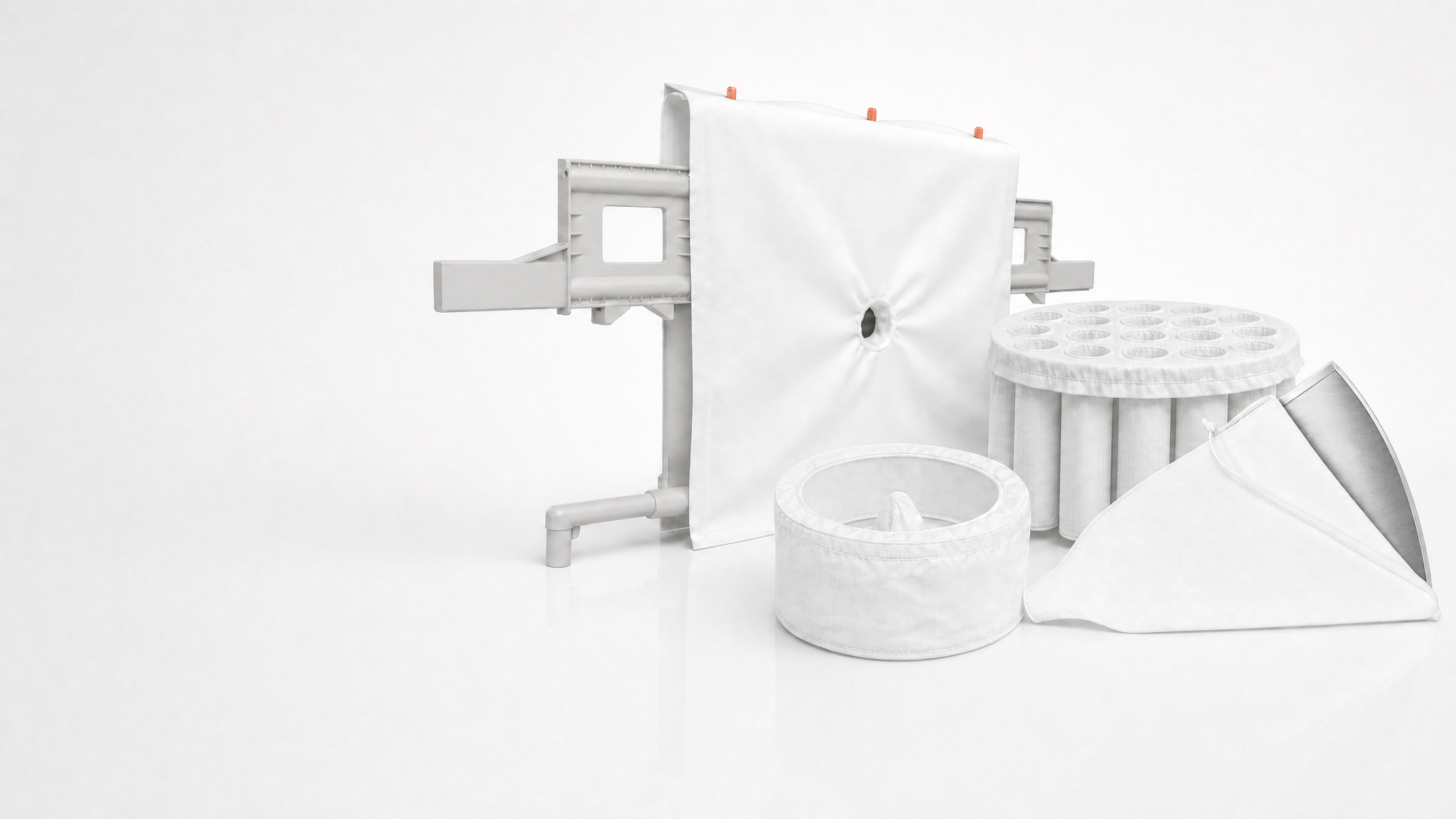
When a filter press cloth does not fit, the problem usually starts long before installation — at the measuring stage. If you run a filter press, a precise spec sheet helps you avoid leakage, poor cake release, and unnecessary downtime. The good news: with the right reference points, you can specify a custom cloth clearly and repeatably.
🔑 Key Takeaways
- Measure the plate, not a stretched or worn-out cloth.
- Record the feed hole position from fixed reference edges.
- Specify overhangs, flaps, and edge finish exactly — these details affect sealing and service life.
- Send photos, plate drawings, and process data so the cloth can be matched to your operating conditions.
⚙️ Start with the plate, not the old cloth
Used cloths often shrink, stretch, or distort around the feed hole and sealing area. That is why the correct starting point is always the plate geometry, especially if you are replacing cloths on a multi-plate pack or comparing different press generations.
Remove cake, scale, and residue so you can see the true sealing edge and hole position.
Record the effective length, width, and recess depth — not just the outside frame size.
If possible, verify the same measurements on another plate to catch wear, deformation, or inconsistent machining.
| What to measure | How to measure it | Why it matters | Common mistake |
|---|---|---|---|
| Plate length and width | Measure the active cloth area between the sealing edges | Determines the cloth body size | Using overall frame size instead of the sealing area |
| Recess / chamber depth | Measure the depth where the cake forms | Affects cloth tension and cake volume | Ignoring depth and only sending surface dimensions |
| Feed hole diameter | Measure the opening cleanly at the plate face | Needed for the correct collar or cut-out | Reporting an approximate value from the old cloth |
| Plate type | Identify recessed, gasketed, membrane, or non-gasketed plates | Controls sealing method and seam design | Leaving out the plate type entirely |
💡 Tip: Take a photo of each measurement with a tape measure in place and note the plate ID. That makes it much easier for the technical team to verify your numbers later.
🔬 Measure the feed hole and sealing details precisely
The feed hole is one of the most important reference points on a filter press cloth. If the hole is off by even a small amount, the cloth can wrinkle, leak, or wear prematurely around the inlet — a common trigger for drip leakage and uneven cake build-up.
When you specify the hole, provide two reference distances: from the hole center to the top/bottom edge and from the hole center to the left/right edge. If the hole has a collar, grommet, or reinforced ring, note that too. For operators dealing with variable slurry conditions, a correct hole spec also helps reduce filter-cloth clogging around the inlet zone.
⚠️ Caution: Never guess the hole position from a torn or stretched cloth. If the old fabric has crept, folded, or been repaired, the measurements can be misleading and the new cloth may not seat correctly.
📊 Define overhangs, flaps, and edge finish
Many fit problems come from vague flap instructions such as “make it a bit longer” or “leave some extra edge.” For a custom cloth, you should define the overhang in millimetres, indicate which side carries the flap, and specify whether the edge is folded, hemmed, welded, or left open.
- Overhang: the amount of cloth extending beyond the sealing surface.
- Flap size: the folded or wrapped section used to secure the cloth.
- Edge finish: stitched, welded, cut, or reinforced depending on media and cleaning conditions.
Rule of thumb: Measure the flap from the sealing edge of the plate, not from the visible cloth fold. That is the dimension that determines whether the cloth closes tightly or leaves a gap.
If your cloth is too short, the press may not seal properly. If it is too long, the fabric can bunch, trap solids, or interfere with closing pressure — especially on older presses where plate alignment is not perfect. That can also shorten service life, which is one reason operators search for help with short filter lifespan.
🛠️ Build a complete specification for custom cloths
When you send a request for custom filter press cloths, the goal is to remove every ambiguity. A good spec allows the manufacturer to produce a cloth that fits the plate, seals correctly, and runs the way your process needs it to run. If you also run other solid-liquid separation equipment, you can compare your press requirements with our solid-liquid separation applications.
📋 What to include in your specification
- Machine or press model and plate type
- Plate length, width, and recess depth
- Feed hole diameter and exact position
- Required overhang or flap size on each side
- Edge finish, seam type, and reinforcement needs
- Process data such as temperature, pH, solids load, and cleaning method
- Photos of the plate and a marked sketch, if available
For plants that need a broader comparison of cloth construction and process compatibility, these product families are a good starting point before you send your final dimensions. The more complete your request, the faster we can recommend the right fabric for your duty cycle and cleaning regime.
✅ Avoid the mistakes that cause leaks and bad cake release
Most specification errors are easy to prevent once you know where they come from. The most common issues are measuring from worn cloths, forgetting the feed-hole offset, and leaving out flap data. Those mistakes often show up later as poor cake release, seepage at the edges, or recurring contamination around the seam.
- Use a calibrated tape or steel rule, not a flexible guess.
- Measure at the plate, not on a cloth under tension.
- Document every side that matters — front, back, and seam orientation.
- Keep one marked sketch or photo with the machine file for future reorders.
💡 Tip: If you are replacing a cloth after a failure, inspect the plate surface first. Burrs, wear marks, or damaged sealing edges can mimic a cloth problem and lead to repeated misfits.
For operators troubleshooting process symptoms rather than dimensions, it can help to compare the cloth spec with the operating issue: cake release problems often point to surface finish or cloth construction, while contamination questions can lead back to stitching or sealing details. If you are unsure whether your issue is dimensional or process-related, start with the measurement record and the plate photo set.
📩 Need Help Choosing the Right Fabric?
Our technical team at R+F FilterElements can help you find the perfect filter fabric for your specific application. Get in touch for a free consultation — we will recommend the right solution based on your machine, process, and operating conditions.