
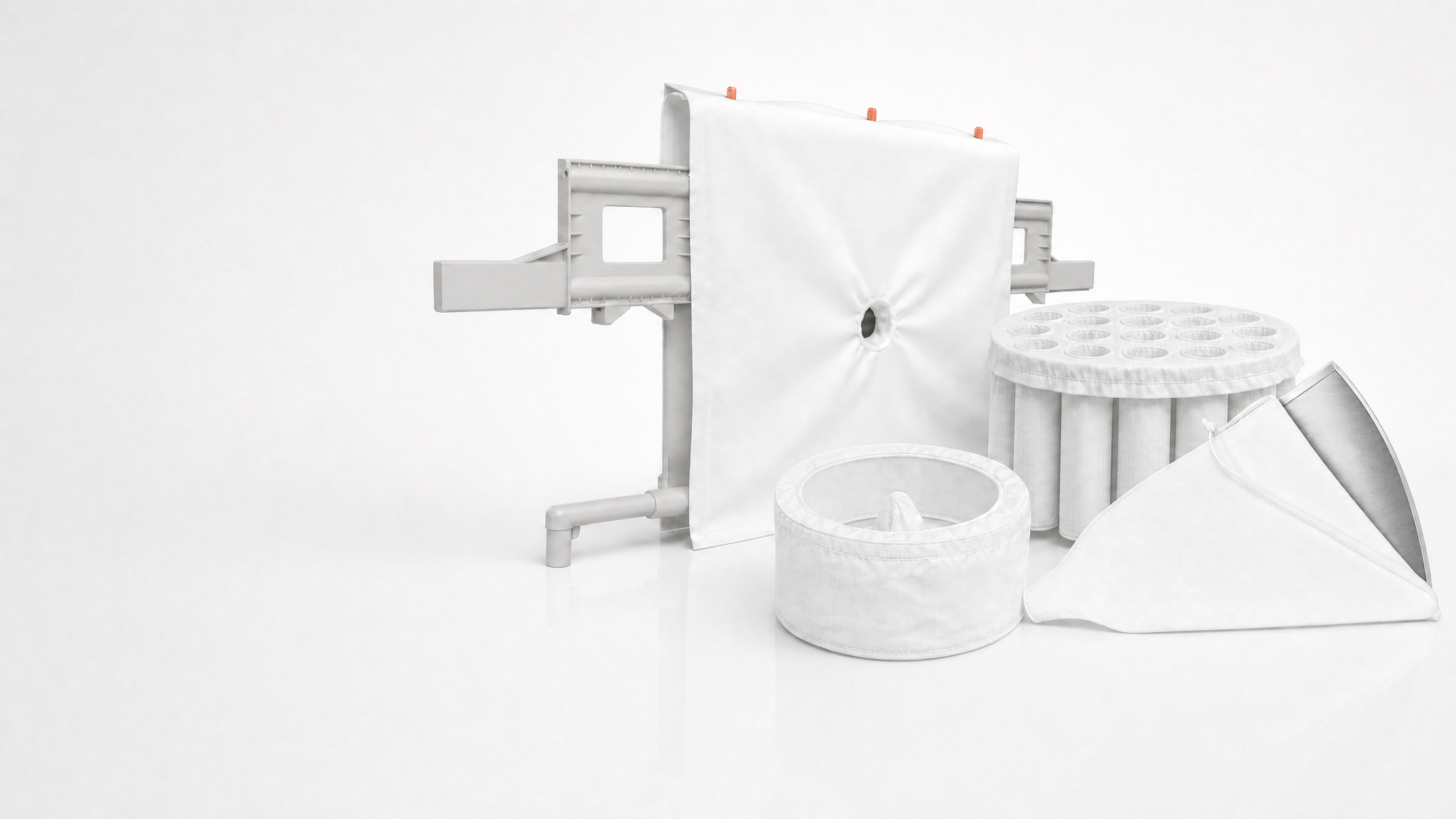
Choosing the right filter press cloth is not just a design decision — it affects how easily your cake drops, how often you stop for cleaning, and how stable your filtrate quality stays from shift to shift. In practice, the biggest choice often comes down to monofilament vs. multifilament yarn construction.
If you run a press in mineral processing, chemicals, food, wastewater, or fine solids recovery, the cloth you choose should support fast discharge, low blinding, and predictable uptime. Here is the operator’s view of where each yarn type performs best.
🔑 Key Takeaways
- Monofilament cloths usually release cake better and resist blinding more effectively.
- Multifilament cloths can be useful for certain fine solids, but they are more prone to fouling and harder to clean.
- For clear filtrate, easier washdown, and longer service life, monofilament is often the first choice.
- The right cloth depends on your solids, chemistry, wash cycle, and whether cake release or retention is the bigger challenge.
⚙️ What Monofilament and Multifilament Really Mean
In a filter press, the yarn construction changes how the cloth behaves under pressure. Monofilament yarn is made from single, smooth strands. Multifilament yarn is made from many fine filaments twisted together, which creates a softer structure but also more internal spaces where solids can lodge.
For most standard filter press duties, especially where uptime matters, monofilament is the more operator-friendly option. It is also the construction most plants compare first when they review their cloth strategy for a filter press.
⚠️ Caution: A cloth that looks “fine” on day one can still fail in service if it blinds quickly or traps solids deep in the yarn. Inconsistent cake release is often the first sign that the yarn construction is wrong for the process.
🔬 Cake Release and Blinding Resistance
The two most visible performance factors on the plant floor are cake release and blinding resistance. If cake hangs on the cloth, discharge slows down, cycle times stretch, and operators spend more time scraping, washing, or troubleshooting leaks.
| Performance factor | Monofilament | Multifilament | Operator takeaway |
|---|---|---|---|
| Cake release | Smooth surface helps solids drop cleanly | More likely to hold fines in the yarn structure | Monofilament usually wins on discharge |
| Blinding resistance | Generally better because the surface is easier to clean | More prone to internal clogging | Better uptime with monofilament in many presses |
| Filtrate clarity | Typically very good when the weave is matched correctly | Can start well, but may drift as cloth fouls | Stable clarity is easier to maintain with monofilament |
| Cleaning effort | Usually easier to wash and restore | Often needs more aggressive cleaning | Lower maintenance burden with monofilament |
💡 Tip: If your press has good initial clarity but the cloth performance drops after a few cycles, you are probably seeing cloth clogging rather than a pore-size problem.
📊 Filtrate Clarity, Service Life, and Uptime
From an operator’s point of view, the best cloth is the one that keeps running without constant adjustment. Monofilament cloths usually support more consistent filtrate quality because the yarn surface is smoother and less likely to trap embedded particles. That smoother surface also makes it easier to recover performance after wash cycles.
Multifilament cloths can still be useful, but their internal structure often means more retained solids, more frequent washdowns, and a shorter effective service interval. If you are fighting short filter cloth lifespan, yarn type should be part of the root-cause review, not just fabric weight or weave.
Rule of thumb: If your biggest complaint is sticky cake or frequent blinding, start with monofilament. If the process is unusual, validate both cloth types in a controlled test before standardizing.
🛠️ When to Use Monofilament vs. Multifilament
Monofilament is usually the better fit when:
- You need fast, clean cake discharge.
- You want fewer wash cycles and less manual cleaning.
- Your press is stopping because of blinding or residual solids.
- You are trying to improve stable filtrate clarity in a demanding process.
Multifilament may still make sense when:
- The process has been proven to perform well with that yarn structure.
- You are running a niche application and need lab or pilot confirmation.
- Cost is the only concern and the process is forgiving.
In most industrial filter press applications, monofilament is the safer starting point for reducing downtime and improving discharge behavior. If you operate in chemical processing, mineral slurries, or other high-throughput duty, that difference can translate directly into more productive hours per week.
📋 Practical Selection Checklist Before You Order
📋 Cloth Selection Checklist
- What is the particle size distribution of the solids?
- Is cake release or filtrate clarity the main priority?
- How often can the cloth be washed in your actual operation?
- Are you seeing blinding, leakage, or unstable cycle times?
- Does your chemistry or temperature place extra stress on the fabric?
If you want a quick way to compare available engineered options for filter press duty, start here:
Is the issue cake sticking, blind cloths, poor clarity, or short life?
Use monofilament as the default for release and cleanability; test multifilament only if the process clearly needs it.
Check discharge time, filtrate clarity, wash recovery, and cloth life over several cycles before standardizing.
💡 Tip: If your current cloth works at first but gets worse as solids build up, review the fabric construction alongside the cycle time and wash routine. Many “process” problems are actually cloth selection problems.
📩 Need Help Choosing the Right Fabric?
Our technical team at R+F FilterElements can help you find the perfect filter fabric for your specific application. Get in touch for a free consultation — we will recommend the right solution based on your machine, process, and operating conditions.