
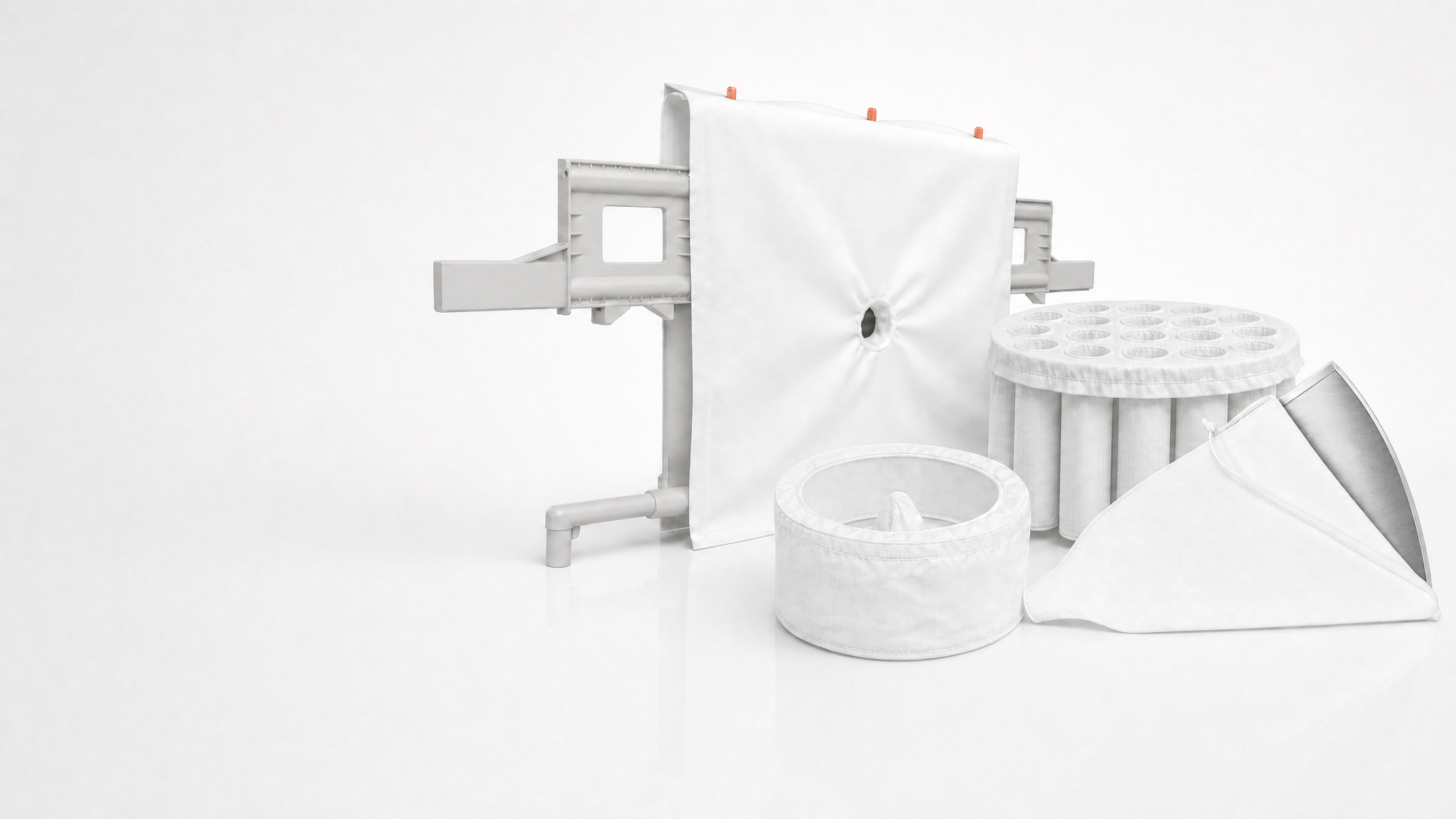
Drum filter cloth blinding is one of the most common reasons a rotary vacuum system starts losing capacity in chemical service. If you run a drum filter in corrosive or reactive slurries, the problem is usually not the machine alone — it is the interaction between slurry chemistry, solids size, operating vacuum, and the fabric surface.
This guide explains why blinding happens, what to check first, and how the right fabric construction and chemical pre-treatment can keep production stable. If you are already seeing rising filtrate clarity issues or falling throughput, this is closely related to filter cloth clogging on industrial filters and the specific demands of chemical industry filtration.
🔑 Key Takeaways
- Blinding often starts with fine particles, sticky crystals, or precipitates lodging in the fabric surface.
- Chemical compatibility matters as much as pore size; the wrong polymer can swell, harden, or lose release properties.
- Pre-coating, pH control, and controlled wash steps can reduce rapid pore blockage.
- For recurring issues, fabric selection should be matched to the slurry chemistry and the drum filter operating cycle.
⚙️ Why Drum Filter Cloths Blind in Chemical Slurries
In a drum filter, the cloth sees repeated cake formation, drainage, washing, and discharge. In chemical applications, that cycle can be interrupted by fine colloids, salt crystals, gels, polymers, or reaction by-products that penetrate the fabric surface and seal the open areas.
Common blinding mechanisms
- Surface sealing: very fine solids block the first layer of pores and form a dense film.
- Internal pore loading: submicron particles migrate into the fabric structure and are difficult to remove by backwash.
- Chemical swelling: incompatible media can alter fiber geometry and reduce permeability.
- Crystal precipitation: changes in temperature or pH can create hard deposits inside the cloth.
- Sticky cake residues: organic binders, oils, or polymers leave a tacky layer that traps more solids.
⚠️ Caution: Do not assume a tighter cloth will solve blinding. If the slurry contains fine reactants or crystallizing salts, a tighter weave can accelerate surface sealing and make cake discharge worse.
🧪 What to Check on the Machine and Process
Before changing the cloth, verify whether the problem is chemical, mechanical, or operational. On a drum filter, blinding can be intensified by poor vacuum balance, inconsistent slurry feed, or insufficient cake washing.
📋 Operator checklist before changing fabric
- Confirm slurry solids size and whether fines have increased recently.
- Check pH, temperature, and conductivity for process drift.
- Review vacuum level, drum speed, and immersion time.
- Inspect cake discharge: is the cake releasing cleanly or smearing?
- Look for scaling, crystal deposits, or sticky residue on the cloth.
Rule of thumb: If the cloth looks clean after washing but blinding returns within a few cycles, the cause is usually chemistry-driven, not just wear.
🔬 Fabric Selection: Matching the Cloth to the Chemistry
The best drum filter cloth is the one that balances chemical resistance, pore stability, cake release, and cleanability. In aggressive chemical service, polyester, polypropylene, or specialty needle felt constructions may behave very differently over time. For related solids handling duties, compare the design logic of RF-BF Series belt filter fabrics and RF-CF Series centrifuge fabrics to see how open structure and release behavior change by machine type.
| Fabric choice | Best for | Operator benefit | Watch-outs |
|---|---|---|---|
| Monofilament woven cloth | Good release and easier washing | Lower surface blinding risk | May allow more fine particle carryover |
| Multifilament / finer weave | Finer filtration and clarity | Improved retention | Can blind faster in sticky or crystallizing slurries |
| Needle felt | High solids loading, polishing duty | Good cake support | May trap fines if pretreatment is poor |
| Chemical-resistant specialty fabric | Corrosive or high-temperature media | Stable performance in harsh service | Must be selected carefully for pH and solvent exposure |
If your slurry changes by batch, the fabric must tolerate those swings. For installations with demanding chemical compatibility, the RF-FF Series filter press fabrics and RF-NF Series needle felt solutions are often evaluated using the same chemical resistance criteria as the drum filter media.
🛠️ Chemical Pre-Treatment and Process Fixes
In many plants, the most effective solution is not just a new cloth — it is a better slurry condition before filtration. Pre-treatment reduces the tendency of solids to seal the fabric and can make the cloth easier to clean during the cycle.
Keep pH, temperature, and reagent dosing consistent so you do not create sudden precipitation on the cloth.
A controlled pre-coat can protect the cloth surface and capture fines before they penetrate the weave.
Adjust wash duration and cake release timing so residues are removed before they harden.
A quick flush at the end of a campaign prevents salts and reaction products from drying into the cloth.
💡 Tip: If your process uses multiple product grades, assign one cloth specification for high-fouling batches and another for cleaner runs. That simple change can extend service life and reduce cleaning downtime.
For plants with frequent campaign changes, it is often worth using a digital selection tool before ordering replacement media. You can find and configure the right filter fabric with our Solution Finder, select your machine, and receive a pre-filled, non-binding inquiry with the relevant specification.
📊 How to Reduce Blinding Over the Long Term
Once the immediate issue is under control, focus on repeatability. The best drum filter performance comes from a combination of fabric, slurry chemistry, and disciplined operating practice.
- Track pressure drop or vacuum trend: rising resistance is an early warning of blind build-up.
- Log chemical changes: even small shifts in neutralization or crystallization can affect cloth loading.
- Inspect after cleaning: if the cloth still feels slick or scaled, the cleaning step is incomplete.
- Review life cycle data: compare one campaign to the next to spot patterns in fouling and discharge behavior.
When the same slurry also runs on other separation equipment, the root cause is often shared. Issues like poor cake release or short filter cloth lifespan usually indicate that the fabric and the chemical environment are not aligned.
📩 Need Help Choosing the Right Fabric?
Our technical team at R+F FilterElements can help you find the perfect filter fabric for your specific application. Get in touch for a free consultation — we will recommend the right solution based on your machine, process, and operating conditions.
If you want a faster starting point, use our Solution Finder to configure the right filter fabric online for your drum filter or related machine, and receive a pre-filled, non-binding specification and inquiry.