
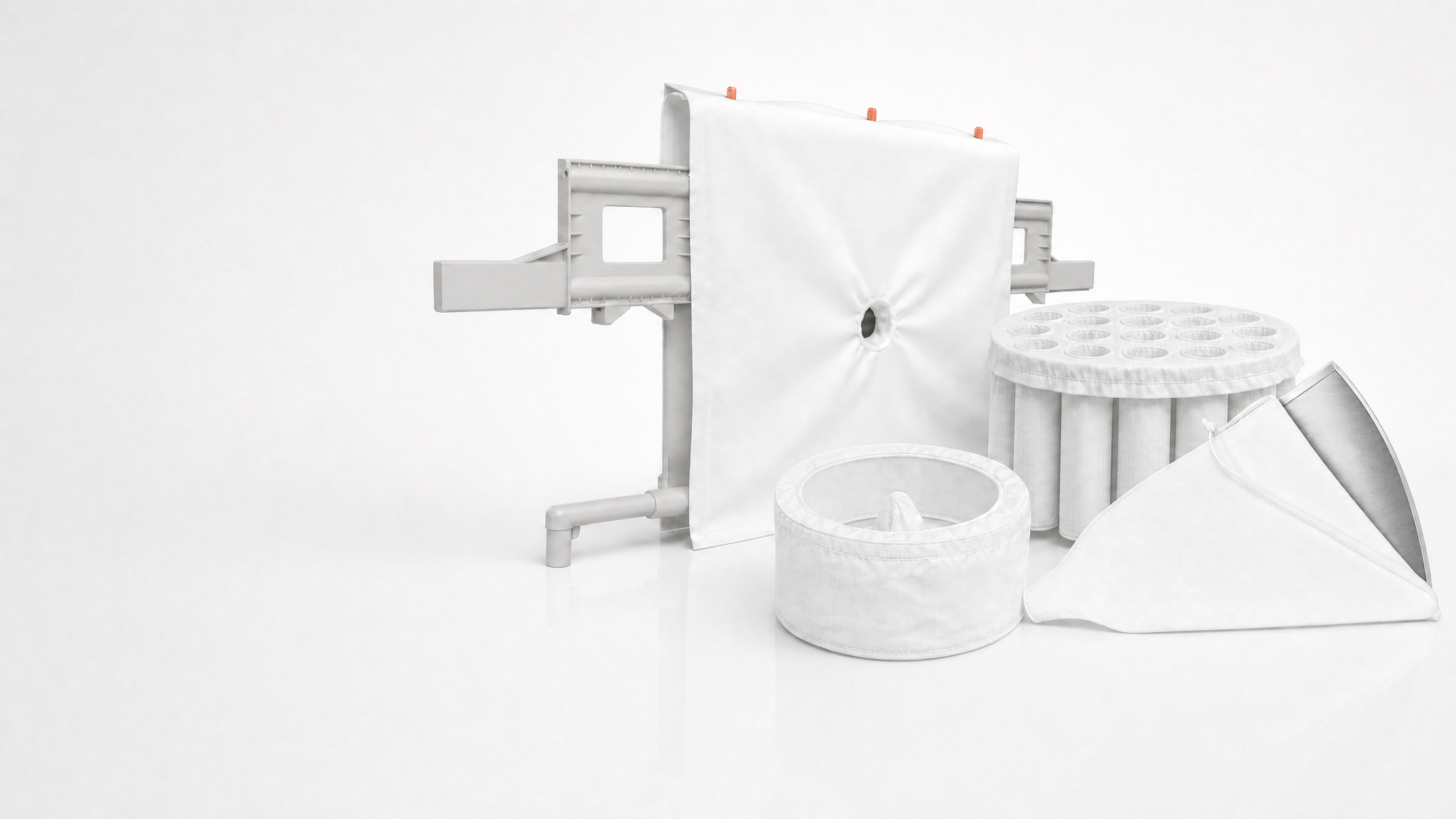
In pharmaceutical solid-liquid separation, the seam is often the weak point that decides whether a batch stays clean or gets flagged during inspection. For a Nutsche filter, ultrasonic welded seams help remove that weak point by eliminating thread holes, loose fibers, and contamination traps in the cloth construction.
If you are running API production under GMP expectations, this matters every day: cleaner discharge, easier cleaning, and a lower risk of particles migrating into the product. That is why operators increasingly specify RF-ANF Series Nutsche Pharma filter fabrics for critical applications.
🔑 Key Takeaways
- Ultrasonic welded seams remove thread perforations that can release particles into the process.
- For pharmaceutical Nutsche filters, cleaner seam geometry supports GMP-oriented cleanliness and validation.
- Welded seams can improve edge stability, reduce fraying, and simplify cleaning between batches.
- Choosing the right seam design is as important as choosing the base fabric for your API process.
⚙️ Why the Seam Matters in API Production
When I look at a Nutsche filter in the plant, I do not just inspect the cake, pressure hold, or discharge behavior — I look closely at the edge construction. Traditional sewn seams create needle holes and thread paths that can become particle traps, especially in highly sensitive pharmaceutical batches.
In API production, that risk is not theoretical. Fine crystals, dust, and residual product can lodge in stitch channels and later dislodge during the next batch. If you are working under pharmaceutical processing requirements, the seam needs to support a repeatable, clean, and inspectable operation.
⚠️ Caution: If seam threads or loose edge fibers are visible during inspection, treat it as a contamination risk. In regulated pharmaceutical service, even minor textile shedding can trigger deviations or rework.
🔬 Ultrasonic Welding vs. Conventional Stitching
Ultrasonic welding uses localized energy to fuse the material layers together. The result is a seam without conventional needle penetrations and without loose seam thread in the process zone. For operators, that usually translates into a cleaner edge and fewer hidden retention points.
| Feature | Conventional stitched seam | Ultrasonic welded seam |
|---|---|---|
| Particle trap potential | Higher due to needle holes and thread channels | Lower because the seam is fused, not pierced |
| Fiber shedding risk | Possible at cut edges and thread ends | Reduced by sealed edge geometry |
| Cleaning behavior | Can retain residues in stitch lines | Typically easier to rinse and inspect |
| Pharma suitability | Depends heavily on design and validation | Well suited for high-cleanliness applications |
For a deeper look at seam-related defects, see our page on contamination caused by stitching. It explains why a seam can become a hidden source of product carryover, especially in multi-batch operation.
📊 What You Gain in Day-to-Day Operation
From the operator’s point of view, the best seam is the one you do not have to think about during shutdown, cleaning, or validation. Ultrasonic welded seams support that goal by reducing the small but costly issues that can interrupt a campaign.
💡 Tip: If your Nutsche filter is used for high-value APIs, prioritize seam integrity during fabric specification just as much as pore rating, permeability, and chemical resistance.
Practical benefits you can notice on the floor
- Less residue accumulation at the seam line
- Cleaner visual inspection before re-use
- Lower chance of loose threads ending up in the product
- More consistent wash and dry behavior across campaigns
In many plants, that also means fewer quality findings during internal audits. If your site already uses engineered fabrics on other equipment — for example RF-FF Series filter press fabrics or RF-CF Series centrifuge fabrics — the same thinking applies: edge design is part of process control, not just fabrication detail.
Rule of thumb: If a seam can trap residue, it can also release residue. For pharma service, design seams to be as close to “non-cleaning-critical” as possible.
🛠️ How to Specify the Right Pharma Nutsche Fabric
When you select a seam design for a Nutsche filter, do not start with the fabric alone. Start with the process conditions: API sensitivity, filtration temperature, cleaning method, cake behavior, and expected campaign length. Then match the seam style to the risk profile.
Identify whether seam particles could reach the product, wash filtrate, or dried cake.
Review CIP/SIP practices, visual inspection requirements, and batch changeover time.
Select a construction designed for your Nutsche filter and your chemistry, temperature, and filtration cycle.
📋 Pharma fabric specification checklist
- Seam construction is thread-free in the product contact zone
- Material compatibility with solvent and cleaning agents
- Temperature and pressure resistance fit the cycle
- Edge stability supports repeated installation and removal
- Documentation supports GMP-oriented quality review
For many operators, the best starting point is the RF-ANF Series Nutsche Pharma fabric, because it is designed with pharma cleanliness in mind. If your process also involves other solid-liquid separation steps, the same contamination-control logic can be applied across your line, from chemical processing to sensitive pharmaceutical production.
✅ Final Takeaway for Plant Operators
Ultrasonic welded seams are essential in pharmaceutical Nutsche filters because they remove one of the most common hidden contamination pathways: stitched seam channels. In a GMP or FDA-regulated environment, that extra control can make the difference between a routine batch and a quality deviation.
If your current cloth shows stitch wear, edge fraying, or recurring cleanliness issues, it is worth reviewing the seam design before the next campaign. The fabric may look like a small component, but in API production, small details carry real risk.
📩 Need Help Choosing the Right Fabric?
Our technical team at R+F FilterElements can help you find the perfect filter fabric for your specific application. Get in touch for a free consultation — we will recommend the right solution based on your machine, process, and operating conditions.