
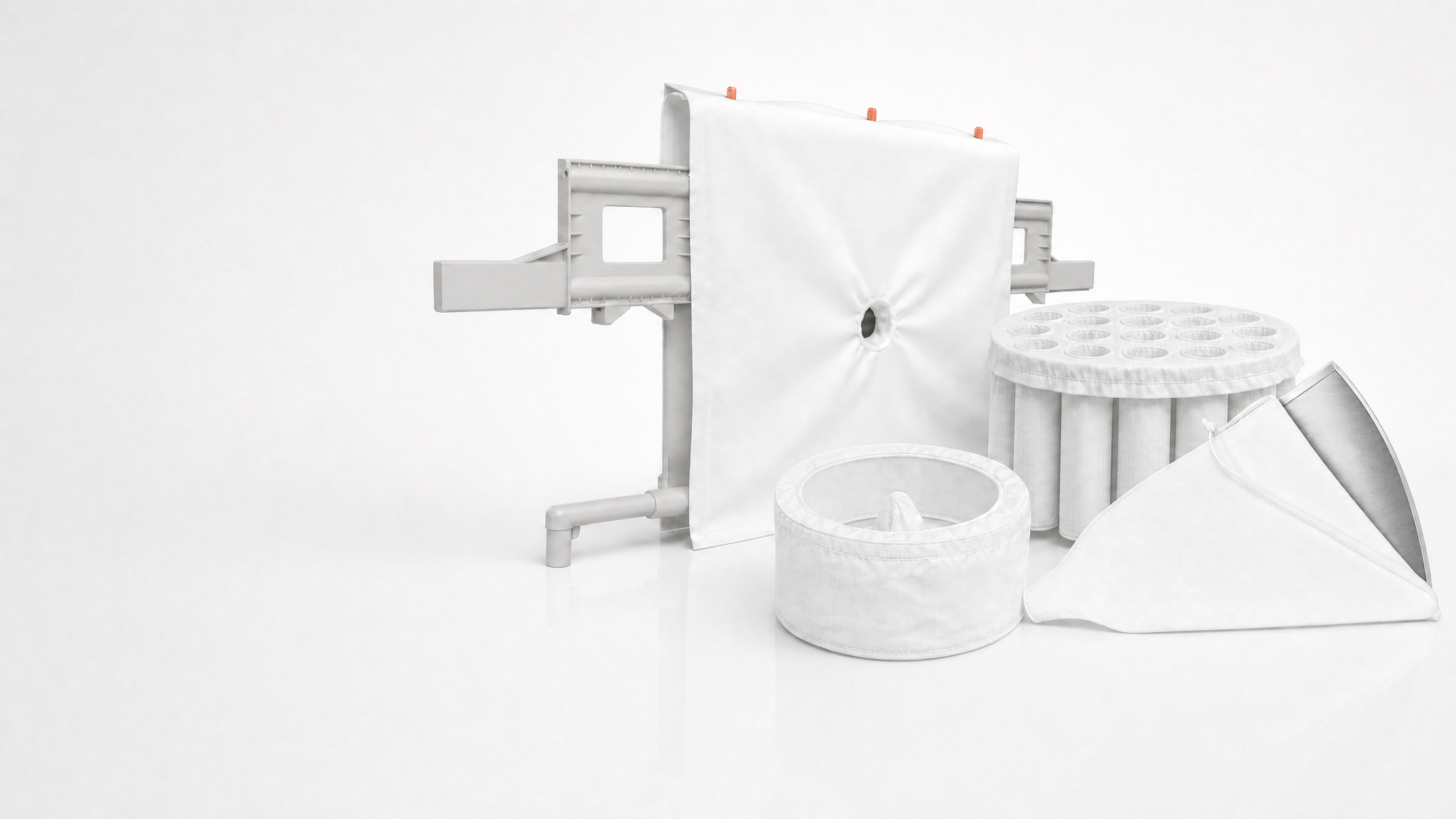
In an agitated Nutsche filter, cake cracking usually starts long before discharge: the top layer dries faster than the core, shrinks unevenly, and opens stress lines. If you run the vessel for chemical, pharmaceutical, or fine-batch drying, the right filter fabric can make the difference between a uniform cake and a cracked, hard-to-handle one on the next cycle. Learn more about the machine itself on our Nutsche filter machine page.
🔑 Key Takeaways
- Cake cracking is usually caused by uneven moisture removal, not just “over-drying.”
- Fabric permeability influences how evenly liquid leaves the cake during the early drying stage.
- A smoother fabric surface reduces sticking and stress points that can trigger cracks.
- Stable agitation, gentle vacuum ramping, and the right cloth construction are the fastest ways to improve uniformity.
⚙️ Why cakes crack during drying
Most cracked cakes in an agitated Nutsche filter are a sign of internal stress. The outer surface loses moisture first, becomes rigid, and then contracts while the wetter core is still moving. Once that stress exceeds the cake’s strength, you get fissures, edge lifting, or a brittle shell that breaks during discharge.
Common root causes from the operator’s side
- Drying too aggressively: vacuum, gas temperature, or jacket heat ramps up too fast.
- Uneven cake thickness: thick zones dry slower and pull the cake apart.
- Poor wash/drain balance: residual solvent or wash liquid creates uneven shrinkage.
- Mechanical stress: agitation set too high, especially when the surface has already stiffened.
- Fabric-related channeling: local high-permeability spots pull liquid out faster than the rest of the cake.
⚠️ Caution: If the cake is already showing surface cracks, increasing agitation speed or applying a stronger vacuum can make the damage worse. In flammable or dusty service, always verify ATEX requirements and consider antistatic options linked to ATEX-related fabric risks.
🔬 How fabric permeability and smoothness affect drying uniformity
The fabric is more than a support layer. In a Nutsche filter, it controls how the mother liquor and wash liquid leave the cake, and that directly affects how evenly the cake dries. If the cloth drains too unevenly, the surface can form a hard skin while the lower layers remain wet.
| Fabric property | What the operator sees | Drying impact | Typical risk if poorly matched |
|---|---|---|---|
| Higher permeability | Fast drainage and quicker deliquoring | Can improve cycle time if flow stays uniform | Channeling, early surface sealing, uneven shrinkage |
| Lower permeability | Slower liquid removal | Can support more even consolidation | Longer cycle time, retained solvent, wetter cake core |
| Smoother surface | Less sticking and easier release | Supports uniform cake contraction during drying | Lower risk of mechanical tearing and crack initiation |
| Rougher surface | More anchoring points on the cloth | May help retention in some slurries | Stress concentration, cake adhesion, crack propagation |
💡 Tip: If your product is prone to shrinkage, aim for a fabric that balances controlled permeability with a smooth release surface. In many Nutsche applications, that means selecting the cloth for uniform drainage first, not just maximum throughput.
For operators working in fine chemical or pharmaceutical production, the fabric choice often matters as much as the drying recipe. Our RF-ANF Series Nutsche fabrics are designed for demanding filtration and drying duties, while the RF-NF Series needle felt fabrics are useful when you need a robust structure and consistent cake support.
🛠️ Practical steps to prevent cracking
The best fix is usually a combination of process tuning and fabric optimization. Start with the drying profile, then validate whether the cloth is helping or fighting the process.
Make sure deliquoring and washing are complete enough that the cake is not drying across wet and dry zones at the same time.
Use a controlled increase in vacuum and temperature so the outside does not seal before moisture can migrate from the core.
Keep mixing gentle once the cake starts to stiffen. Over-agitation can turn small drying stresses into visible cracks.
Inspect for blinding, polishing, damage, or localized wear. Uneven cloth performance often creates uneven drying zones.
Rule of thumb: If cracks appear mainly in the center, the cake is usually drying too fast at the surface; if they appear near edges or discharge zones, check agitation, cake thickness, and cloth release behavior first.
📊 Choosing the right fabric for your drying profile
If your current cloth is either too open or too rough, the drying profile can become unstable. In practice, you want a fabric that drains evenly, releases cleanly, and does not create localized hot spots or dead zones. That is especially important in a chemical industry batch where product quality depends on repeatable drying behavior.
For process teams comparing options across equipment types, it helps to look at the whole separation system, not just the cloth. The product families for RF-FF Series filter press fabrics and RF-BF Series belt filter fabrics show how fabric construction changes drainage and release behavior in different machines, which is useful when you benchmark your Nutsche process against other units.
📋 Pre-run checklist for cracking prevention
📋 Nutsche drying checklist
- Confirm cake thickness is consistent across the vessel
- Verify cloth is clean, intact, and free of local blinding
- Check vacuum and heating ramp rates before starting drying
- Reduce agitation before the cake becomes brittle
- Inspect whether discharge damage is being mistaken for drying cracks
- Document where cracks appear: center, edge, or near the agitator path
If cake cracking keeps recurring, the issue may overlap with cake release problems or even filter cloth clogging. In those cases, the cloth is not just a separator; it is part of the drying control strategy.
📩 Need Help Choosing the Right Fabric?
Our technical team at R+F FilterElements can help you find the perfect filter fabric for your specific application. Get in touch for a free consultation — we will recommend the right solution based on your machine, process, and operating conditions.