
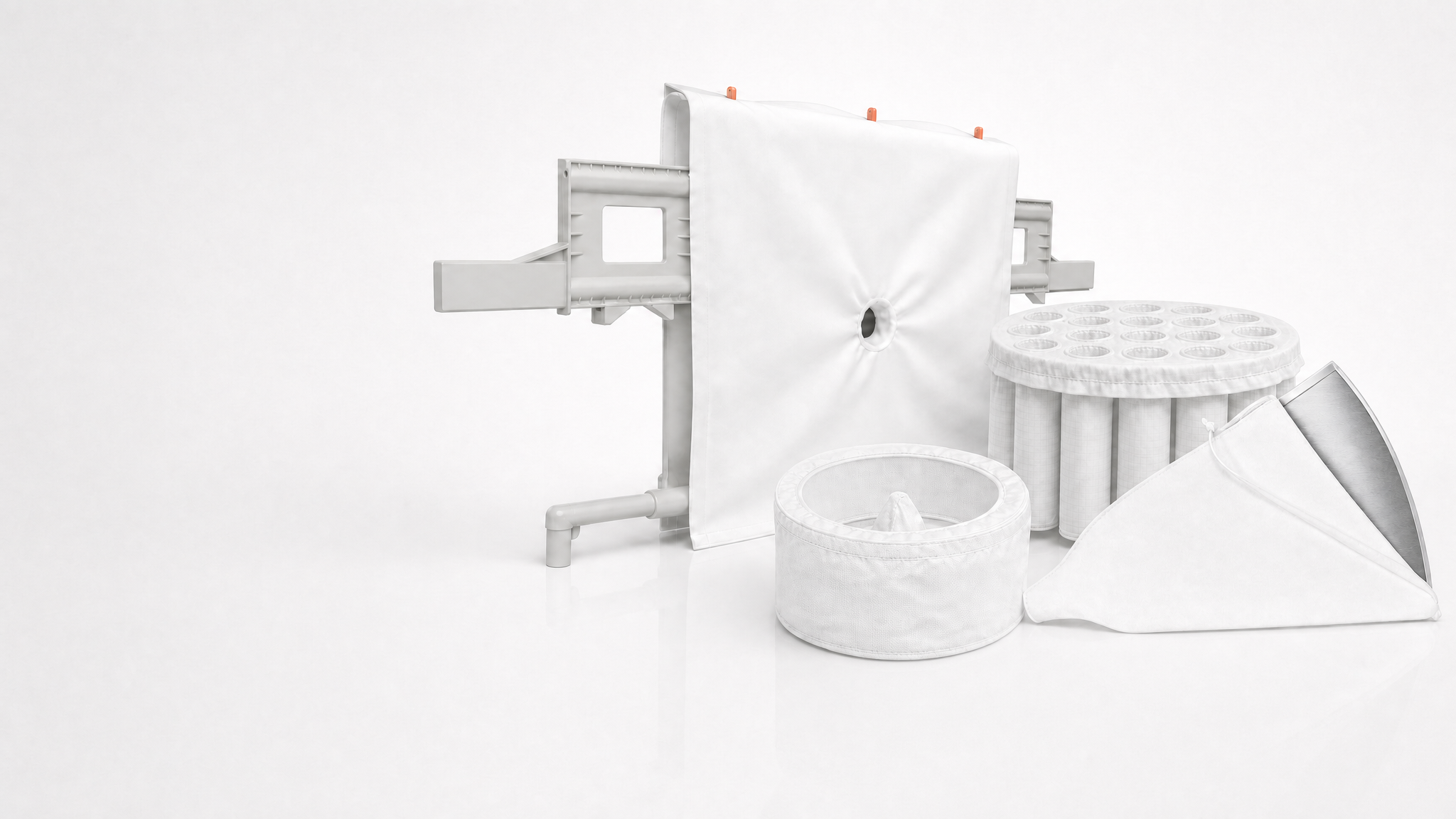
In chlor-alkali production, brine purification is one of the quiet process steps that has a big impact on plant stability. If calcium, magnesium, iron, and other fine precipitates are not removed reliably, downstream electrolysis can suffer from scaling, contamination, and avoidable downtime. For operators running filter presses or candle filters, the right filter cloth is a practical lever for keeping brine clean and the line running.
🔑 Key Takeaways
- Brine purification in chlor-alkali plants typically uses primary and secondary filtration to remove Ca/Mg/Fe precipitates.
- Polypropylene (PP) is usually the best fabric choice because it resists saturated NaCl brine and trace caustic well.
- Fine retention, low blinding, and long service life are essential for continuous operation on filter presses and candle filters.
- R+F RF-FF Series filter press cloths are designed for demanding solid-liquid separation in chemical service.
🏭 Why brine purification matters in chlor-alkali plants
In a chlor-alkali cell room, purified brine is not optional — it is the feedstock that protects membranes, electrodes, and overall process efficiency. Raw brine often contains Ca²⁺, Mg²⁺, Fe, suspended solids, and trace organics, all of which can trigger scaling or reduce electrolysis performance.
Most plants run a primary purification stage to remove the bulk of hardness and a secondary polishing stage to catch fines and residual precipitates. In practice, that means operators need fabrics that retain very fine solids without excessive pressure drop or premature blinding. For related chemical process filtration, see our chemical industry applications overview.
🔬 Primary vs. secondary brine purification
The first stage usually removes most of the precipitated hardness salts formed after chemical treatment. The second stage is more demanding from a filtration point of view, because the remaining particles are finer and can be more difficult to discharge cleanly.
| Stage | Main objective | Typical solids | Filter media challenge |
|---|---|---|---|
| Primary purification | Remove bulk hardness and reaction products | Coarser Ca/Mg precipitates, hydroxides | High throughput, stable cake formation |
| Secondary purification | Polish brine before electrolysis | Fine residual precipitates, trace iron compounds | Fine retention, low blinding, clean discharge |
When the secondary stage is unstable, operators often see pressure spikes, longer cycle times, or solids carryover. If that sounds familiar, it may be time to review the cloth structure and also check for related issues such as filter cloth clogging and short filter lifespan.
⚙️ Best machine types for brine filtration
In chlor-alkali service, the most common equipment is the filter press. Some plants also use candle filters or other pressure filtration systems when polishing requirements are strict. The best fabric choice depends on whether the machine is optimised for cake filtration, deep filtration, or fine polishing.
For operator teams comparing press options, our filter press machine overview is a useful starting point. If you are running different solid-liquid systems in the same plant, you may also want to review pressure leaf filter and vacuum filter configurations for broader process context.
🧪 Why polypropylene is the material of choice
For saturated NaCl brine with trace caustic exposure, polypropylene (PP) is usually the safest and most economical fabric material. PP offers excellent resistance to NaCl brine, NaOH, and many process additives, while maintaining good mechanical stability in wet chemical service.
Rule of thumb: If your brine contains saturated salt plus trace caustic, start with PP before considering more specialized materials.
Compared with less suitable fabrics, PP gives operators a strong balance of chemical resistance, manageable moisture behaviour, and long service life. That matters because brine filtration is rarely a batch-only task; most plants need dependable cloth performance across many cycles without frequent unplanned changeouts.
⚠️ Caution: Avoid selecting a fabric only by initial permeability. In brine service, the wrong structure can blind quickly, shorten cycle life, and increase washwater demand.
🛠️ Selecting the right weave, pore structure, and finish
To keep fine precipitates in the cake and away from downstream equipment, the cloth should combine fine retention with good release behaviour. That means the fabric structure, yarn type, and finish all matter — not just the base polymer.
Measure particle size, cake moisture, and the ratio of Ca/Mg/Fe precipitates in both purification stages.
Choose a fabric that captures secondary-stage fines without causing excessive flow resistance.
Check cake release, seam design, and washing behaviour to reduce downtime and extend cloth life.
📋 Brine cloth selection checklist
- Compatible with saturated NaCl and trace NaOH
- Fine retention for secondary purification solids
- Low tendency to blind or glaze
- Stable seam and edge construction
- Good cake release after dewatering
- Suitable for continuous or near-continuous operation
For operators wanting a fast starting point, the RF-FF Series filter press cloths are built for demanding industrial filtration and can be configured for brine purification duties. If your plant also runs other slurry duties, our RF-BF Series belt filter fabrics may be relevant for adjacent process areas.
✅ Practical optimisation tips for longer cloth life
The best cloth still needs good operating discipline. Brine filtration issues often come from a mix of chemistry, hydraulics, and maintenance practice rather than one single failure point.
- Keep chemical dosing stable so precipitate formation stays predictable.
- Avoid overfilling chambers, which can force fines deeper into the fabric.
- Use proper wash cycles to reduce salt crystallisation and residual scaling.
- Inspect for stitching wear, edge leakage, and early signs of channeling.
- Track cycle time trends to catch blinding before throughput drops sharply.
💡 Tip: If your cake release becomes inconsistent, first review cloth condition and cake moisture before changing the entire filtration setup.
When you are ready to narrow down the best fabric specification for your machine, you can find and configure the right filter fabric with our Solution Finder. It helps you select your filtration machine online and generate a pre-filled, non-binding specification and inquiry.
📩 Need Help Choosing the Right Fabric?
Our technical team at R+F FilterElements can help you find the perfect filter fabric for your specific application. Get in touch for a free consultation — we will recommend the right solution based on your machine, process, and operating conditions.
Prefer a guided start? Use our Solution Finder to configure the right fabric for your brine purification line and send a pre-filled, non-binding request in just a few steps.