
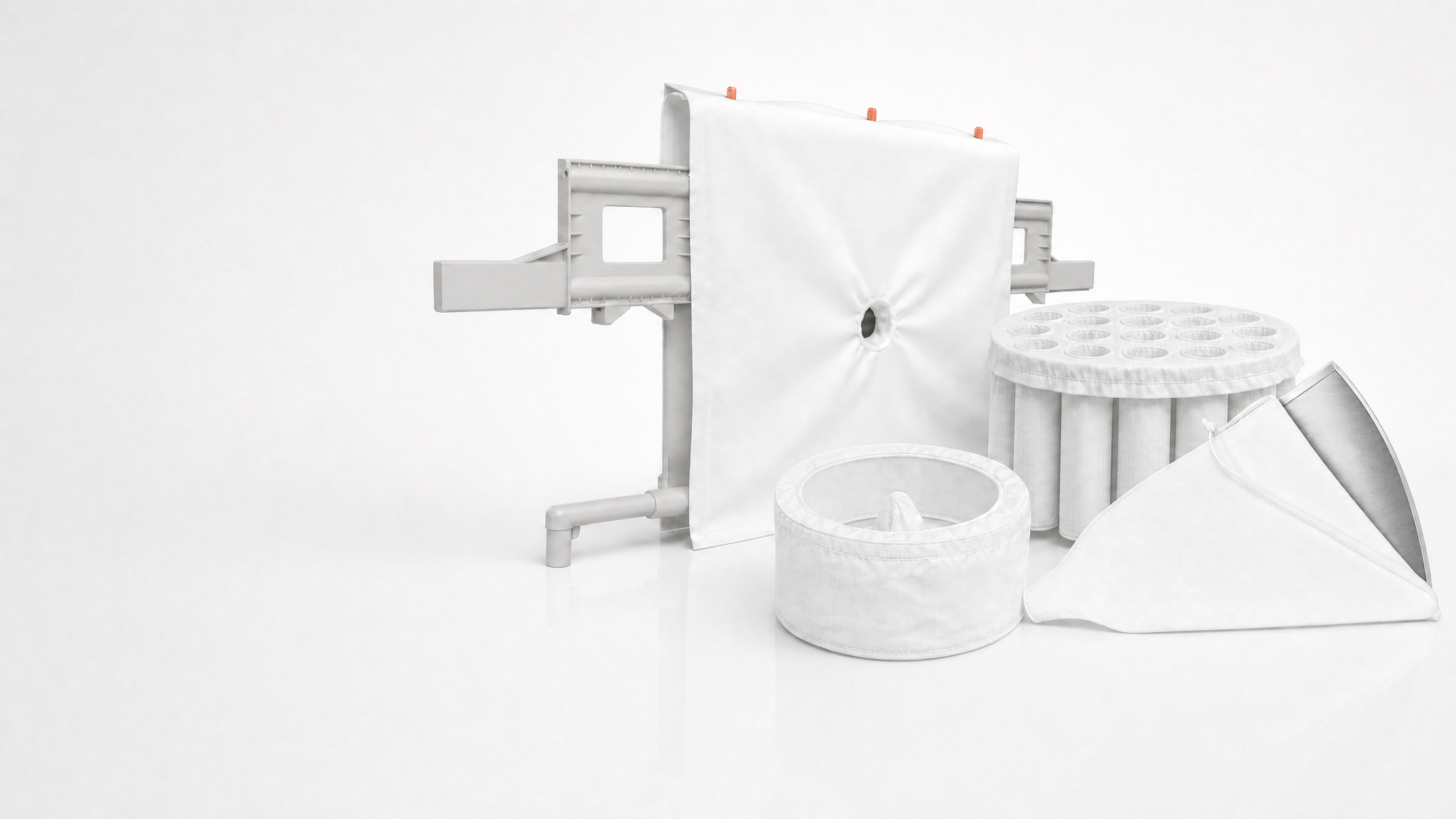
In abrasive mining slurries, disc filter cloths wear out faster than most operators would like. The good news: with the right fabric construction, smart treatment choices, and a few daily operating habits, you can extend cloth life and keep your rotary disc filter running more consistently.
This guide focuses on what matters on the plant floor: how cloth material, surface finish, filtration conditions, and maintenance routines affect service life on disc filters in mining applications.
🔑 Key Takeaways
- Match the fabric to the abrasion profile of your slurry, not just the particle size.
- Surface treatment matters because it can reduce blinding, improve release, and limit premature wear.
- Stable operation — especially vacuum, submergence depth, and cake discharge — helps prevent mechanical damage.
- Inspection and cleaning discipline are often the fastest way to extend cloth life without changing the machine.
⚙️ Why Disc Filter Cloths Fail Early in Mining
In mining, cloth life is usually limited by a combination of abrasion, chemical exposure, and operating instability. Sharp mineral particles can scuff the surface every rotation, while poor cake release forces the cloth to work harder than intended. If the cloth starts to blind, operators often compensate with more vacuum or longer cycle times, which can accelerate wear even further.
When cloths fail too soon, the root cause is often not the fabric alone. Check for misalignment, uneven vacuum distribution, damaged supports, excessive solids loading, and rough discharge points. If short service life is a recurring issue, this problem overview on short filter lifespan is a useful starting point.
⚠️ Caution: Running a disc filter with excessive vacuum or a damaged drainage system can tear cloths faster than normal wear. Check the operating envelope before increasing pressure to “force” throughput.
🧪 Choosing the Right Fabric Construction
For abrasive mining service, the best cloth is usually the one that balances mechanical strength with controlled permeability. A cloth that is too open may let fine particles embed deeply into the structure, while a cloth that is too tight may blind quickly and raise differential pressure.
Material and weave considerations
- Monofilament surfaces often help with release and cleaning because solids sit more on the surface.
- Reinforced constructions are useful where edge loading, tension, or frequent handling creates extra stress.
- Balanced permeability reduces the need for harsh cleaning and helps maintain stable production.
- Heat and chemical resistance should match your process water, reagents, and cleaning agents.
For rotary disc filter operators, the RF-RD Series disc filter fabrics are designed for this exact type of duty, where wear resistance, drainage behavior, and consistent cake release must stay in balance.
Rule of thumb: If the cloth is wearing out at the same spot every time, the problem is often mechanical. If it is blinding everywhere, the fabric selection or process chemistry is likely the bigger issue.
🔬 Fabric Treatments That Can Extend Cloth Life
In mining, fabric treatment is not just a finishing detail. The right treatment can reduce particle adhesion, improve discharge, and make cleaning more effective. That means less manual intervention and fewer aggressive wash cycles.
📋 Treatment selection checklist
- Does the surface need better release?
- Is particle carryover causing blinding?
- Will the treatment withstand your cleaning chemistry?
- Does the finish reduce contamination risk?
Operators often see the best results when the cloth finish matches the cake behavior. If solids are sticky or fine, a surface treatment that supports easier release can reduce drag on the cloth during discharge. If the slurry is highly abrasive, a treatment that protects the outer fibers without reducing drainage too much may be the better compromise.
If you are comparing cloth options for other solids-liquid equipment on site, it can also help to review product families such as RF-BF Series belt filter fabrics or RF-FF Series filter press fabrics to understand how fabric construction changes with machine duty.
🛠️ Operating Habits That Protect Cloths
Even a well-chosen cloth will fail early if the filter is run too aggressively. Small adjustments in day-to-day operation often produce the biggest gains in cloth life.
Keep solids concentration and particle size as steady as possible. Sudden spikes create shock loading and uneven wear.
Use only the vacuum level needed to form a stable cake. Excess suction can compact solids into the weave and increase friction.
Make sure discharge points, doctoring, and cloth tension are aligned so the cake leaves cleanly instead of scraping the fabric.
Check edges, seams, and high-load zones before small defects turn into full cloth failure.
💡 Tip: A short rinse immediately after discharge is often more effective than aggressive cleaning later. Removing fines before they set into the cloth helps prevent blinding and reduces mechanical stress.
📊 What to Monitor on the Shift
Cloth life improves when operators track the right indicators. You do not need a complex condition-monitoring system to spot trouble early. A simple routine can reveal whether the fabric is wearing normally or being overstressed.
| Indicator | What it Means | Action |
|---|---|---|
| Higher vacuum to maintain throughput | Cloth blinding or cake resistance is increasing | Review fabric finish and cleaning routine |
| Frequent tears near edges | Mechanical rubbing or tension issues | Inspect alignment, supports, and installation |
| Poor cake release | Surface adhesion or blinding is building up | Check treatment, weave, and discharge setup |
| Uneven wear across sectors | Feed or vacuum distribution is not uniform | Inspect operating balance across the disc |
For operators looking to compare multiple filter media options across the plant, the configure your rotary disc filter filter fabric online tool is a practical way to define your requirements and receive a pre-filled, non-binding specification and inquiry.
✅ Practical Maintenance Routine for Longer Service
Once the right cloth is installed, maintenance discipline becomes the difference between average and excellent service life. The goal is not to over-handle the cloth, but to catch damage before it spreads.
📋 Weekly operator checks
- Inspect for localized abrasion and edge fraying
- Confirm cloth tension is still uniform
- Look for caked fines that do not rinse away
- Check for leakage paths and bypass around seals
- Document any changes in cycle time or discharge quality
If your site also runs vacuum filtration in other duties, comparing cloth behavior with a rotary disc filter versus a vacuum filter can help you spot whether the issue is machine-specific or related to slurry characteristics.
📩 Need Help Choosing the Right Fabric?
Our technical team at R+F FilterElements can help you find the perfect filter fabric for your specific application. Get in touch for a free consultation — we will recommend the right solution based on your machine, process, and operating conditions.
To speed up the selection process, you can also configure your rotary disc filter filter fabric online and receive a pre-filled, non-binding specification for your mining duty.